Bay Area Air Quality Management District - Apr 29, 2026 - Hearing
Bay Area Air Quality Management District • Bay Area Air Quality Management DistrictApril 29, 2026
Locunity is a independent informational service and is not an official government page for this commission.We use AI-assisted analysis and human editorial review to publish information.
Air District Board Digs Into $476.6M Budget, Refinery Revenue Risks
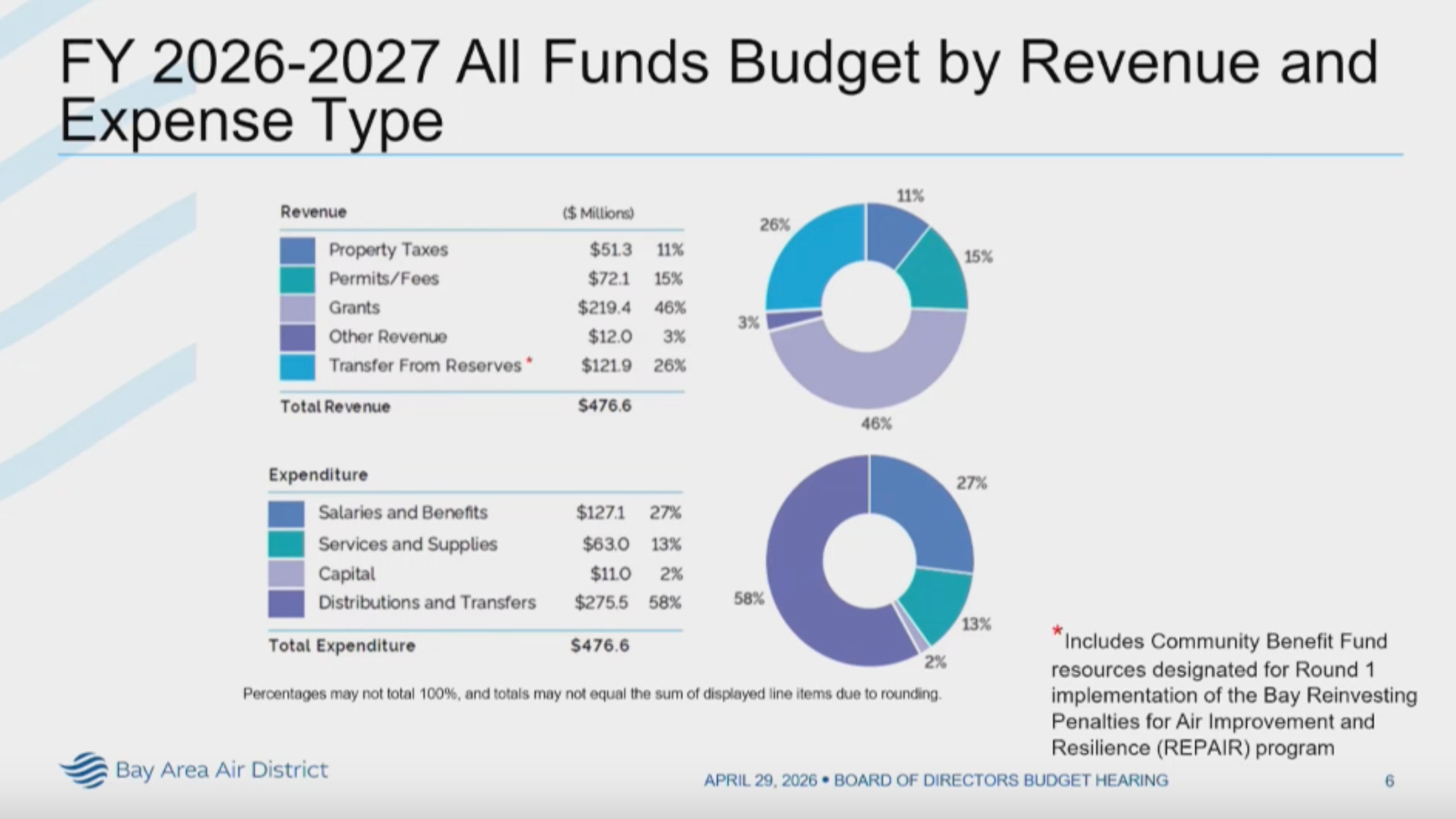
The Bay Area Air Quality Management District (BAAQMD) Board of Directors held its first public hearing on a proposed $476.6 million budget for fiscal year 2026-2027, a spending plan that channels $98 million in penalty-derived funds to pollution-impacted communities and bankrolls a push to clear a chronic permit backlog. No vote was taken — that comes June 3 — but board members used the hearing to press staff hard on whether the district's finances can withstand refinery closures, rising costs, and an expenditure trajectory growing three times faster than revenue.
$476.6M proposed budget splits $270.8M for general operations and $205.8M for grant and incentive programs, with no new positions added
Permit processing up 20% year over year, but board members demand faster progress and training that makes staff "solution oriented" for companies from Tesla to refineries
Expenditures outpacing revenue 3-to-1 over five years sparks calls for contingency planning and scenario modeling before June adoption
Valero refinery in Benicia stops refining crude oil, plans marine terminal conversion — district already under-recovers $500,000 annually at the facility
Board directs staff to bring back top-customer revenue breakdowns, year-over-year trend data, and range-of-scenarios analysis for June 3 adoption hearing
A Half-Billion Dollar Blueprint for Air Quality
The basics: The proposed FY 2026-2027 budget totals $476.6 million, divided between a $270.8 million General Fund for day-to-day operations and a $205.8 million Special Revenue Fund for grants, incentives, and community programs. The largest single investment: $98 million from the Community Benefit Fund for the Bay Repair program, which directs settlement and penalty money back to communities in Benicia, Richmond, and surrounding areas hit hardest by pollution.
Why it matters: This is the first of two required public hearings. The budget is built around the district's 2024-2029 strategic plan and assumes a 12% vacancy rate, 2.5% salary and benefit increases, $5 million in discretionary pension trust contributions, and $122 million in transfers from reserves — $98 million of which funds Bay Repair. No new staff positions are proposed, though 24 vacant positions will be reclassified. The organizational structure separates Science and Policy into two service areas under separate deputy executive officers.
Where things stand: General fund reserves are projected to decline from $125 million to $73 million — still at 25% of the operating budget, in compliance with the district's reserve policy. Staff described the decline as driven by short-term strategic investments that taper off by 2029, including $13.6 million in ongoing investments from reserves (covering the Refinery Community Air Monitoring program and permit backlog staffing) and $10.4 million in new one-time investments.
Chair Lynda Hopkins praised the plan's values alignment:
"It's really lovely to actually come here and have line items out for civil rights, community investment, diversity, equity, inclusion and environmental justice. And I also really appreciate the investments in our permitting work to really make sure that we are effective and efficient," she said.
What's next: Budget adoption is scheduled for the second public hearing on June 3, 2026 — the final opportunity for public input before the board votes.
Permit Progress: 20% Jump, But Board Wants More
Why it matters: The district's permit backlog has frustrated companies ranging from refineries to clean-energy manufacturers. The budget includes $6 million to fund 29 staff positions for the backlog reduction plan approved in September 2025.
Where things stand: Staff reported a 20% increase in permit processing between 2024 and 2025, though the gains were concentrated in routine applications.
"That's mostly related to the more routine permit applications that come through because those complex ones really require that advanced staffing that we're hoping to really come online in the coming months," said Meredith, a staff member.
Board Member David Haubert, representing Alameda County, pressed for a sharper focus on speed and customer service:
"I still feel that we need to accentuate even more that we will conquer the permitting backlog. And I believe a key in that is training our staff," he said.
Haubert cited Tesla, Applied Materials, and Bloom Energy as companies needing faster permitting — not just refineries — and asked how much is being invested in staff training. Staff responded the district is spending "hundreds of thousands of dollars" on collaboration and project management training, including escalation processes for applications that get stuck.
The other side: Board Member Joelle Gallagher, representing Napa County, offered a counterpoint, commending the progress:
"I think that it really is worth noting that a 20% increase in permitting in 2024-25 is actually really significant. And so good job."
What's next: The board directed staff to include year-over-year tracking and industry-satisfaction benchmarks in future budget presentations.
Revenue Versus Spending: A 3-to-1 Gap Alarms Board Members
Why it matters: Multiple board members flagged a structural imbalance — revenues growing far slower than expenditures — and demanded that staff show their work on long-term sustainability before the June vote.
Where things stand: Board Member Juan Gonzalez, Mayor of San Leandro, put the numbers bluntly:
"Our revenues have grown over the last five years from 2023 to 2027, just approximately $18.4 million. But our expenditures in that time period will grow by $52 million."
He urged staff to communicate to the public that this gap is a temporary "blip" driven by backlog investments, and advocated for the district to aspire to fully fund its pension and other post-employment benefits (OPEB) liabilities.
"I really do think that because of how we operate and because we have the flexibility, I believe that we should always aspire to 100% funding on our pension OPEB liabilities," Gonzalez said.
Board Member David Haubert pushed further, calling for contingency planning given economic uncertainty and the ongoing energy transition:
"I would advocate that we, in this changing environment of a just transition and changes that have to be made structurally, we have to recognize that as things go away, if costs are going to stay high, that's just going to exacerbate that."
The other side: Board Member Bilal Mahmood, representing San Francisco, questioned whether the five-year forecast relies too heavily on projected revenue increases of 3-4% annually from permit fees and property taxes rather than expenditure reductions. Staff explained that the reserve decline from $125 million to $73 million reflects short-term strategic investments that taper off by 2029.
Director Linda Sell, representing Sunnyvale, also asked about the reserve trajectory, prompting staff to walk through the timeline and confirm the $73 million floor remains within the district's 25% reserve policy.
What's next: Staff committed to providing year-over-year analysis and scenario planning for the June 3 adoption hearing.
Valero's Shutdown Raises Hard Questions About the District's Revenue Base
Why it matters: BAAQMD already under-recovers its costs at every refinery it regulates — by roughly $2.5 million total — and the conversion of the Valero refinery in Benicia into a marine terminal removes one of the district's major permitted facilities from active refining. As the Bay Area's refinery landscape shifts, so does the revenue foundation of the region's air quality regulator.
Where things stand: Board Member Steve Young, Mayor of Benicia, informed the board that Valero has stopped refining crude oil, stripped employment to 20-30 people, and is converting to a marine terminal for refined gasoline at the state's direction.
"The state is wanting them and they're in the process of converting to a marine terminal to accept refined gasoline instead of processing oil there. As part of that, they've asked that the equipment and machinery not be dismantled," Young said,
Young also noted that the equipment is being preserved in case a future buyer wants to resume operations. He asked whether a new permit type would be needed and what BAAQMD's monitoring role would be for the new operations.
Executive Officer Dr. Philip Fine responded that the existing permit would likely cover the marine terminal:
"Our preliminary assessment is that if they want to continue as a marine terminal, it would not require a change to their current permit."
He added there would be no immediate budget hit for a couple of years.
Meredith, a staff member, quantified the existing shortfall:
"Currently we are under-recovering at the refineries, all of them, by roughly $2.5 million. At Valero, somewhere on the order of $500,000 we're under-recovering."
Board Member Bilal Mahmood had earlier flagged the broader trend:
"The refinery in Vallejo is shutting down this month, is my understanding. And broadly, crude oil production is dropping. And that's predominantly, I think, a lot of where our fees are being generated from."
Board Member Ray Mueller, representing San Mateo County, proposed a concrete fix for better visibility:
"I really think it would be worthwhile for us to separate our top 10 customers and what the revenue projection is for each of them from permits. And in that way that also allows us to create a more fulfilling dialogue with those customers throughout the year."
Fine agreed to incorporate at least the top five refineries into the June budget presentation.
Chair Lynda Hopkins directed staff to bring back information on the revenue delta and a range of budget scenarios for the June 3 adoption hearing.
Decisions: No vote was taken — this was an informational hearing. The board's direction was clear: model the refinery transition's budget impact and present options before June.
Minor Items
No public comment was received on either the budget hearing or non-agenda matters.
Board member comments were deferred to the next regular meeting.
Next meeting: The second public hearing and budget adoption vote is scheduled for June 3, 2026, followed by the regular board meeting. That hearing is the last opportunity for public input before the budget is finalized.