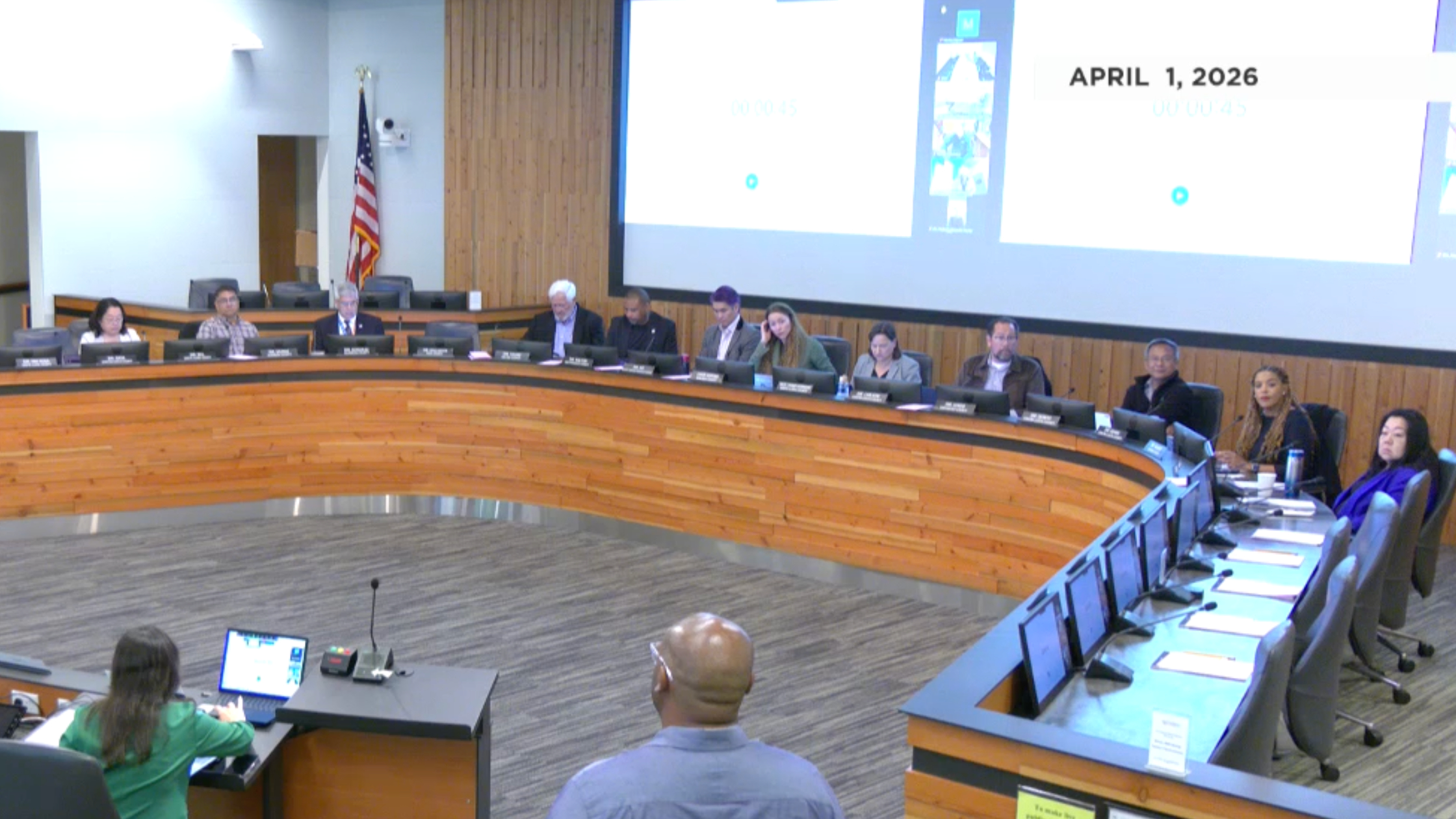
Bay Area Air Quality Management District - Apr 01, 2026 - Regular Meeting
Bay Area Air Quality Management District • Bay Area Air Quality Management DistrictApril 1, 2026
Locunity is a independent informational service and is not an official government page for this commission.We use AI-assisted analysis and human editorial review to publish information.
Board Adopts East Oakland Clean Air Plan, Exposes Dust Enforcement Failures
The Bay Area Air Quality Management District board confronted a stark gap between its regulatory promises and enforcement reality at its April 1 meeting, unanimously adopting a sweeping emissions reduction plan for East Oakland while ordering staff to fix a broken dust enforcement system that produced zero financial penalties across 60 facilities over five years. Meanwhile, more than 20 community members — primarily from communities of color — packed the meeting to demand economic protections ahead of a May vote on water heater electrification rules.
Board adopts East Oakland "Right to Breathe" plan targeting industrial dust, truck pollution along the I-880 corridor, and Oakland Airport emissions in a community where residents live 15–20 years less than neighboring areas
Community Advisory Council exposes enforcement collapse: a Vallejo cement plant self-reported capacity 20 times below manufacturer specs, went five years without a dust violation despite dozens of complaints
Board orders 90-day staff response to seven Community Advisory Council enforcement reform recommendations, including mandatory permit verification and modern monitoring tools
More than 20 public commenters demand transparency on upcoming water heater electrification rules, with one senior reporting a $50,000 conversion quote
Board opposes AB 2752 and two other state bills seen as threats to local air district regulatory authority over refineries
District hires 13 new staff including its first Civil Rights Officer and first Environmental Justice Law Fellow
Broken System: 25 Inspections, Zero Violations at Vallejo Cement Plant
Community Advisory Council (CAC) Co-Chair Patrick Messac and CAC member Ken Szutu delivered a detailed case study that laid bare systemic failures in the Air District's fugitive dust enforcement apparatus — and the board responded by ordering staff to come back with answers.
The basics: Crown Hill Materials, a concrete mixing facility in Vallejo, has been producing daily cement dust affecting nearby residents for five years. The CAC dug into the enforcement record and found a pattern of futility: nearly two dozen complaints in 2024 alone, 25 inspections over 20 months, and zero confirmed violations of any applicable fugitive dust rule.
Why it matters: The problem isn't limited to one facility. The CAC reviewed enforcement data across all 60 aggregate facilities in the district's jurisdiction and found that over five years, not a single fugitive dust financial penalty was issued under any of the applicable regulations.
"CAC reviewed five years of data for the notices of violation for all aggregate facilities across the jurisdiction. All applicable fugitive dust rules — not a single violation of 6.1, not a single violation of 6.6 and not a single violation of 1.301 tied to a financial penalty over those five years," said Messac.
Where things stand: The case study revealed a particularly damning permitting gap. Crown Hill's permit exemption was based on self-reported throughput of 12 cubic yards per hour. But the manufacturer doesn't make models under 60 cubic yards per hour — the actual equipment was rated at 120–200 cubic yards per hour, roughly 20 times the permitting threshold. Dust sampling took over seven months and did not include health assessments for heavy metals or crystalline silica. The current enforcement regime relies on opacity-based methods — essentially sun-angle readings developed in the 1800s — that inspectors struggle to apply consistently.
The CAC presented seven recommendations: a customer-centered complaint process with published logs; more enforceable rules replacing outdated opacity methods; strategic use of modern monitoring tools and digital evidence submission; online publication of permits and exemptions; independent verification of equipment capacity for permits; institutionalizing case studies as a regular practice; and a data-driven "top community concern" pipeline.
The other side: Executive Officer Dr. Philip Fine acknowledged the District largely agrees with the CAC's assessment.
"There's not a lot of daylight between what you heard today from our CAC members and what staff believes needs to be done," he said
He noted that staff is already developing a new fugitive dust rule incorporating air monitoring, video evidence, and best management practices.
Director John Gioia, who represents an AB 617 community in the Richmond area, validated the findings.
"I have seen what came out in this presentation is very similar to comments we've heard over many years on a number of facilities around the Bay Area," he said.
Public commenters reinforced the urgency. Ashiya Jani of the Sierra Club shared personal experience with dust in Oakland and urged the board to strengthen rules. Kathy Kerridge, a Benicia resident, noted fugitive dust is also a problem around oil refineries and endorsed the camera monitoring recommendation as practical and affordable.
Decisions: The board voted unanimously (For: 19, Against: 0, Absent: 3) on a motion by Vice Chair Vicki Veenker, seconded by Gioia, to direct staff to review and analyze all seven CAC recommendations and report back by the July board meeting.
What's next: Staff will return in July with a formal response to each of the seven recommendations. The District's broader fugitive dust rulemaking, which includes a white paper already in circulation, will proceed in parallel.
East Oakland's 'Right to Breathe' Plan Becomes Official
After three years of community-driven development, the board unanimously adopted the East Oakland Community Emissions Reduction Plan (CERP) — a blueprint to address some of the Bay Area's worst cumulative air pollution burdens.
The basics: The CERP, developed under the state's AB 617 program in partnership with Communities for a Better Environment and a 24-member Community Steering Committee, covers six focus areas: built environment and land use, commercial and industrial sources, illegal dumping, public health and community wellness, transportation and mobile sources, and urban greening and workforce development.
Why it matters: East Oakland residents have a 15–20 year shorter life expectancy than people in neighboring Oakland Hills and Piedmont. The plan targets the sources driving that gap: fugitive dust from aggregate facilities, diesel truck traffic along the I-880 corridor, and emissions from Oakland Airport.
Key actions include improving complaint systems, a Caltrans study of a truck ban on the 580 corridor, electrifying Oakland Airport ground support equipment, urban greening projects, and workforce development programs.
Where things stand: Youth voices anchored the community testimony. CSC Youth Co-Chair Michaela Patton testified about the stark life expectancy gap. CSC member Jerry McGee Tyner shared perspectives from young people, including children unable to have recess because of poor air quality.
Director Juan Gonzalez raised an important tension: how to pursue cleaner operations while preserving industrial manufacturing capacity that provides jobs. He also placed the plan's transportation provisions in historical context.
"In the '50s and '60s, we could probably have a master's class on institutionalized racism in planning and zoning and allowing trucks along the 880 corridor and not on the 580 corridor," he said.
Director John Gioia identified a potentially transformative opportunity: shifting Oakland Airport from crude oil aviation fuel to sustainable aviation fuel.
"Probably the single most important thing that the Oakland airport can do to reduce jet fuel emissions in East Oakland and the surrounding neighborhood is to shift from a crude oil aviation fuel to a sustainable aviation fuel," he said, noting that Phillips 66's Rodeo facility could supply it via existing pipeline and cut jet emissions by 60–70%.
Director Mark Salinas proposed a green business recognition program for companies that exceed environmental standards. Public commenter Bill Crotinger, president of Argent Materials and an industry member of the steering committee, supported the plan but requested factual corrections about his company's violation count and contested its designation as a "facility of concern," describing investments including an autonomous watering robot for dust control.
Decisions: The board voted unanimously (For: 16, Against: 0, Absent: 6) to adopt the final draft CERP and approve the CEQA exemption determination. The motion was made by Salinas and seconded by Director Lena Tam.
What's next: Implementation begins with annual progress tracking. The plan's transportation, greening, and industrial monitoring provisions will unfold over a multi-year timeline.
Community Groups Sound the Alarm on Electrification Costs
A large, organized group of more than 20 community members — primarily from communities of color across the Bay Area — turned out to demand transparency and economic protections ahead of the Air District's expected May vote on water heater electrification rules.
Why it matters: The coordinated turnout, organized in part by the Environmental Justice League, signals significant grassroots opposition to electrification mandates perceived as economically burdensome — even as some commenters pushed back on what they called misinformation about the rules' scope.
Where things stand: Speakers from Oakland, San Francisco's Tenderloin, Hayward, San Leandro, Vallejo, and Contra Costa County raised consistent themes: the economic burden on low-income residents and seniors, lack of transparency about who pays for conversion costs, and demands for guaranteed funding or subsidies.
Mark Williams of the Environmental Justice League set the frame.
"It's so important to the Environmental Justice League that not only focus on the environment and the work that you do around air quality, but also the economic impacts that your rules have," he said.
Evelyn, a senior homeowner, said she was quoted $50,000 to electrify her older home and asked who would pay for seniors, disabled, and mentally ill residents. Gina Alexander, an El Sobrante resident and former transit union president, raised concerns about renters bearing costs passed through by landlords. Chaka of Oakland asked directly whether conversion costs would come out of people's pockets or if there would be a funded plan.
The other side: Kathy Kerridge of Benicia pushed back, noting that the district has never passed stove regulations and that inexpensive plug-in water heater options exist that don't require electrical panel upgrades. Public commenter Yasi noted that water heaters and furnaces emit more pollution than all Bay Area cars combined and urged attendees to learn more at the May meeting.
Chair Lynda Hopkins noted the full discussion would occur at the May board meeting. Director John Gioia observed this was the first time he had heard from opponents of the proposed ordinance, having previously heard mainly from supporters.
What's next: The board is expected to take up the water heater electrification rules at its May meeting.
Board Defends Regulatory Authority, Opposes Refinery-Backed Bills
Legislative Positions
The board took positions on six state bills, drawing a firm line against legislation it sees as undermining local air district authority — while Chevron argued existing cost analyses fall short.
Why it matters: With federal environmental protections being rolled back, the board moved to protect what staff characterized as essential local regulatory power over refinery and industrial emissions.
Where things stand: The board opposed three bills. AB 2752 would require BAAQMD and South Coast AQMD to retroactively analyze all policies affecting oil refineries for compliance costs, consumer impacts, tax revenue effects, and employment — without allowing cost recovery. Staff said the requirement is unnecessary given existing socioeconomic analysis obligations and the board's own pending enhanced economic impact policy. AB 1791 would cap South Coast rule costs at 2 cents per gallon of gas and require legislative committee review, setting a precedent for other air districts. SB 1392 would exempt older vehicles from smog check requirements.
The board supported SB 299 to fix a CEQA daycare center loophole, SB 954 to close advanced manufacturing CEQA exemption gaps, and AB 2313 regarding gas corporation incentives. The AB 2313 vote was segmented because Director Dionne Adams recused herself due to her PG&E employment.
Heidi Taylor of Healthy Martinez urged opposition to AB 2752.
"The only folks being served by AB 2752 is WISPA and the refineries it serves," she said.
Todd Osterberg of Chevron countered that existing socioeconomic analyses underestimate compliance costs, citing Rule 8-8 where staff estimated $150,000 but the district is now requiring tens of millions in equipment.
Supervisor Ken Carlson raised the disconnect between staff cost estimates and actual compliance costs as a legitimate concern warranting continued attention — though he supported the oppose position on AB 2752.
Decisions: The board passed both legislative votes unanimously — the main package (For: 14, Against: 0, Absent: 8) and the AB 2313 support vote (For: 12, Against: 0, Absent: 10). Staff also flagged SB 1075 (Reyes), a sweeping AB 617 reform bill, for future committee discussion.
Minor Items
Consent calendar (Items 7–13) approved unanimously (For: 19, Against: 0, Absent: 3), covering minutes, communications, violations report, travel report, and three committee reports.
Bay Area Clean Air Foundation 2027 budget and director appointments approved unanimously (For: 13, Against: 0, Absent: 9); presentation waived due to time.
Thirteen new Air District staff introduced, including Kimberly Leafat as the first Civil Rights Officer heading a newly established Civil Rights Office, Adrian Wong as the first Environmental Justice Law Fellow, and Jamie Jefferson as assistant counsel bringing 19 years of enforcement experience from the California Attorney General's office.
Regional Climate Action Plan update deferred to written summary as quorum narrowed late in the meeting.
Jennifer Cohen of the Pacific Merchant Shipping Association expressed concern that the Protecting Blue Whales and Blue Skies vessel speed reduction program was expanded with only five weeks' notice and no meaningful industry consultation.
Jack Fleck of the Keep Coal out of Oakland coalition urged the Air District to exercise permitting and enforcement authority over coal shipments at the Oakland terminal.
Three closed sessions on litigation and labor negotiations produced no reportable action.