
BART Board Backs Fremont Station Housing Talks as Budget Fight Looms
Board of Directors • Bay Area Rapid Transit DistrictOctober 22, 2026
Locunity is an independent informational service and is not an official government page for this commission. All information is sourced from public footage and an analysis of official agendas with the aid of responsible, fact-checked AI. to report an error or omission.
BART's board voted 9-0 on Oct. 22 to open exclusive negotiations with Pacific Development and Affirmed Housing for a mixed-income project and public plaza on nearly 8 acres at Fremont station. The same meeting delivered better-than-budgeted year-end finances, followed by a sharp exchange over how to measure costs, a preview of the post-election budget debate set for Nov. 12.
Fremont TOD Phase 1 advances 9-0: 30-month exclusive deal with Pacific-Affirmed team, plus an optional 18 months
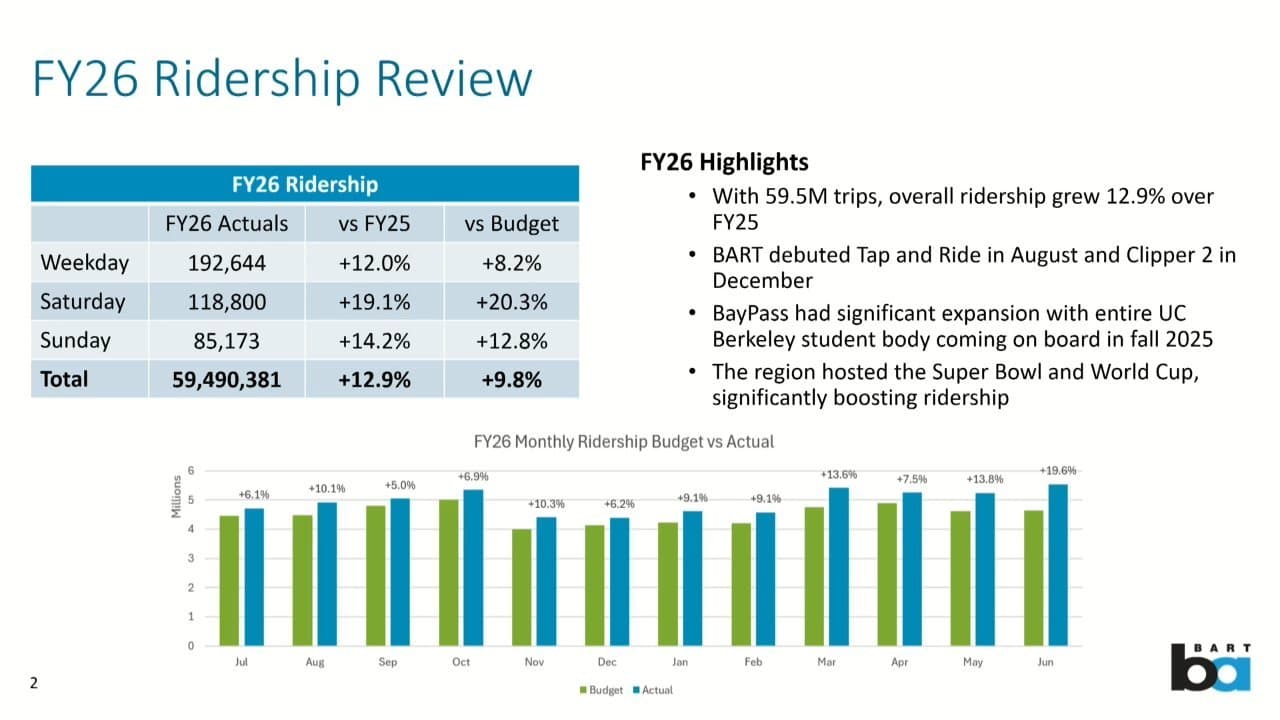
FY26 beats budget: ridership up about 13%, $74M less emergency aid needed
Directors Liz Ames and Janice Li clash over pre-pandemic cost benchmarks ahead of Nov. 12 budget return
Engineer and Director Ames press concerns on VTA extension design standards and variances
Regional transit measure outreach: speakers and directors stress accountability before voters decide
Fremont Station Gets Its Developer
The basics: An exclusive negotiating agreement, or ENA, gives one development team sole rights to negotiate a deal with BART for a set period. It is not final approval. Staff will return to the board with deal terms later.
Why it matters: Staff said the site is zoned for high density and included in Fremont's housing element. Directors framed the planned plaza as a way to turn stations into destinations that build ridership.
Where things stand: BART owns almost 8 acres for Phase 1 of a larger Fremont site, and the board adopted goals and objectives for it in January. Staff issued a request for proposals in April and received two responsive proposals in July. A panel of BART, Fremont and VTA staff reviewed them.
"The clear top-ranked team was Pacific Development and Affirmed Housing," said Carly Payne, TOD Group Manager.
The team proposes a market-rate building and a family affordable building, about 5,200 square feet of nonresidential space and privately financed horizontal infrastructure, meaning streets and utilities. A cafe tenant has already sent a letter of interest. Ali Gaylord, Senior Vice President of Development at Affirmed Housing, described the plaza, the cafe space and community connections. Sean Murphy of Pacific Development cited his firm's track record and infrastructure experience.
"As always, we retain the right to terminate the ENA if the developer is not making timely progress," Payne said.
The other side: Directors did not oppose the deal, but they pushed on what it would deliver. "I'm just trying to get the handle on the missing middle housing," said Director Liz Ames, District 6. "That missing middle is critically important for us to build as efficiently as possible and essentially design those units," Murphy responded.
Director Barnali Ghosh, District 3, raised concerns about circulation.
"I just want to make sure we preserve this site plan and all of the intentions within the site plan for the connections," she said.
Director Mark Foley, District 2, said the plaza earned his yes vote but questioned the thin field of two bidders. "What are we doing to try to help make sure that smaller firms are more competitive and maybe get an opportunity to lead a project in the future?" he asked. A BART TOD staff member said the agency has "held in-person events to bring together the smaller developers with the larger developers, as well as small business consultants."
Roland, a public commenter, supported the project. He asked BART to consider reserving affordable units for its employees, citing AB 2263 for VTA, and urged transit agencies to back common legislation.
Decisions and stakeholder impacts: Ames moved the item and Director Victor Flores, District 7, seconded. It passed unanimously (For: 9, Ames, Flores, Foley, Ghosh, Hernandez, Li, Raburn, Rinn, Wright; Against: 0; Absent: 0). Families seeking affordable housing in Fremont and future plaza users stand to gain. The developers secure 30 months of exclusive rights. BART keeps its exit option.
"Building transit-oriented development at this station will future-proof the ridership for that station," said Director Robert Raburn, District 4.
What's next: Staff will return with deal terms during the ENA period.
FY26 Ends Better Than Budgeted, Deficit Intact
Why it matters: The stronger results delay BART's reliance on emergency funds but do not close the gap. A third of the agency's cash is borrowed, and pension liabilities remain.
Where things stand: Staff said FY26 ridership beat budget every month for the first time since COVID and rose about 13% over FY25. Clipper BayPass accounted for 7% of trips and tap-and-ride for 22%. Revenue came in $63.4M above budget, and expenses landed just under budget. Total emergency assistance needed fell by about $74M, and $17M of that improvement is new since May.
"It does not change the math of our structural deficit, which still remains," said Christopher Simi, Budget Director.
Finance staff reported about $1.7 billion in cash and investments. Of that, $545M is borrowed through a federal TIFIA loan and a state loan. Outstanding principal totals roughly $4.3 billion. CalPERS funded ratios improved.
"Nearly one-third of BART's total holdings are financed by loans," said Pam Romero, Director of Financial Control and Accounting.
Decisions and stakeholder impacts: The item was informational, and the board took no vote. Director Matthew Rinn, District 1, urged a plan to reduce reliance on the loans. Director Barnali Ghosh, District 3, welcomed the trend but added: "It's a great outlook, but it's not enough to solve a structural deficit." Alita Dupree, a public commenter, commended BART's financial stewardship.
What's next: The audit goes to the Audit Committee on Nov. 16 and to the full board Dec. 3.
Pre-Pandemic Yardstick Sparks Sharp Exchange
Where things stand: Director Liz Ames, District 6 cited about $93M in overtime, professional fees rising from $5M to $66M, and a drop in the farebox ratio, the share of costs covered by fares. "We have a fiscal cliff coming potentially, or maybe not so bad," she said.
The other side: Director Li, District 8, rejected the comparison to pre-2020 levels. "There was a whole damn pandemic that happened," she said. Li noted the board has already set an alternative service plan and FY27 budget, which Ames opposed, with a return after the November election. She said this item was not a budget decision. Li also noted the staff memo shows the professional fees line came in 7.4% under budget.
A senior budget director disputed the starting point of Ames' comparison: "In FY18, we spent about $28.7 million in professional fees in the reports I have internally." He offered a full breakdown.
Information requests: Director Robert Raburn, District 4, asked for Clipper transfer accounting. "I think the appropriate vehicle for sharing that information would be the monthly ridership report that I send out to the board early in the following month," said Pamela Herhold, Assistant General Manager for Performance and Budget. Director Victor Flores, District 7, asked how many days or weeks of operations the emergency funding would have covered.
Vice President and Director Edward Wright, District 9, asked about revenue-positive budget lines. He also flagged a cost of tap-and-ride growth: "We need to make sure we're not kind of losing our grasp on the thread of the increased cost or decreased revenue from the credit card processing fees."
What's next: Staff confirmed the board returns to budget topics Nov. 12.
VTA Extension Standards Draw Safety Warnings
Why it matters: BART must oversee operations, maintenance and safety on VTA's BART Silicon Valley Phase II extension. Critics say cost pressure could erode BART's standards.
Where things stand: The VTA Partnership Special Committee reported that an agreement had been reached to conduct a targeted review of BART's design criteria manual, aligned with other standards.
The other side: Barney Smits, a public commenter speaking as a licensed engineer, criticized the process during three separate comment periods. He asked about 76 or more variances, raised the departure of a VTA contact and alleged that cost-driven decisions have reduced safety. Under Board Matters, Director Liz Ames, District 6, said no 60% design exists for the tunnel's HVAC and electrical systems. She warned against reducing standards to minimum code and cited a discussion of $200M to $300M in savings.
"We have a lack of transparency on this project on variances that have been approved to date," Ames said.
Dupree offered a contrasting view. She expressed confidence that the project team can start boring on schedule and urged keeping commitments.
Decisions and stakeholder impacts: The board took no action. The speakers' claims about safety and savings were not addressed or confirmed by staff during the meeting.
Measure Backers Want an Accountability Pitch
Mike Cluster, a Pleasant Hill rider who volunteers for the regional transit measure, said the measure faces difficulty in Contra Costa County. He said the public perceives that BART does not manage money well. Cluster urged BART to tell voters what it will do if the measure passes and how it will control costs.
"The takeaway from that voter poll is that all tax measures require accountability," Director Robert Raburn, District 4, said, referring to an Oakland Chamber of Commerce poll.
Director Barnali Ghosh, District 3, reported presentations on the alternative service plan to Cal leaders, the Berkeley City Council and Albany community leaders. She said growing ridership does not guarantee service. The measure's outcome will shape the Nov. 12 budget discussion and any potential service cuts.
Minor Items
Consent calendar passed 9-0: Oct. 8 minutes, a debt underwriting pool, Low Carbon Transit Operations Program funding and an EUNA Solutions grants software award.
General Manager Bob Powers reported the two highest post-pandemic ridership days in October, including a record Saturday of about 172,000 during Fleet Week.
Mahsa Azad, founder of Azad Engineering, credited BART's prompt-payment enforcement with helping her firm grow from one person to about 30 professionals.
Director Foley flagged a Caltrans closure for rehabilitation work starting this winter that may increase ridership.
Closed session on evaluations of five senior officers ended with no reportable action.
Looking Ahead
M Line bus bridges between 24th Street and Daly City run Nov. 14-15 for train control work. The holiday toy drive benefiting Hively begins Nov. 16. Budget talks resume Nov. 12, the audit reaches the Audit Committee Nov. 16, and the full board takes it up Dec. 3.