
Board of Directors - May 28, 2026 - Meeting
Board of Directors • Bay Area Rapid Transit DistrictMay 28, 2026
Locunity is a independent informational service and is not an official government page for this commission.We use AI-assisted analysis and human editorial review to publish information.
BART Board Validates $1B in Savings as Ridership Surges Ahead of Pivotal Budget Vote
BART's board received its strongest fiscal hand in years at this week's meeting — surging ridership, a $52 million budget surplus, and an independent audit confirming over $1 billion in transit agency cost savings. But the good news arrives against a backdrop of structural deficits, a $13 billion tunnel extension dogged by safety and governance concerns, and a November ballot measure that will determine whether BART can sustain current service levels.
- Independent audit validates $1B+ in savings across four Bay Area transit operators, with BART contributing more than $1 billion; board must commit to efficiency strategies by July 1
- Q3 financials come in $52M better than budget, driven by ridership revenue, allowing staff to eliminate the most damaging budget-balancing tool ahead of FY27 adoption
- BART posts best on-time performance in a decade — 94.4% customer on-time — as crimes against persons drop 41% and weekday ridership hits 192,000
- Directors and public raise alarm over the $13B Silicon Valley tunnel extension, citing safety standard reductions, contractor irregularities, and VTA oversight gaps
- Board votes 8-0 to back SB 1408, granting Contra Costa County new authority for a transportation sales tax of up to 1%
- Contingency plan detailed: if the November revenue measure fails, BART would cut 63% of service but redeploy 50–70 workers to accelerate capital projects
The Audit That Could Unlock BART's Financial Lifeline
The basics: Under SB63, the Metropolitan Transportation Commission commissioned an independent review of Bay Area transit operators' financial efficiency — a prerequisite before the region can advance a potential revenue measure to the November ballot. The Phase One findings, prepared by consulting firm Nelson Nygaard, were presented to the board for the first time.
Why it matters: BART must formally accept a set of "early action strategies" by July 1 to remain eligible for the regional revenue measure that staff have described as the agency's financial lifeline. The board will vote on adoption at its June 11 meeting.
Where things stand: The review found that four Bay Area operators together achieved more than $1 billion in operating savings. BART alone accounted for $516 million in operating savings and $549 million in capital savings — including $395 million from the Fleet of the Future procurement. The consultants validated that BART's operating cost per revenue hour is below the median among U.S. heavy rail operators, despite operating in a region 10% more expensive than the national average.
"The one over $1 billion in savings achieved across the four operators — we're well supported. This is an independent external validation of the work these agencies have done," said Director Matthew Rinn.
Staff recommended a suite of early action strategies: continuing fare compliance and gate optimization, enhancing parking revenue through demand-based pricing, leasing fiber and telecom assets, expanding the Clipper BayPass program, improving service speed and reliability, and right-sizing train lengths.
The other side: Director Liz Ames pushed for the review to include organizational right-sizing, citing LA Metro's practice of publishing detailed org charts with span-of-control metrics. "Having the span of control type audit that has a detailed org chart — like what LA Metro did — this is not radical. This is intended to be an efficiency metric," she said. But Director Janice Li and staff clarified that the third-party consultants specifically did not recommend further staffing cuts.
Director Mark Foley cautioned that parking rate increases cannot happen in isolation. "You can't simply raise fares $5 and say, good luck. Part of it is partnering with your bus feeders to say, can we improve frequencies? Can we improve routes?" he said.
Director Rash Ghosh corrected the framing around demand-based parking, noting that the goal is maintaining availability, not discouraging driving.
Vice President Edward Wright asked for timetables tied to each strategy: "I just want to express my strong interest in seeing timetables for the early action strategies, including when progress would be reported back to the board."
Decisions: The item was informational. Staff will bring the strategies for formal board acceptance on June 11.
What's next: The board's July 1 deadline is firm — without a commitment to the early action strategies, BART risks disqualification from the regional revenue measure heading to voters in November.
Strong Ridership Drives $52M Surplus, Reshaping the FY27 Budget
Why it matters: BART's Q3 financial results are $52.4 million better than budget, giving staff the room to eliminate the most damaging fiscal shortcut from the FY27 spending plan — the deferral of retiree health benefit trust (RHBT) contributions — and replace it with less costly TIFIA borrowing.
Where things stand: Budget Director Chris Simi and AGM of Finance Aaron Spraguen presented back-to-back on the Q3 results and FY27 budget changes. Ridership revenue accounted for $20 million of the positive variance — 40% of the total — with investment income $9 million above budget and sales tax $8.5 million above projections. Labor costs came in slightly over budget at 0.5% on gross wages, with overtime remaining a challenge.
For FY27, staff eliminated the RHBT deferral — previously flagged as the most damaging budget-balancing option — and substituted TIFIA borrowing. Total borrowing decreased thanks to carry-forward from the FY26 surplus. Staff plan to ask the board to direct any remaining FY26 SB125 emergency assistance toward further reducing FY27 borrowing.
The five-year fiscal projection still shows structural deficits, even with $300 million or more per year in regional measure revenue.
Director Rinn acknowledged the progress but flagged the remaining gap: "That $89 million TIFIA to bridge the gap to bring us to net zero is still concerning. But kudos for getting us to a net zero, which has been a huge lift."
The other side: Director Ames advocated for a $1 billion annual capital budget, arguing the 10-year capital investment plan justifies the figure. "We have a $10 billion capital investment plan over 10 years. So that's a billion a year. That's where I'm getting that from," she said. She also pushed to reduce FTE vacancies and control overtime.
Director Li pressed Ames to specify exact budget lines she would change rather than offering general criticisms, noting Ames has consistently voted against past budgets. "I'm asking you specifically — what are the projects you would like to see included in the FY27 capital budget? And or what are the specific budget lines?" Li said.
VP Wright raised a pointed concern: the capital budget does not include funding to resurface the southwest plaza at 16th Street Mission station. "I remain uncomfortable with advancing a capital budget that does not include funds to resurface the southwest plaza at 16th Street in the Mission or even complete design work for resurfacing," he said. Staff indicated they plan to apply for OBAG 4 funds for design.
Board President Melissa Hernandez asked about litigation risk if the revenue measure passes but faces court challenges.
What's next: The board will vote on FY27 budget adoption at its June 11 meeting.
Best Performance in a Decade: On-Time Hits 94.4%, Crime Drops 41%
Why it matters: The numbers validate BART's safety and service investments and build the public trust the agency needs ahead of the November revenue measure.
Where things stand: AGM of Operations Sylvia Lamb reported 94.4% customer on-time performance — the best non-COVID result in over 10 years — with 82% of key performance indicators met, the highest since 2021. Average weekday ridership hit 192,000, up 14.9% year-over-year. Saturday ridership surged 26%. Customer satisfaction reached 89%.
Of 2,000 trains delayed by state-of-good-repair issues, 1,500 were delayed 10 minutes or less — a sign of effective rapid response.
Chief Franklin reported crimes against persons fell 41% quarter-over-quarter, from 9.1 to 4.2 per million riders. Auto theft dropped 14% and auto burglary fell 21%. Police presence was observed by over 20% of passengers. The Progressive Policing Bureau conducted more than 2,300 wellness checks and diverted 3,318 calls from armed response. Hiring remains a challenge: 591 applications yielded only seven sworn officer hires.
Director Li connected the dots between operations and ridership: "When we provide high quality, on time, reliable, safe service, people will ride and they will come back."
Director Ames noted the results are particularly impressive given BART's $14 billion infrastructure backlog. VP Wright requested a public-facing performance dashboard.
What's next: Directors urged better external communication of the positive results ahead of the November ballot measure.
Alarm Bells Over the $13B Silicon Valley Tunnel Extension
The basics: BART's Silicon Valley Phase 2 (BSV2) extension — a $13 billion VTA-led tunnel project connecting San Jose's Diridon Station to Santa Clara — was the subject of sharp questioning during the VTA Partnership Special Committee report and again during public comment.
Why it matters: BART will ultimately operate and maintain the extension, making VTA's cost overruns, safety standard changes, and fiscal capacity direct liabilities for BART riders and taxpayers.
Where things stand: Director Raburn reported on the May 22 joint committee meeting reviewing construction progress, funding, and design. Director Li raised governance red flags, noting VTA has struggled to maintain quorum for its own oversight committee. "If we are simply struggling to meet quorum for an oversight committee, does it make sense for the oversight committee to be how it is? If it's not really doing what it's supposed to," she said.
Director Ames raised technical concerns about tunneling constructability, citing the Seattle Bertha project — a 54-foot tunnel boring machine that became stuck underground, forcing the governor to shut down the project. She questioned why the BSV2 peer review committee had not examined that precedent. She also questioned why BART design fire safety standards are being reduced through variances in the project's design criteria manual.
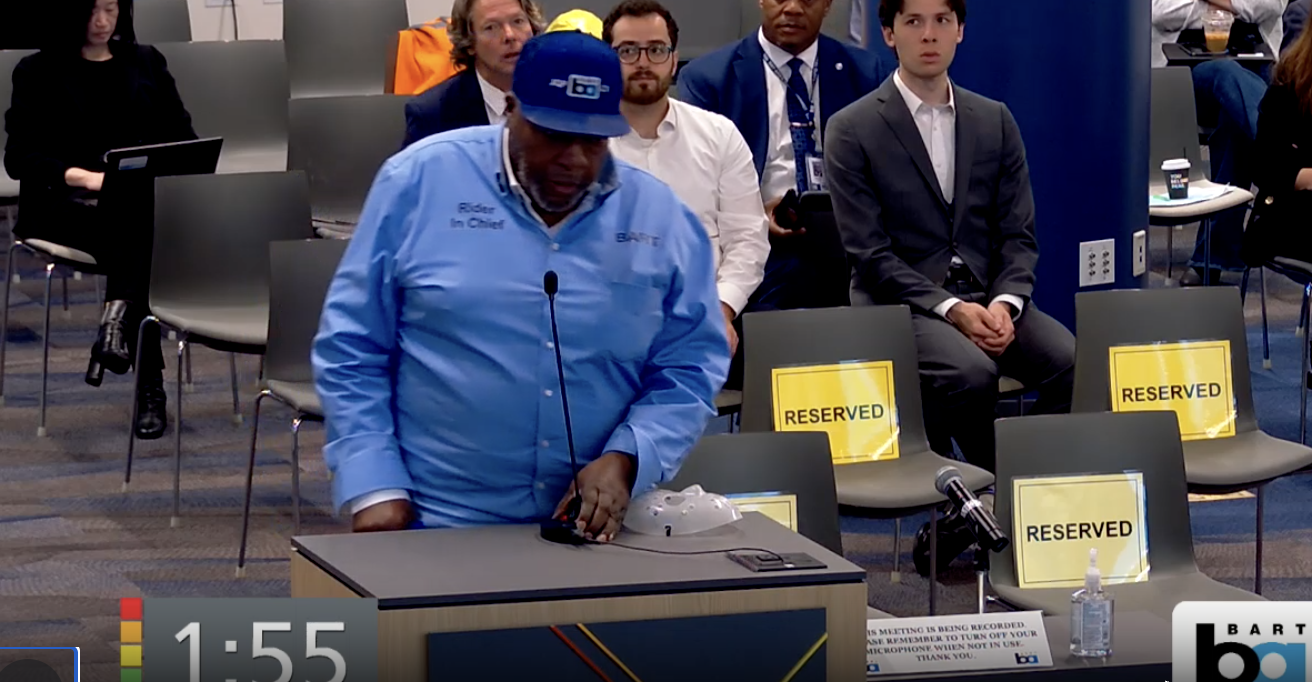
Public commenter Barney Smits made multiple appearances throughout the meeting, alleging contractor mismanagement and raising fiscal alarms. "How is it possible that the contractor VTA fired is still working and collecting 30 to 50 million dollars a month?" he asked. He also warned that VTA Director Jain has estimated $500 million per year in operations costs that VTA cannot pay, comparing the situation to the 2004 "grand divorce" with San Mateo County when BART had to absorb extension operations and maintenance costs.
Public commenter Roland LeBrun presented an alternative Diridon station design addressing emergency evacuation concerns and revealed that the 13th Street vent shaft has been eliminated from BSV2 plans, raising security and tunneling questions. He also noted fewer fare gates are planned at Diridon than at the 28th Street station.
What's next: The BSV2 concerns remain unresolved and are likely to surface again as the project advances through its stage gate process. Smits urged the board to establish a dedicated BSV2 subcommittee.
If the Ballot Measure Fails: BART's Plan B
Why it matters: If the November regional revenue measure fails, BART would implement 63% service cuts by January 2027. This presentation explored how to make the best of that worst-case scenario.
Where things stand: Interim AGM Joy Sharma presented the capital program impacts of the alternative service plan. Systemwide 9 p.m. closures would roughly double weekday construction windows — from 1.5–3 hours to 4.5–6 hours. After skills assessments and targeted training, BART could shift approximately 50–70 operating employees into capital support roles (office engineering, inspection, quality assurance), in addition to the 840 positions already capital-reimbursable. Highly specialized work, such as Communications-Based Train Control installation, would still require consultants. Constraints include CPUC regulatory maintenance requirements, emergency response capacity, and design readiness.
Director Ghosh urged deeper labor collaboration: "I would love for us to have more conversations that this is not the end of this. Even between now and November there should be more conversations and transparency around how these positions work now and how they work going forward."
Director Foley and Director Ghosh both pushed for bringing contracted work in-house where possible. Director Ames suggested adding traction power projects to absorb additional workers. Director Li cautioned that this remains a thought exercise and it would be premature to formalize a roadmap.
What's next: The alternative service plan remains a contingency. Its viability depends entirely on the outcome of the November revenue measure.
Board Backs New Contra Costa Sales Tax Authority
Director Foley moved to support SB 1408, authored by State Sen. Jesse Artogin and sponsored by the Contra Costa Transportation Authority (CCTA). The bill would grant CCTA authority until 2045 to impose a countywide sales tax of up to 1% for transportation, subject to voter approval and exempt from the combined county rate limit.
Foley noted CCTA's role in funding the eBART Antioch extension. Director Ames supported the measure but expressed frustration that transit funding consistently relies on sales taxes rather than corporate taxes. Director Victor Flores recused himself due to employment with the bill author's office.
Decisions: Passed 8-0 (For: Hernandez, Raburn, Ames, Foley, Ghosh, Li, Wright, Rinn; Recused: Flores). CCTA is looking to put a measure on the ballot as early as 2028.
Minor Items
- Consent calendar passed unanimously 9-0, including approval of May 14 meeting minutes, resolution consolidating 2026 BART district elections with the general election, FY27 Proposition 4 appropriations limit, a reimbursement resolution for future bond-funded capital expenses, the Clipper BayPass participation agreement amendment, and a contract with Contra Costa County Health Services for the CORE BART Homeless Outreach Team.
- Director Ames pulled the Proposition 4 appropriations limit item for brief discussion, pushing unsuccessfully to increase the capital program to $1 billion annually before it was approved on the consent vote.
- Ridership update: GM Bob Powers reported ridership 12% higher year-over-year, with May tracking 14% above budget and 15% above last year. Weekend ridership was especially strong — a 20,000-rider Sunday bump during Carnival in the Mission over Memorial Day weekend.
- FIFA World Cup grants: BART secured $291,000 from FEMA and $1.1 million through MTC (FTA funding) for FIFA World Cup preparation.
- BART Prom has sold over 1,000 tickets at $15 each, with 200 more released.
- CARB advocacy: GM Powers sent a letter opposing amendments to the Cap and Invest program that he said would "drastically reduce proceeds, leaving scraps or little to no funding" for transit. Directors Raburn, Flores, and Ames traveled to Sacramento to advocate against the amendments.
- Concord Naval Weapons Station: Director Foley reported the Concord City Council approved its agreement with the U.S. Navy to purchase the weapons station land, which could bring 12,000 homes near the North Concord BART station — a significant transit-oriented development opportunity.
- The meeting was adjourned in memory of VP Wright's grandmother, Gretna Van Fleet — the namesake of the Grammy Award–winning rock band Greta Van Fleet.