Board of Directors - Feb 26, 2026 - Meeting

Board of Directors - Feb 26, 2026 - Meeting

Board of DirectorsBay Area Rapid Transit DistrictFebruary 26, 2026

Sources:

Locunity is a independent informational service and is not an official government page for this commission.We use AI-assisted analysis and human editorial review to publish information.

BART Board Approves Emergency Plan for 70% Service Cuts If Revenue Measure Fails

The BART Board of Directors voted 8-1 to adopt a two-phase emergency roadmap that would slash train service by up to 70%, raise fares 50%, eliminate nearly 1,200 jobs, and potentially shutter 15 stations — all contingent on whether voters approve a regional revenue measure this November. The same meeting that formalized the agency's most consequential budget action in its 54-year history also exposed the fragility of its current operations: a single failed network card at Lake Merritt knocked out transbay service for 45 minutes during the Thursday morning commute, and two encampment fires in February melted fiber optic cables and closed the Transbay Tube.

  • BART board approves two-phase emergency service plan 8-1, authorizing staff to prepare for three-line service, 9 p.m. closures, up to 15 station closures, and nearly 1,200 job cuts if no new revenue materializes

  • Lone dissenter says the plan lacks hope: Director Ames argues the board should present an intermediate scenario with reduced service and supplemental state funding, not just a doomsday roadmap

  • Morning network failure strands transbay riders for 45 minutes, with directors reporting absent station agents, wrong signage, and inaudible train announcements

  • Two encampment fires disrupt service in February, melting fiber optic cables and prompting BART to install K-rail barriers at West Oakland

  • Governor signs $590M transit loan at BART facility, but full use depends on voters approving the ballot measure

  • Tri Valley business leader warns station closures would hit $52 billion regional economy


The Fiscal Cliff Gets a Countdown Clock

The BART Board approved the FY27 Alternative Service Plan on a vote of 8-1 (For: 8 — Directors Li, Foley, Ghosh, Raburn, Rinn, Flores, Wright, Hernandez; Against: 1 — Director Ames; Absent: 0), directing staff to prepare implementation plans for phased service cuts, fare increases, and potential station closures should a regional revenue measure fail in November 2026.

The basics: The plan is a budget roadmap, not an immediate service change. No stations close today. Full service continues past midnight. Headways remain unchanged. But the vote authorizes staff to develop closure criteria, begin Title VI analysis, and prepare layoff processes — putting BART on a formal countdown clock.

Why it matters: Without voter approval of a new regional revenue source, BART cannot balance its budget. Even the deepest cuts in the plan cannot guarantee long-term sustainability. As Director Victor Flores warned: "There is no guarantee that if we get to the point where we have to close stations that we will achieve a balanced budget. Because if riders leave, it will be unsustainable."

Two Phases of Cuts

Director of Financial Planning Michael Eisman presented the plan's architecture. Phase 1 (January 2027) would reduce the system to three lines with two trains per hour — a 63% cut in train hours — close service at 9 p.m. daily, delay Saturday openings to 8 a.m., impose 30% fare and parking fee increases, and eliminate approximately 600 positions across maintenance, police, cleaning, and administration. Even with those cuts, $72 million in reserves would be needed.

Phase 2 (July 2027) would add a cumulative 50% fare increase, up to 15 station closures and/or elimination of 25% of system track miles, nearly 1,200 total position cuts (40% for administrative functions, 30% for police, 25% for maintenance and cleaning), and elimination of nearly all capital allocations.

A key change from the board workshop two weeks prior: station closures moved from Phase 1 to Phase 2, reducing savings by approximately $10 million, backfilled from reserves. "Two weeks ago we had 10 station closures proposed in January at the workshop. We did not hear a board consensus to take action on specific station closures at this time," said Eisman. (Lightly edited for clarity.)

The Sole Dissent

Director Liz Ames cast the lone no vote, arguing the board should present communities with something between full service and catastrophe. "I'm talking about a service plan to continue from January 1st into outer years to show supplemental funding that's needed," she said. "I'm not talking about a Covid budget. I'm talking about a service plan that ends at 9 p.m. past January 1, 2027, onto outer years of 2028."

General Manager Bob Powers and financial planning staff pushed back, saying the plan already represented the maximum service BART could provide without new revenue and that hypothetical state funding scenarios could not be budgeted.

Fare Increases, Pension Obligations, and the Math

Director Rash Ghosh challenged the board's acceptance of 30% fare increases, noting the impact on low-income riders. "We have not had any conversation here about the impact of the 30% fare increases," he said. "We've kind of just accepted that the 30% fare increase is okay." He questioned whether reserves should be used to reduce fare increases rather than defer station closures.

CFO Joe Beach explained that roughly $260 million would remain in reserves at fiscal year end against a 15% ($150 million) policy requirement, leaving limited additional capacity.

Director Mark Foley raised pension and retiree medical obligations: "Employees dedicated their entire working life to this agency and have put all of their retirement income into a basket for the remainder of their life. I think we need to ensure that we're doing everything we can to meet our obligations for pension."

"Not a Tactic — It's Math"

Vice President Edward Wright pushed back forcefully on media characterizations of the exercise as a scare tactic. "I've seen some of the media accuse us of doing this exercise as a scare tactic. And yes, this is very scary, but that's not a tactic, it's math. And doing this exercise is our fiduciary duty as this board."

He framed the plan as the "best case scenario" in a measure-fail world — showing BART running some service rather than shutting down entirely.

Director Robert Raburn, who moved the motion, walked through the human impact: "Three-line service, two trains per hour at Hayward. That means we go from this time next year from six trains an hour to two — students going to Cal State East Bay, sorry, you're not going to be able to just get to class on time or get home in time for dinner."

Chair Janice Li repeatedly emphasized the action's limited scope: "This action today does not implement any changes to our service. All stations will remain open. We will continue the full service that we are providing today. We are not closing anything."

Board President Melissa Hernandez stressed that station-area economic development must factor into closure decisions: "I just want to be clear that economic development plays a huge role on making sure that these stations stay open."

Public Comment: Existential Stakes

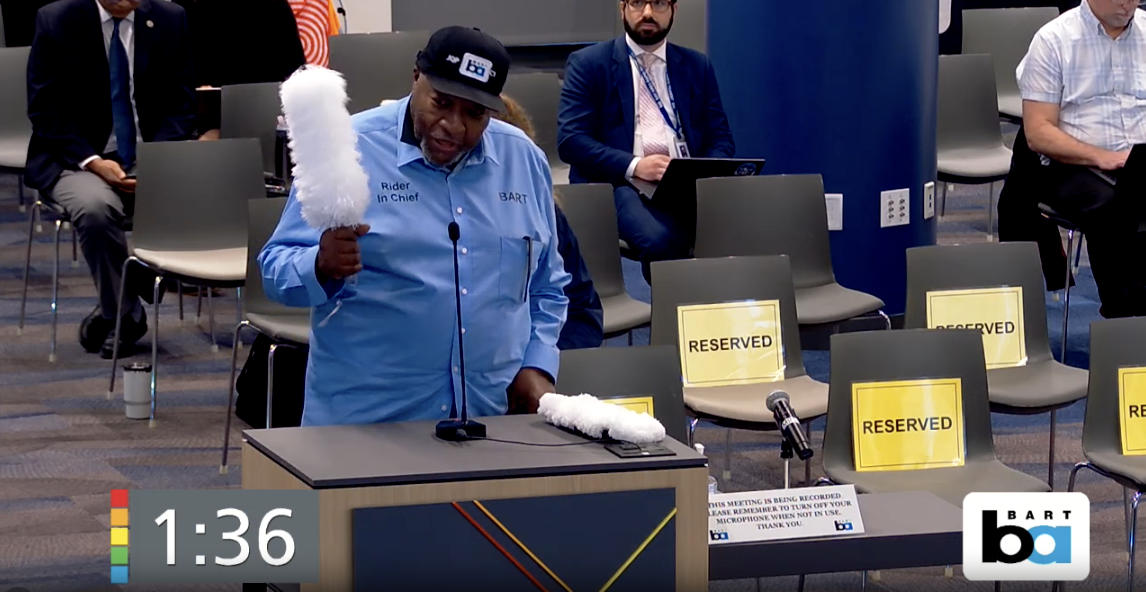
Public commenters ranged from stoic to alarmed. Katie Marcel, CEO of the Innovation Tri-Valley Leadership Group, urged the board to consider the cascading impacts of potential Dublin/Pleasanton station closures on the $52 billion GDP Tri Valley economy, warning cuts would push more cars onto congested corridors and undermine Valley Link and other future regional solutions.

A public commenter named Robin warned that 9 p.m. closures would devastate Bay Area nightlife and entertainment venues dependent on BART riders, and urged phone banking to support the revenue measure. Glenn Overton pledged riders would stay with BART "to the end" and invoked climate change consequences of losing the system.

Decisions: The plan passes to staff for continued implementation preparation. Director Foley introduced a request for community information events in each board district to explain the alternative service plan to the public.

What's next: Staff will develop specific station closure criteria, begin required Title VI equity analysis, and prepare layoff processes. Actual implementation would require future board votes on the budget, Title VI findings, and individual station and line decisions. Everything hinges on the November ballot measure.


A Single Card Failure Exposes BART's Fragile Backbone

At approximately 8:05 a.m. on the day of the meeting, a supervisory network card failure at Lake Merritt station caused a system network failure between West Oakland and 24th Street on the M Line, knocking out both tracks. The Operations Control Center lost routing control and the systemwide PA system failed. Service through the Transbay Tube was disrupted for approximately 45 minutes during peak commute.

Why it matters: The outage struck during a month when ridership was running 8% above budget — a trend the agency desperately needs to sustain its financial case for the ballot measure. Several directors were personally affected and came to the meeting with firsthand accounts of the communication breakdown.

Where things stand: Director Janice Li channeled rider frustration: "Bob, you just reported on our ridership numbers in February. We are consistently getting better and better numbers with customer satisfaction. We are seeing our ridership numbers perform above budget and these things are happening and it just makes me feel like we could be in such an even better place."

Director Ghosh reported poor on-train communication with "mumbling" announcements and no information for passengers approaching the MacArthur transfer station. "When it does happen, how we communicate needs to be a priority," he said.

Vice President Wright reported that at Civic Center there was no station agent and no signage about the outage. "I stood in front of the gates and started turning people away," he said.

General Manager Powers acknowledged the failures were "unacceptable" and "self-inflicted," noting: "We're doing so well. But for these self-inflicted challenges with the operations in the system, we could be doing so much better if we can tighten that up a little bit."

What's next: The GM committed to follow up on outage communication improvements and the feasibility of disabling fare gates during outages to prevent riders from entering affected stations. Director Foley asked whether the forthcoming CBTC train control system would improve redundancy; Powers said the failure was a network issue, not a train control problem.


Encampment Fires Threaten Fiber, Force Emergency Response

Two encampment-related fires disrupted BART service in February. On Feb. 15, a gas generator exploded at a homeless encampment on Union Pacific right-of-way between Hayward and Union City, causing an all-day service disruption. On Feb. 22, a burning RV at an encampment near 5th Street at West Oakland melted fiber optic cable and led to closure of the Transbay Tube.

Why it matters: The fires represent an escalating and recurring threat to BART's aging fiber infrastructure that piecemeal negotiations with individual cities cannot solve at the scale of a 131-mile system.

Where things stand: In response to the West Oakland fire, Chief of Police Kevin Franklin worked with Oakland PD and fire officials to clear encampments. GM Powers confirmed K-rail barriers were placed to prevent vehicle access under the trackway.

Director Raburn called for a statewide legislative approach: "I would much prefer that we not go about this in a piecemeal fashion." He noted a September letter to Oakland City Council requesting encampment exclusion zones within 25 feet of active rail had stalled.

Director Ames called for systematic tracking and mapping of encampments near BART facilities.

What's next: BART is pursuing both physical barriers (K-rail) and legislative advocacy in Sacramento for statewide protections around transit infrastructure.


Governor Signs $590M Transit Loan at BART Facility

Board President Melissa Hernandez reported that Governor Newsom signed AB 117 at BART's Daly City shop, authorizing up to $590 million in interest-free loans to MTC to support operations at BART, AC Transit, Caltrain, and Muni. The signing followed a Jan. 27–28 Sacramento advocacy trip where seven directors, the GM, labor leaders, and advocates met with Bay Area legislative delegation members, transportation and budget committee chairs, the Governor's office, and CalSTA.

Why it matters: The loan provides near-term fiscal certainty for Bay Area transit agencies, but its full use depends on voter approval of the regional revenue measure. CFO Joe Beach clarified that in the measure-succeeds scenario, BART plans to draw approximately $39 million in the first half of FY27 and $58 million in the second half. In the measure-fails scenario, BART would draw only the first $38 million because the agency would lack repayment capacity.

Senator Wiener was recognized for his advocacy for transit in Northern California.


Minor Items

  • Consent calendar approved 8-0, including approval of meeting minutes, a collector shoes order, and the appointment of Eliana MacHevsky to the BART Civilian Police Review Board. MacHevsky is a staff attorney at the National Police Accountability Project and a Berkeley Law graduate who works as a civil rights litigator. CPBRB Chair Dana Lang expressed enthusiasm for adding legal expertise to the panel.

  • Audit Committee report: Inspector General investigations into force account tagging recovered approximately $1.7 million from construction contracts. A Link 21 performance audit covering August 2019 through June 2024 produced 24 recommendations, all accepted by management.

  • February ridership is running 8% above budget, continuing a positive trend.

  • Item 7A was deferred to a future meeting at staff's request.

  • Public commenter Barney Smits called for a board subcommittee on the BART to Silicon Valley Phase 2 project, citing safety concerns including elimination of emergency exits in tunnels and VTA's failure to comply with BART standards.

  • Public commenter Joe Kunstler recommended closing on Sundays and Saturdays before cutting evening service and suggested turning stations into "third places" with coffee shops and businesses.