
Board of Directors - Mar 26, 2026 - Meeting
Board of Directors • Bay Area Rapid Transit DistrictMarch 26, 2026
Locunity is a independent informational service and is not an official government page for this commission.We use AI-assisted analysis and human editorial review to publish information.
Survey Finds 87% Call BART Essential, but Crime Keeps Non-Riders Away
The BART Board of Directors met March 26 with a packed agenda that put the agency's post-pandemic recovery narrative under a microscope: a new five-county survey confirming overwhelming public support for the system — and revealing exactly what's stopping millions from using it. The board also approved a contested safety plan over a lone dissent, greenlit $9 million for desperately needed maintenance vehicles, and bid farewell to a senior operations leader whose departure opens a critical gap.
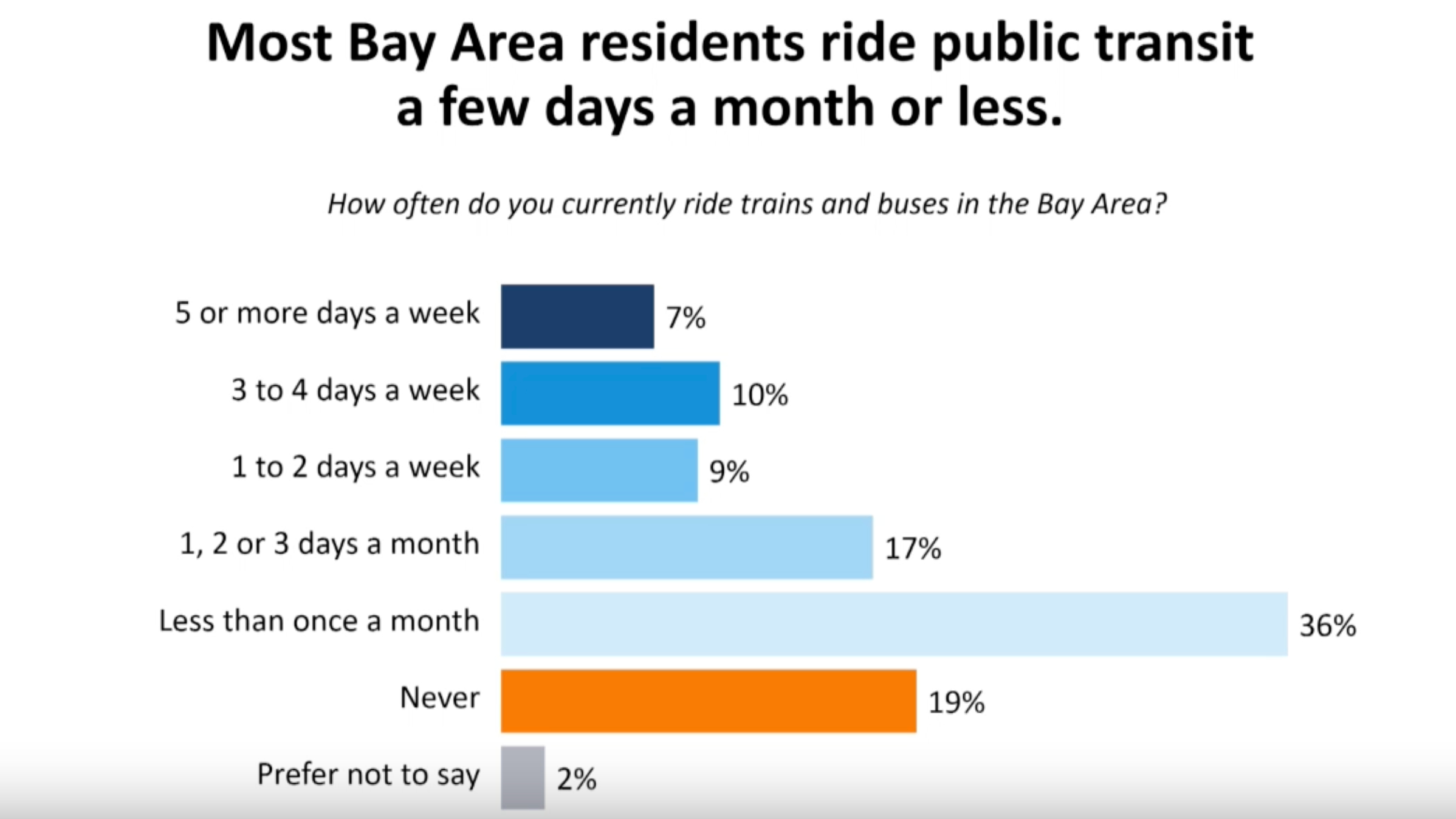
New survey of 1,400 Bay Area residents finds 87% say BART is essential to regional quality of life — but crime tops the list of reasons non-riders stay away
Safety plan approved 8-1 after Director Liz Ames pushed unsuccessfully to add VTA-style continuous improvement provisions and delay for a board presentation
$9M authorized for 126 replacement maintenance vehicles, with 47 already out of service and fleets averaging well over 100,000 miles
Ridership hits 14% above last year, with Saturday trips reaching 85% of pre-pandemic levels
Operations chief Shane Edwards departs after 11 years, leaving a leadership vacuum as BART navigates budget uncertainty and VTA Phase 2 challenges
Directors float bold ideas to grow ridership: eliminating the Oakland Airport Connector fee, launching a public performance dashboard, and partnering with airlines and sports teams
Crime Is the Wall. Can BART Break Through It?
A sweeping new survey gives BART both its strongest public validation and its clearest marching orders as the agency stares down a fiscal cliff when federal COVID relief expires in January 2026.
The basics: FM3 Research partner Curtis Below and BART Director of Marketing and Research Dave Martindale presented findings from a January 2026 survey of approximately 1,400 residents across Alameda, Contra Costa, San Francisco, San Mateo, and Santa Clara counties.
Why it matters: With a potential ballot measure on the horizon, the survey provides a data-driven foundation for BART's case to voters — and exposes the gap between public goodwill and actual ridership.
Where things stand: BART holds a 53% favorable rating, roughly 2-to-1 favorable versus unfavorable. Among riders, 59% report satisfaction; that figure jumps to 72% among frequent riders. But the headline number is this: approximately 56–60% of non-riders say they are open to trying BART. The barriers keeping them away are clear. About half of non-riders cite crime as a major reason they don't ride. Cleanliness follows close behind, then the distance to stations.
Airport trips emerged as a potential low-hanging fruit for converting non-riders into occasional passengers.
Martindale outlined the agency's response: a "Clean, Safe and Satisfied" marketing campaign featuring digital ads, radio and TV spots secured through trade agreements, and partnerships with local news outlets including Patch, Berkeleyside, and Oaklandside. A "Transit Saves" campaign focused on traffic and pollution will launch around Earth Day in April, with FIFA World Cup messaging planned for June.
The other side: Directors offered a barrage of suggestions that at times veered into strategic brainstorming.
Vice President Edward Wright zeroed in on the crime data and called for accountability measures:
"The primary message we're hearing from the public, which aside from the fact that most people are appreciative of BART and think BART is really important, crime is the number one concern that the public has and safety improvements are the single most important thing to the public that we can be doing."
He pushed for a public-facing quarterly performance report dashboard modeled after Muni's.
Director Liz Ames urged the agency to reframe its pitch around the word that kept surfacing in the data:
"To me, this is all about the word convenience. I really think convenience needs to be part of our messaging."
Director Rash Ghosh argued that BART's own voice has limits:
"BART telling people that we're doing all this right only works up to a point. And after that, you need trusted messengers in the community to be able to deliver those messages."
He urged the agency to enlist community partners to spread the word about post-pandemic improvements like elevator attendants and reopened bathrooms.
Director Matthew Rinn pushed for a more aggressive posture:
"BART needs to play offense. And I know we have comms in the team in the room, but we're trying to gain 100,000 riders a day."
Director Victor Flores proposed reducing or eliminating the Oakland Airport Connector fee:
"I definitely would be interested in seeing if we can get the Oakland Airport Connector fee reduced or completely eliminated."
He also floated partnerships with Southwest Airlines and the Golden State Warriors for promotions.
Director Janice Li wanted to understand how non-riders form their opinions in the first place:
"I am so curious in hearing how people who don't regularly take BART — and that's a lot of folks, given the survey — how they get their info about current BART conditions."
Director Robert Raburn advocated for enhancing the BART app with bike routing and Bay Wheels integration to address the "stations too far" barrier. Director Mark Foley asked about deploying BayPass for convention attendees from events like RSA, Dreamforce, and Disrupt.
Public commenter Glenn connected the survey results to a tangible rider experience issue, arguing that restroom conditions are a "mediating variable" that can permanently deter riders and urging BART to modernize restrooms to a dignified standard. Alita suggested broadening future surveys beyond the five-county district to include visitors.
What's next: The survey data will inform both BART's ridership growth strategy and messaging for a potential future ballot measure. Staff will evaluate director proposals on airport fares, a performance dashboard, and community partnerships.
Safety Plan Passes 8-1 as Ames' Push for Tougher Standards Falls Short
Why it matters: BART's annual Public Transportation Agency Safety Plan is required by the Federal Transit Administration and faces an imminent California Public Utilities Commission audit — making delay risky. But the lone dissent exposed unresolved board tensions over whether the plan is ambitious enough, particularly regarding VTA Phase 2 oversight.
Where things stand: Director Liz Ames pulled the safety plan from the consent calendar, requesting a board presentation and arguing that the plan's annual revisions were minimal. She pointed to VTA's safety plan as a model:
"I looked at VTA's safety plan, and they had continuous improvement in there... but they had means and methods of continuously improving the safety, talking about monitoring, mitigation plans, correction, action plans."
She also sought language addressing BART Silicon Valley Phase 2 (BSV2) safety protocols.
The other side: General Manager Bob Powers defended the plan, noting it had been reviewed by all departments and that briefings were offered to every director. He described it as a model within FTA circles. Chief Safety Officer Jeff Lau confirmed that annual review is federally required and that a CPUC audit is imminent, making prompt approval preferable.
Decisions: Ames moved to table the plan for a future meeting. The motion died for lack of a second. Director Janice Li then moved to approve, seconded by Director Robert Raburn. The plan passed 8-1. (For: 8 — Li, Flores, Foley, Ghosh, Raburn, Rinn, Wright, and Hernandez. Against: 1 — Ames.)
Public commenter Barney Smits, a licensed professional engineer and former BART engineer, reinforced Ames' concerns from a different angle. During general public comment earlier in the meeting, Smits requested the board establish a separate subcommittee on the $13 billion BSV2 project, citing a December inspector general report identifying safety risks and deviations from safety standards. Later, during general public comment for items not on the agenda, he warned that BSV2's announced upgrade to 2026 NFPA 130 standards would require rewriting the entire Design Criteria Manual, force adoption of the 2025 California Building Code, and add years of delay and significant cost.
What's next: The approved plan goes forward to CPUC ahead of the expected audit. Ames' dissent and Smits' public comments ensure that BSV2 safety oversight will remain a live issue for future meetings.
$9M for Aging Fleet: 47 Vehicles Already Dead on Arrival
Why it matters: With 47 maintenance vehicles already non-operational and the remaining fleet averaging model years 2000–2015 with many exceeding 200,000 miles, BART's ability to maintain 131 miles of track and 50 stations is on the line.
Where things stand: Group Manager of Project Delivery, Javed Khan, presented a request for board authorization to purchase up to 126 vehicles — including heavy-duty trucks, mid-duty trucks, light-duty trucks, and approximately a dozen high-railers — at a cost not to exceed $9 million. The purchases would use pre-approved California leveraged procurement agreements, and funding is entirely federal, restricted to non-revenue vehicles.
Director Janice Li asked for more detailed breakdowns in future executive decision documents regarding vehicle types and which divisions would receive them. Director Rash Ghosh raised a procedural concern, recommending that items with unidentified funding sources come to the board as action items rather than consent calendar items. Ghosh also urged BART to use trusted community voices in explaining why these investments matter.
Public commenter Alita asked whether the procurement agreements allow purchase of electric vehicles. Staff confirmed that EV and hybrid options are not excluded but that some specialized vehicles — particularly high-railers — are not available in electric models. Director Robert Raburn suggested a "Meet BART Vehicles" coloring book for public education.
Decisions: The motion passed unanimously, 9-0. (For: Li, Flores, Foley, Ghosh, Ames, Raburn, Rinn, Wright, and Hernandez.)
Operations Chief Departs, Leaving a Critical Gap
General Manager Bob Powers announced that Assistant General Manager of Operations Shane Edwards is leaving BART after approximately 11 years. Edwards rose from assistant chief maintenance officer to chief maintenance officer to AGM of operations — a trajectory Powers described in deeply personal terms.
Powers credited Edwards fostering a "collaborative and thoughtful" partnership with labor and for rescuing VTA Phase 1 when BART had to step in to make it operational, Edwards served as the agency's VTA liaison, contributed to the Transbay Tube seismic retrofit, and built relationships with SEIU, ATU, AFSCME, and other unions.
Director Rash Ghosh and Director Janice Li both expressed concern about the speed of filling Edwards' role. Public commenter Barney Smits also praised Edwards' work.
Why it matters: Edwards' departure creates a significant leadership vacuum in day-to-day operations at a moment when BART faces simultaneous pressures from budget uncertainty, VTA Phase 2 challenges, and the need to sustain its ridership recovery.
Ridership Recovery Gains Momentum
General Manager Bob Powers opened his report with encouraging numbers: March ridership is tracking 10% above budget and 14% above the same period last year.
"Over February and into March, our Saturdays have reached about 85% of pre-pandemic ridership levels," he said.
The agency is preparing for a busy stretch of weekend events including No Kings rallies, Oakland Roots games, and Giants games, with longer 8-car trains planned on the Orange and Red lines. Director Robert Raburn highlighted a new tool for welcoming first-time riders at those events:
"One of the exciting things that will be available on Saturday that wasn't available in the prior two events is BART has tap and ride. That means you can just show up at any BART station with your credit card."
Powers also noted BART will receive the East Bay Economic Development Alliance's Legacy Award, recognizing enduring regional impact.
Minor Items
Consent calendar approved 9-0, including items A through H (with item F pulled for separate discussion). Items included Ryan Manriquez's appointment to the BART Accessibility Task Force. Manriquez, a UC Berkeley Master of Public Policy student who uses a power wheelchair, lives in a transit-oriented development near El Cerrito del Norte and previously served as UC Davis student body president and on the board of the Center for Independent Living. Directors Flores, Ghosh, and Raburn all congratulated him.
Inspector General salary increase of $14,815, retroactive to Jan. 1, 2026, approved 8-0 after closed session. Hernandez was absent from the vote.
MTC extended the Lyft Bay Wheels bike share contract for five years through FY32, Li reported, with $2.5 million reinvested in dock and e-bike expansion beyond San Francisco into Oakland, San Jose, and transit station areas.
Ames mentioned Bike Fremont's interest in expanding Bike to Work Day energizer stations at Warm Springs.
Ghosh reported presenting BART's alternative service plan to Hercules City Council, with similar presentations planned for El Cerrito and Richmond.
Summer schedule: The board will cancel its July 23 and Aug. 27 meetings.
D.C. advocacy trip: Six directors and staff held 17 meetings over two days with congressional offices and committee staff, discussing customer-facing improvements, the alternative service plan, and federal funding for projects including station LED lighting. The Picard Group served as the agency's federal advocates.
Public commenter Joe Kunstler urged BART to "play to win" on the budget crisis and recommended the agency develop a drone policy.