Unions, Directors Push Labor Seat as BART Drafts Its AI Rules
Board of Directors • Bay Area Rapid Transit DistrictOctober 8, 2026
Locunity is an independent informational service and is not an official government page for this commission. All information is sourced from public footage and an analysis of official agendas with the aid of responsible, fact-checked AI. to report an error or omission.
BART is writing its first districtwide artificial intelligence policy, and labor has already won the argument over who sits at the table. At an Oct. 8, 2026, information session, most directors backed the unions' call for a standing oversight committee and pressed staff for immediate limits on AI in policing and personnel decisions. The board also logged BART's best ridership days since COVID, weeks before a regional funding measure goes to voters.
AI policy framework previewed: unions and at least five directors back a standing labor oversight committee.
Director Janice Li seeks immediate guardrails banning AI in HR and policing/surveillance.
Two highest post-COVID ridership days (254K, 248K) spark warnings that service can't keep pace.
Former BART engineer, Director Liz Ames press for briefings on VTA's Silicon Valley extension; December update promised.
Consent calendar passes 7-0, moving Warm Springs funds into a permanent Fremont wetland endowment.
Youth organizers of a 200-plus-rider speedrun honored as directors float a formal youth voice.
Labor Wants a Permanent Seat on AI
Why it matters: More than half of BART staff who answered an internal survey already use AI on the job, yet the district has no board-adopted policy. The rules will decide whether AI can touch personnel decisions, policing or rider data.
Where things stand: Assistant General Manager Boris Lipkin and Assistant General Manager Ravi Misra presented Phase 1 findings. Their work included director listening sessions, two union leadership meetings, a staff survey with about 400 responses and scans of New York MTA, TxDOT, APTA, USDOT and UITP.
"Over half of the folks who responded said that they use AI tools in their work at BART at least once a month," said Lipkin.
Staff proposed three tiers. The board would adopt a district AI policy. A governance process would evaluate tools. Administrative directives would cover privacy, security, and authorized and prohibited uses. All three would align with labor contracts and BART's Surveillance Technology Policy. Draft principles include safety, privacy, accuracy, accountability, transparency and workforce empowerment.
Misra warned about cost, citing a small company whose monthly AI bill hit "half a million dollars" with no return on that spending. He said BART has been experimenting with AI for about three years, including a chatbot in the BART app.
Labor's push: Chris Finn, president of ATU Local 1555, said the unions' core demand, an ongoing oversight committee with labor, was left out of the first draft. Sal Cruz, president of AFSCME Local 3993, spoke for BART's major unions. "That's why we're proposing a standing AI adoption and oversight committee with labor at the table on an ongoing basis," said Cruz. "A one-time briefing can't keep up with technology that changes this fast."
The board's read: Director Liz Ames, Director Victor Flores, Vice President Edward Wright and Director Mark Foley backed an oversight committee. Li went further and called for interim rules now. "I do not want AI tools in any way interfacing with our policing and surveillance," said Li. "We will not have a successful AI policy or policy implementation if unions are just being told what the district is doing."
Li also called draft goal 5 redundant. "We don't need to be an AI innovation leader at this time," she said.
Wright opposed generative fake imagery and asked again for a public performance dashboard. "We also know that facial recognition models built around AI have shown clear bias over and over," said Wright. Foley urged staff to be candid that some jobs may disappear in five or 10 years. "We need to think about a kill switch," he said.
The other side of the ledger: Some directors focused on costs and resilience rather than labor. Director Robert Raburn raised data centers' energy demand, which competes with BART's clean-power purchases. "Each AI search contributes to increased energy use at data centers," said Raburn. He also challenged goal 5's wording: "Define resources. Are humans resources?"
Director Rash Ghosh asked that AI's environmental impact be tracked in BART's sustainability report. She also worried about skill loss if tools fail. Director Matthew Rinn stressed privacy and called for department-level subplans.
What's next: No vote was taken. Misra said a draft policy will return in "a few months" as an information item for another round of feedback. A later adoption vote would follow.
Riders Return Faster Than the Budget Planned
Why it matters: BART's fiscal 2027 baseline budget and August service change were set when weekday ridership averaged just over 200,000. Demand has since jumped past that level, weeks before a regional transit sales tax goes to voters.
Where things stand: "We've had the 2 highest ridership days since COVID," said General Manager Bob Powers. Those days were 254,000 riders on Tuesday and 248,000 on Wednesday. A K-pop concert at Oakland Arena and Fleet Week helped drive the numbers.
September ended about 4.5% above budget and about 14% above a year ago. Monthly averages set records of 223,000 on weekdays and 144,000 on Saturdays. Bay Pass ridership grew about 40% year over year and now makes up about 6.5% of trips.
The capacity squeeze: Li said morning trains are extremely full and asked for timelines to lengthen them. "The amount of service we're putting out is not going to match the ridership given how quickly it's growing," she said.
Powers said operations staff monitor crowding data daily. "If we need to go from 8s to 9s or 8s to 10s, we have the rolling stock to do that," he said. He agreed to look into Li's request for analysis of how responsive the baseline budget can be.
The political wrinkle: One director warned that voters are reading the recovery as proof BART doesn't need money. Ridership remains far below the pre-pandemic levels needed to close the deficit. "We're being almost punished for doing a good job of bringing back riders," the director said.
The other side: Walnut Creek resident Craig Bender, a public commenter, challenged BART's Alternative Service Framework. That plan projects $23M a year in savings from closing 10 little-used stations. "How can it possibly cost $6,000 per day to keep a minor station open?" asked Bender, who said he will vote no. Public commenter Joe Kuntzler urged voters to pass the measure.
Directors Demand a Closer Look at VTA's Tunnel
Why it matters: VTA is building BART Silicon Valley Phase II from Berryessa into San Jose, but BART will run the trains. A joint BART-VTA meeting was set for the following day at BART headquarters.
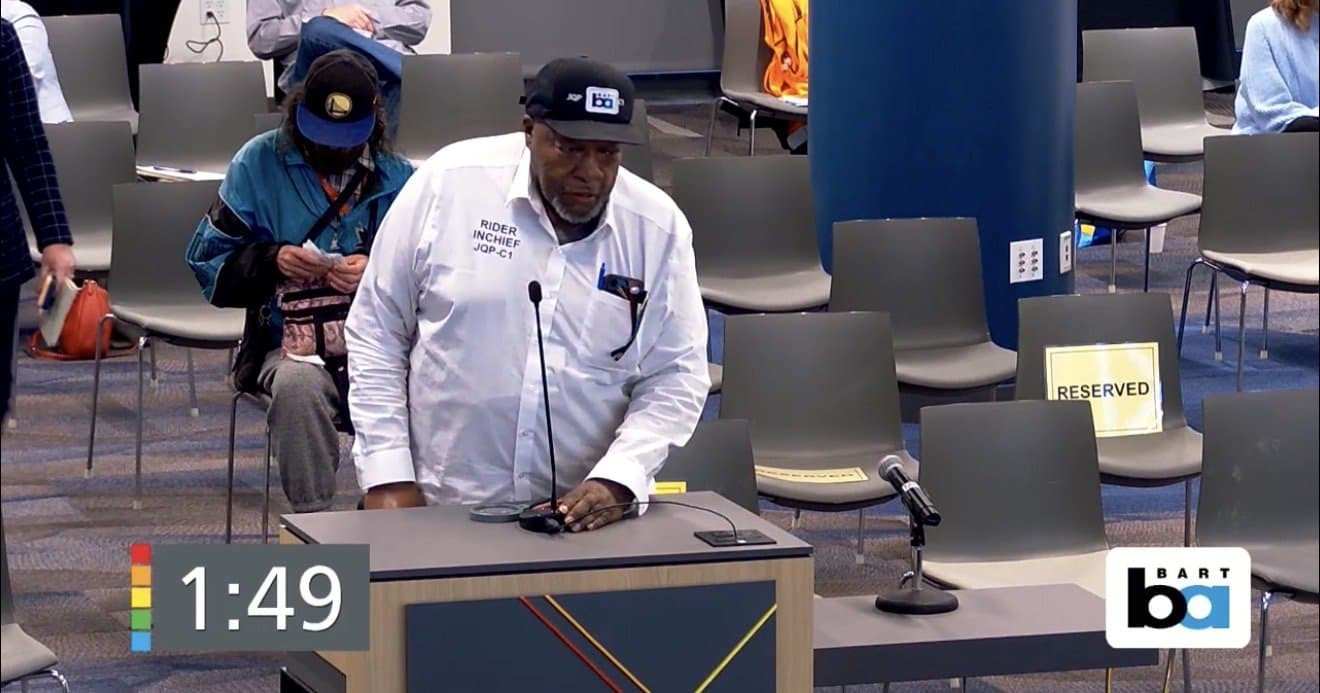
Where things stand: Public commenter Barney Smits described himself as a 25-year BART engineer and fire life safety expert. He asked why no Phase II items were on the agenda. He cited calculations of 17 tunnel-muck trucks per hour for 3.5 years and called a Sept. 28 project memorandum an effort to sideline BART engineering and its variance process.
"The memorandum is totally inadequate and evasive," said Smits. Later, during public comment, he described the variances he had received: "At least half were significant reductions in safety."
Ames said his comments resonated and that the board gets little preparation on the project. "There's certain elements that are unsettling, like the estimate hasn't been updated for years," said Ames, who asked for milestone updates.
What's next: "We have a scheduled BART VTA Phase 2 update to this board at the first meeting in December," said Powers. He added that Assistant General Manager Sharma would brief directors before the joint meeting.
Warm Springs Leftovers Fund a Wetland Forever
Why it matters: The 5.4-mile Warm Springs Extension opened March 24, 2017, with a subway under Lake Elizabeth in Fremont Central Park. The area is habitat for red-legged frogs, burrowing owls and California tiger salamanders. BART's mitigation duties under a California Fish and Game contract continue.
Decisions and stakeholder impacts: The board approved the consent calendar, including the resolution (Matter 26-389) redirecting remaining Regional Measure 2 project funds to a wetland mitigation endowment. Raburn moved and Rinn seconded. Vote: For: 7 (Ames, Flores, Foley, Raburn, Rinn, Wright, Hernandez); Against: 0; Absent: 2 (Ghosh, whose vote was not recorded, and Li).
Raburn framed the endowment as both a legal obligation and a promise to the community. Ames, who grew up near the lake, credited BART for switching from a bridge to a tunnel after community opposition. She said the John Muir Land Trust will steward the site. "They're going to maintain this and make sure it's a wetland for life," said Ames.
Smits, who worked on the project, backed the shift. "Still came in significantly under budget, which is great," he said. He also urged BART to build the largely designed Irvington station.
Teen Transit Fans Ask BART for a Seat
Board President Melissa Hernandez honored high school and college organizers of the Sept. 6 BART Community Speed Run, held for Transit Month. Organizer David Rabinovich said more than 200 people attended. "We believe 30 to 40 of these attendees had never ridden BART before," he said.
Justin Chen, a Palo Alto High School junior and founder of the New Urbanism Initiative, said the group aims to reach every Bay Area high school, youth organization and library. Stanford first-year Harvey Chang said the route favored accessibility over speed.
Why it matters: One director noted that San Francisco's school and community college boards seat youth representatives. "We don't have that at BART," the director said. Another director asked staff whether BART has considered a youth advisory committee. Youth organizer Matt suggested BART work through school districts such as SFUSD. The board took no formal action.
Minor Items
Whistleblower policy: Revised anti-retaliation policy approved 7-0 on consent, answering Contra Costa Civil Grand Jury requests.
Radio contract: Agreement No. 6M3795 awarded to Dailey and Wells Communications for P25 radio maintenance.
Aira pilot: Three-month pilot connects blind and low-vision riders to live video guides; evaluation follows.
Irvington station: Ames said Fremont prioritizes the station but needs right-of-way from a private owner.
Closed session: Board discussed Hill and Mora litigation and Lake Merritt station terms; nothing reported.
Looking ahead: The BART-VTA joint meeting follows this session. The regional transit sales tax measure goes to voters in November. A Phase II update is due at the board's first December meeting, and a draft AI policy is expected in a few months.