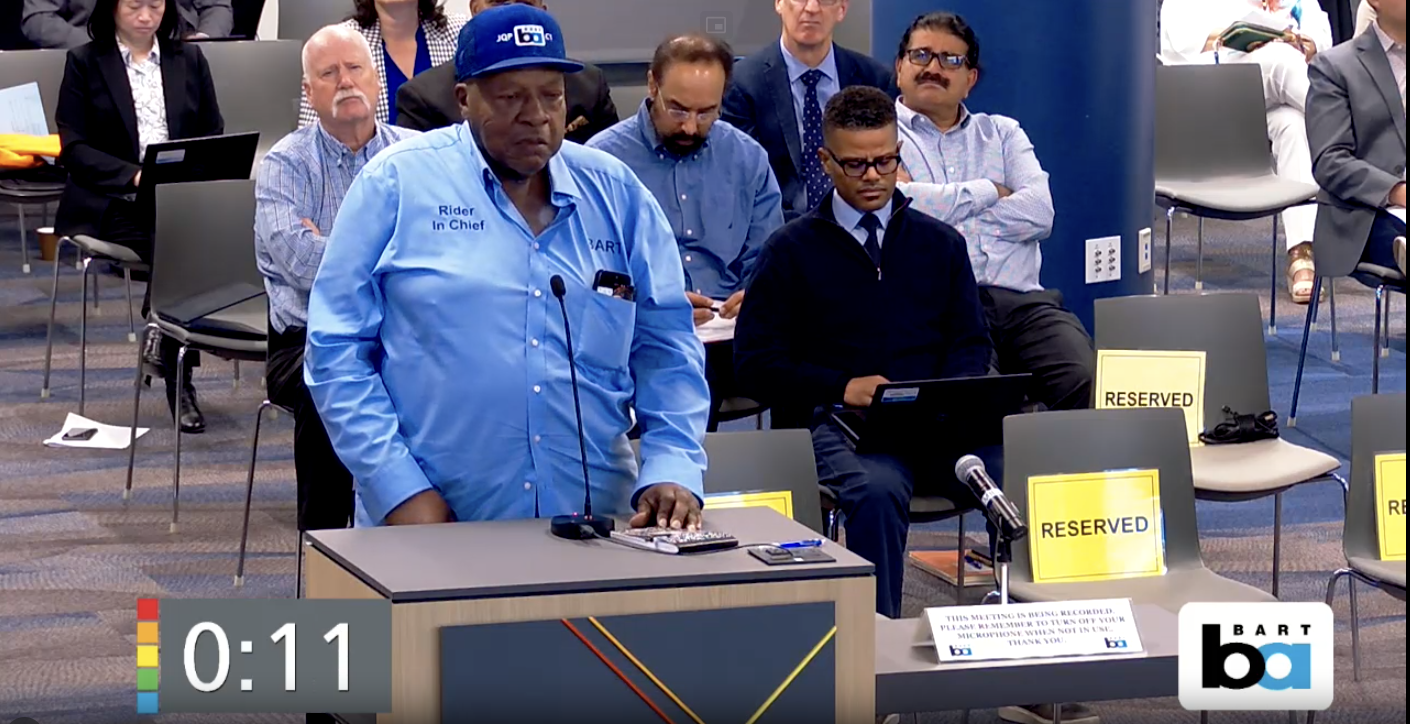
Board of Directors - Jun 11, 2026 - Meeting
Board of Directors • Bay Area Rapid Transit DistrictJune 11, 2026
Locunity is a independent informational service and is not an official government page for this commission.We use AI-assisted analysis and human editorial review to publish information.
BART Adopts FY2027 Budget 8-1 as Record Ridership Meets Looming Fiscal Cliff
BART's board approved a budget that keeps full service running and fares flat — but the 8-1 vote exposed a fault line over whether the agency is doing enough to close a structural deficit that hinges on a November ballot measure no one can guarantee will pass. The same meeting delivered a unanimous stamp on eight state-mandated efficiency strategies, a $285 million bridge loan, and a Transbay Tube investigation that found no smoking gun — just a complex, aging system that produced its best reliability month on record after millions in emergency upgrades.
- FY2027 budget passes 8-1, with Director Liz Ames casting the lone no vote over $14 billion in unfunded capital needs and $80M+ in overtime spending
- Board unanimously adopts all eight SB63 efficiency strategies required to unlock a regional revenue ballot measure, including a new station retail study
- $285 million MTC bridge loan approved 9-0, giving BART operating cash through FY2027 backed by state transit assistance
- No single root cause found for Transbay Tube disruptions, but three new substations and modern relays produced the lowest train delay month ever recorded
- Community members clash over BART PD hiring of Deputy Chief Antoinette Turner, with advocates demanding termination and supporters urging due process
- Engineers and commenters warn VTA's Silicon Valley extension is collapsing, potentially saddling BART with $500M/year in unfunded costs
Budget Survives, but the Cracks Are Showing
Why it matters: The FY2027 budget keeps BART's full service intact with no fare increases — the central promise heading into a make-or-break November vote on a regional revenue measure. But the budget assumes that measure passes, and a $7 million mid-year risk from state greenhouse gas reduction fund cuts could force tough choices before voters ever weigh in.
Where things stand: Budget Director Christopher Simi presented a budget fundamentally unchanged from two weeks prior. Strong ridership revenue and cost controls produced a $52.4 million carryforward from the current fiscal year — a cushion, but not a solution. The budget explicitly assumes passage of the regional tax measure. Staff flagged $7 million in LCTOP and GGRF funding they do not feel confident about receiving.
Chair Janice Li framed the vote in existential terms: "We are taking a vote today. We have to take a vote to keep the district, to keep our service, to keep BART running," she said, inviting every director to speak.
Director Mark Foley moved the item and praised the agency's journey since SB1031. Director Victor Flores credited the budget process but called for deeper cost controls. Director Rash Ghosh struck a philosophical chord, noting the tension between fiscal management and community need. "Public transit is really a public good," Director Ghosh said. "It kind of sucks to be in a position where we have to so closely manage expenses, revenue, and kind of run it as a business instead of providing the service that our communities need."
The other side: Director Liz Ames, the sole dissenter, pointed to a $14 billion unfunded capital backlog and more than $80 million budgeted for overtime as evidence that cost controls remain insufficient. She argued the board should be matching the backlog with a concrete investment game plan rather than deferring infrastructure needs.
Director Robert Raburn raised the GGRF wildcard directly: "The legislature must pass the budget by June 15. It is widely believed that the final negotiations on GGRF expenditures will extend into August." He asked the General Manager to agendize a review of SB109 at the next PPAL committee meeting.
Board President Melissa Hernandez emphasized the budget does not cut service or raise fares — two commitments that are politically essential with a ballot measure on the horizon.
Public commenter Alita Dupree thanked the board for maintaining fare programs and urged attention to electricity costs, which she pegged at $88 million to $93 million annually.
Decisions: The budget passed 8-1 on roll call. Director Ames cast the sole no vote. All other directors — Flores, Foley, Ghosh, Li, Raburn, Rinn, Wright, and Hernandez — voted yes.
What's next: The budget takes effect at the start of FY2027. The fate of GGRF funding depends on state budget negotiations expected to extend into August. If those funds are cut, staff will need to identify offsets mid-year — or bring the board back for a revision.
Eight Efficiency Mandates Locked In Before Ballot Measure
Why it matters: SB63 requires BART's board to formally act on financial efficiency strategies before voters consider the regional revenue measure this November. Failing to adopt them could undermine voter confidence in BART's fiscal discipline.
Where things stand: Director of Financial Planning Michael Eisman presented Phase 1 results from an MTC-commissioned review by outside consultants. The eight early-action strategies BART can implement within one to three years span revenue and cost categories: improving fare compliance and faregate performance, enhancing parking revenue, monetizing fiber-optic assets, conducting a station retail feasibility study (added by MTC's Oversight Committee after the initial mailing), reducing transit travel times, right-sizing the fleet during low-demand periods, reviewing contract costs with partner agencies, and expanding the Clipper Bay Pass.
Vice President Edward Wright called the outside review a validation of BART's direction: "We should feel vindicated and validated by the fact that these third party experts have come in and put forward a set of recommendations that from my view are wholly aligned with the priorities that we've set as a board." He expressed particular enthusiasm for the station retail recommendation, noting half the current board was not seated when BART last examined retail in 2024.
Public commenter Alita Dupree supported all eight strategies and urged the board to consider electricity purchasing as a potential ninth area of savings. Kim Shipp advocated for a set-aside fund to assist homeless and mentally ill riders who evade fares, sharing a personal story about a church member's elderly mother whose mentally ill son repeatedly encounters fare enforcement.
Decisions: The motion, moved by Director Raburn and seconded by Director Flores, passed unanimously by voice vote, 9-0.
$285M Bridge Loan Keeps the Lights On
The basics: The board authorized General Manager Bob Powers to execute a $285 million loan from MTC funded by state TIRSIP grants and secured by state transit assistance revenue under AB117. Proceeds will be drawn in two tranches — one this month and one in January — to minimize interest costs.
CFO Joe Beach confirmed the terms are unchanged from prior board briefings. When public commenter Roland Lebron asked about the distinction between the TIRSIP funding source and STA security, Beach clarified: STA is pledged as security, not the source of the loan funds.
Decisions: Passed 9-0 on roll call with no board discussion.
No Smoking Gun in Transbay Tube — but Best Reliability Ever
Why it matters: The M Line disruptions between West Oakland and Daly City — including through the Transbay Tube — have been among BART's most visible service failures. Riders and elected officials alike wanted a clear answer. They didn't get one — but the fixes deployed in the absence of certainty have worked.
Where things stand: Assistant General Manager Sylvia Lam and Chief Infrastructure Officer Miyot San presented findings from one of the most exhaustive investigations in BART history: hipot testing at 45–50 times operating voltage, destructive and non-destructive materials testing, forensic debris analysis, and a seven-car test track experiment with coverboard sections removed.
The conclusion: no single root cause. Instead, multiple contributing factors across an interconnected traction power system. Completed fixes include three new substations adding 25 megawatts of capacity, negative return system inspections and rebalancing, modern multipurpose relay installation at Transbay Tube gap breaker stations, and substantial fieldwork — more than 4,000 feet of new rail and nearly 700 direct fixation pad replacements.
The results speak loudly. "In May we saw 10 trains delayed because of vehicle issues. That is the first time ever since we've been counting train delays," said AGM Lam.
Going forward, staff is deploying data loggers for real-time monitoring between substations, implementing predictive software on trains, and establishing formal change management procedures with GM office review. A consultant's full report is expected in August.
The other side: Director Ames was blunt in her frustration: "The root cause is very unsettling for me. We spent a lot of time, we looked at a lot of equipment, we said there's an ecosystem. And I am very just perplexed why we can't come up with a game plan from this." She connected the investigation to the broader $14 billion unfunded infrastructure backlog, citing $365 million in time-critical, unfunded electrical infrastructure rehabilitation alone.
Public commenter Barney Smith, a licensed professional engineer, was sharper: "This report is essentially useless. Blown insulators and coverboard fires are not even mentioned in this report." Smith argued that dust-coated ceramic insulators conducting 1,000 volts to ground are the clear weak link.
Vice President Wright offered a counterpoint, praising the investigation team for intellectual honesty: "I want to express my appreciation for your resistance of the urge to give an easy, singular answer that is wrong and give a more accurate, more complex answer that actually helps us address real problems."
Director Flores pressed staff and confirmed: "Even though we didn't identify one singular root cause, the vulnerabilities and issues that were found have been fixed or addressed or on track to be addressed."
What's next: The consultant's final report is expected in August. Staff is transitioning from reactive investigation to predictive monitoring and formal change management — a shift that will be tested as the aging system continues to demand capital investment far exceeding available funds.
Controversy Over BART Police Deputy Chief Hire
Why it matters: BART created its Progressive Policing and Community Engagement office to rebuild public trust after the Oscar Grant shooting and years of scrutiny. The hiring of Deputy Chief Antoinette Turner — a former San Leandro police officer allegedly involved in the assault and unlawful transport of Shaquille Coleman — now tests whether that office's credibility can survive its first major personnel controversy.
Where things stand: Multiple public commenters addressed the board during general public comment. Mita Gucci told the board she came against her doctor's orders post-surgery to demand Turner's immediate termination, alleging Turner was present during the Coleman incident and participated in covering up a hit-and-run by the San Leandro police chief. She questioned why BART PD Chief Kevin Franklin hired Turner knowing her history.
Rafiloe Gajela of the Anti Police Terror Project connected the hire to the Oscar Grant legacy and BART's Civilian Oversight Board, warning that lateral transfers of misconduct-involved officers are "how people wind up dead." Gajela said Franklin has fostered problematic patterns and practices within BART PD.
The other side: Joan Johnson spoke in Turner's defense, citing 16 years of law enforcement experience and urging the board to weigh criticisms carefully against "incomplete or misleading information." Sharon Kidd, a former BART Citizen Review Board member who said she knows both Turner and Franklin personally, cautioned against snap judgment before all facts are gathered.
No board action was taken.
BSV2 Alarm: Engineers Warn Silicon Valley Extension at Risk
Why it matters: If VTA's BART to Silicon Valley Phase 2 extension collapses, BART could inherit massive unfunded operating obligations for infrastructure it didn't build and can't afford to run.
Where things stand: Barney Smith, speaking during both the GM report and general public comment periods, warned that VTA board members are resigning, the project oversight committee could not establish a quorum, and the original contractor KST has asked to rejoin without competitive rebidding. "VTA is required to pay BART for all operations and maintenance costs. These yearly operating costs could be as much as $500 million. VTA will not be able to pay this amount," Smith said.
Roland Lebron urged all board members to watch the VTA oversight committee meeting happening that same day. He flagged contract packaging concerns and the elimination of adits — tunnel connection structures — from the $2.5 billion tunnel-only contract as severe risk exposure.
Smith has repeatedly called for a BART BSV2 subcommittee. No board action was taken.
Record Ridership and FIFA Preparations
BART hit 236,000 trips on Tuesday — its highest single day since the pandemic. May 2026 averaged nearly 203,000 weekday riders, 12% above the prior year and 14% above budget. Four of the top 10 post-pandemic ridership days occurred in May alone.
General Manager Bob Powers detailed extensive FIFA World Cup coordination, including extra staffing, coordination with VTA's operations control center, an activated emergency operations center, and a Saturday precursor event — Qatar vs. Switzerland — that will serve as a dry run before Tuesday's late-night game. "We're promoting tap and ride. Tap and ride and tap and ride. Nothing else but tap and ride," GM Powers said.
Minor Items
- WiFi expansion: Four more San Francisco stations — 16th, 24th, Glen Park, and Balboa — now have WiFi, bringing the total to nine.
- BART Prom: GM Powers called the community event "just awesome," praising staff across unions and departments for planning and execution.
- BART Mart: Pop-up retail activated at Castro Valley station.
- APTA award: BART received the 2026 Rail Security Gold Award for its Next Generation Faregates.
- Pride events: A June 23 panel will feature Director Wright, Dennis Markham, and Marshallette Ramsey.
- Clipper2 rollout: Director Matthew Rinn raised media-reported glitches. GM Powers acknowledged the problems, said "we deserve better" from a regional perspective, and noted MTC has a closed session on June 24 to address the issues.
- Community outreach: Director Ghosh relayed requests from El Cerrito and Richmond residents for earlier Sunday service, later night trains, and better signage. Director Raburn reported personally inspecting Transbay Tube infrastructure upgrades. Director Foley presented to the Brentwood City Council and attended the Building and Construction Trades lunch.
- Powell Street Station restrooms: Public commenter Glenn Overton described deplorable conditions and called for ventilation improvements during FIFA visitor season.
- Measure RR oversight: The Bond Oversight Committee adopted its 2026 annual report, per Director Raburn.