
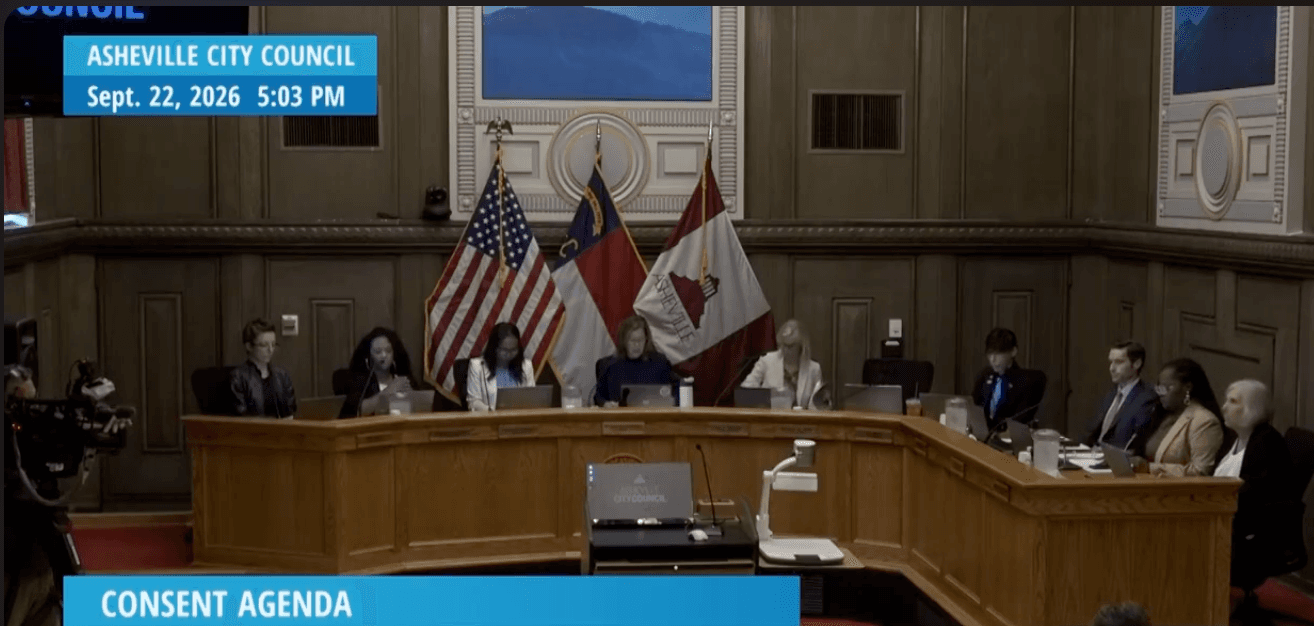
Asheville Reworks $4.7M Homelessness Plan as Council Member Questions Nonprofits
City Council • AshevilleSeptember 22, 2026
Locunity is an independent informational service and is not an official government page for this commission. All information is sourced from public footage and an analysis of official agendas with the aid of responsible, fact-checked AI. to report an error or omission.
Asheville is retooling a one-time $4.7 million federal housing allocation to deliver rapid rental help for people pushed into homelessness after Tropical Storm Helene. At a Sept. 22, 2026, public hearing, one council member bluntly challenged how much of that money will reach people versus nonprofit payrolls. Days before Helene’s second anniversary, residents also pressed the city on a crumbling East Asheville cliff, urban bears and what they called unanswered calls and emails.
- HOME-ARP plan amendment would add short-term rent aid and prioritize people newly homeless after Helene.
- A council member rejects “another $60,000 case manager,” and demands a spending breakdown before any vote.
- East Asheville seniors face $3.5M–$7.8M in repairs for a cliff shedding rocks onto Azalea Road.
- Three speakers push bear conflict zones and tougher trash rules as a BBC crew films.
- Helene recovery video tallies 55 infrastructure projects and about $40M for housing.
1 Big Thing: A $4.7M Pivot to Rapid Rehousing
The basics: HOME-ARP is a one-time federal American Rescue Plan housing program administered through HUD. Asheville leads the four-county Asheville Regional Housing Consortium, which includes Madison, Buncombe, Henderson and Transylvania counties.
“Back in 2021, we received a one-time $4.7 million allocation through the HOME-ARP program, and those funds must be fully invested by August 2030,” said Jane Shelton, city Community Development staff.
Where things stand: The original plan put a little over $3 million toward affordable rental housing, $1 million toward supportive services such as mental health and substance abuse care, and about $700,000 toward administration and planning. It set no preference among qualifying populations and did not use coordinated entry.
The amendment would:
- Add short- to medium-term rental assistance and case management under a rapid rehousing model.
- Prefer households experiencing homelessness, especially those homeless for the first time after Helene.
- Route referrals through the Asheville-Buncombe and Balance of State coordinated entry systems.
Coordinated entry is a shared referral system. Shelton said it exists “so that folks who are experiencing homelessness don’t have to seek out services at 20 different locations.” Sarah Newberry, Grants Director, Homeward Bound, added that many nonprofits participate, including Helpmate, Safe Shelter and Eliyada.
Mayor Esther Manheimer warned that “short-term rental” could be confused with vacation rentals, asking for “something that makes sure that we’re not subsidizing short-term rentals.” Staff agreed to clarify the wording.
The other side: One council member delivered the sharpest critique of the night.
“I’m getting a little skeptical of all this money that we’re giving out to nonprofits,” said a council member. “I don’t want another $60,000 case manager.”
She asked how much of the $1 million would buy concrete help, such as deposits, AC units, application fees and food cards. She also objected to being asked to weigh in without that breakdown, relaying constituent complaints that “the problem’s getting worse, but yet we keep throwing all this money at these folks.”
Shelton replied that the administration line reimburses city staff time. “It makes it a budget-neutral program to the city,” she said. The services breakdown won’t exist until partner agencies apply. Council was promised a follow-up with the breakdown of the $1 million.
The council member who chairs the HOME Consortium said the recently homeless focus came from consortium discussion. It reflects the higher time and cost of resolving chronic homelessness, she said. “So there’s a more formal process ahead.”
Decisions and stakeholder impacts: The hearing was for input only, and no vote was taken. People newly homeless after Helene stand to gain priority. Nonprofits in coordinated entry would likely handle referrals, but they now face open council scrutiny over staffing costs. “Any contracts for awarding this to any agency will come before this council,” Shelton said.
What’s next: Written comments are open through Oct. 2. Partner contracts will return to council.
Azalea Road Cliff: Seniors Say City Won’t Help
Why it matters: The 42-home Viewpoint 55+ community could face repair assessments of $50,000 to nearly $100,000 per homeowner. The threatened road carries about 195,000 Wildlife Center visitors a year and serves a soccer complex.
Where things stand: Ann Sensabaugh, immediate past HOA chair, Viewpoint subdivision, spoke with 10 minutes of yielded time. She said residents have spent more than $200,000 on geotechnical and environmental engineers.
“At this time, the bids to fix our cliff erosion and landslides range from $3.5 to $7.8 million,” Sensabaugh said.
Residents asked the city to help only with the cliff above Azalea Road, where rocks and trees keep falling and have crushed guardrails. “In fact, the city response was, well, if anything fails, we’ll help you clean it up,” she said. She suggested city pile driving, and possibly blasting, in 2012–2014 may have contributed to the damage. She also noted there are no caution signs in the area.
“We have written you. We’ve asked you for help. We have been rebuffed at every turn,” Sensabaugh said.
The other side: The damage sits on HOA common area, not city property. “But this one also abuts the public right-of-way, so it’s a more complex situation,” said Mayor Manheimer.
What’s next: “I feel like we need to have a follow-up meeting about this, but we can’t hash it out tonight,” Manheimer said. A council member offered to raise signage at the next public safety meeting. Another forwarded Sensabaugh’s email from last year to the city manager.
Bear Advocates Push Conflict Zones
Why it matters: Speakers cited a state wildlife official who said one-third of North Carolina’s human-bear conflicts occur in Asheville and Buncombe County. Meanwhile, filmmakers from the BBC’s Natural History Unit are documenting the city’s response.
Where things stand: Three residents made a coordinated case:
- Liz Thompson, a Beaver Dam Valley resident, asked for dedicated tax money for bear education. She called the $50 unsecured-waste fine ineffective and pointed to Boulder and Colorado Springs as models.
- Janice Reardon, a North Asheville resident, described Dolly, a mother bear whose cubs were trapped and who faces placement at the North Carolina Zoo. She left a one-page proposal for human-bear conflict zones requiring bear-resistant trash cans and commercial dumpsters.
- Hannah Purcell, who led the campaign to save Dolly, framed coexistence as a safety issue for families. She urged systemic and infrastructure changes in partnership with the Wildlife Commission.
What’s next: Council did not respond substantively. The proposal would affect residents, haulers and commercial dumpster owners if taken up.
Helene, Two Years On: Recovery by the Numbers
City Manager DK Wesley replaced the quarterly update with a video marking Helene, which struck Sept. 27, 2024. She said staff decided to make the video only days earlier.
Where things stand: “55 infrastructure projects, including everything from parks to roadways and water lines, are in progress as we repair and rebuild,” the city’s video reported. It also cited:
- Full restoration of the North Fork spillway fuse gate this September.
- Removal of more than 6,500 tons of debris from the watershed.
- Planned treatment plant upgrades to eliminate super turbid water, plus a new alternate transmission main.
- More than $2M in federal disaster recovery dollars for a community hub network.
- $15.5M for small businesses, with relief already reaching 70 businesses.
- Nearly $18M for three multifamily developments serving more than 330 families.
- More than $22M for single-family home repair serving more than 50 families.
Other Voices at the Mic
Costco tree fee: Sharon Summerall, representative, Coalition of Asheville Neighborhoods, said the revised Costco project skips Technical Review Committee review and waives the tree canopy fee-in-lieu. She said that has never happened before. “That sets a precedent for something like a data center wanting to come in,” she said.
Flock cameras: Bobby Skelton, a public commenter, said 11 stationary Flock cameras are still recording. “You said you canceled the contract. Which one is it? Pick a side,” he said.
Living wage: Gino Perez, a public commenter, said, “Today, ART’s contractor starts drivers at $25 an hour. The city’s pledge for full-time workers is $20. $24.10 is the local living wage.”
Weaver Park: Sally Grau of Bring Back Weaver read parent survey comments calling the rebuilt playground small and unsafe. She asked for a redo.
Mold and social media: Eric Inskip, a disabled veteran, said grandfathered rental designs leave tenants with no code remedy for mold. Jake Feldman urged the city to link its Instagram to the city website and to allow comments consistently on YouTube.
Minor Items
- Consent agenda passed (For: 6, Against: 0, Absent: 1, Councilmember Maggie Ullman, at Climate Week in New York City).
- $403,000 CDBG grant will replace lead and galvanized service lines at single-family homes.
- $189,839 in federal transit planning funds accepted for FY2027; the city will also apply for an NCDOT transit apprenticeship grant.
- Other consent items included a three-year cleaning contract for eight facilities, a Buncombe County General Assistance agreement and Nature Center ticketing renewal.
- Closed session on a real property acquisition and a claim approved (For: 6, Against: 0, Absent: 1).
Looking ahead: HOME-ARP written comments close Oct. 2. The Lovely Asheville Annual Fall Festival, approved for beer and wine, runs Oct. 10–11, 2026.