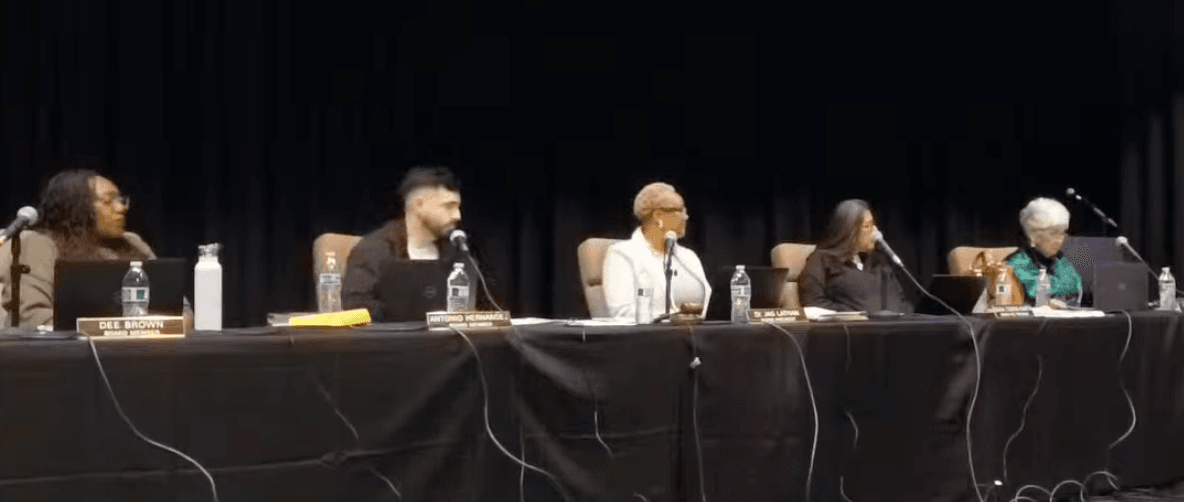
Governing Board - Mar 11, 2026 - Meeting
Governing Board • Antioch Unified School DistrictMarch 11, 2026
Locunity is a independent informational service and is not an official government page for this commission.We use AI-assisted analysis and human editorial review to publish information.
Board Acknowledges $32M Deficit, Self-Certifies Budget as Qualified
The Antioch Unified School District Governing Board confronted the full scale of its fiscal crisis March 11, voting unanimously to downgrade its own budget certification from positive to qualified — a rare admission that the district cannot prove it can meet its financial obligations without $32 million in cuts it has not yet identified. The marathon session, which stretched past midnight, also revealed that special education now consumes nearly half the district's funding and that federal civil rights monitors have flagged the district for disproportionately identifying African American students for disability services.
Board self-certifies budget as "qualified," acknowledging $32 million structural deficit that could trigger state receivership
Special education costs balloon to $97 million — nearly half of all LCFF revenue — as district enters federal disproportionality status
Fiscal advisor warns district actually needs $36 million in "hard cuts" to stabilize; cites nearby Plumas Unified's loss of local control as cautionary tale
Staff, parents and union deliver emotional testimony opposing elimination of behavior specialists, reading teachers and counselors
In-house van driver program saves $720,000 by replacing outsourced special education transportation
$32 Million and Counting: The Budget Reckoning
The basics: California school districts must file second interim budget reports certifying whether they can meet financial obligations for the current and two subsequent fiscal years. A "positive" certification means the district is solvent; "qualified" means it may not be able to meet its obligations without significant changes. A "negative" certification can trigger direct state intervention.
Why it matters: Without identifying $32 million in ongoing reductions by May, Antioch Unified risks county oversight escalation and, ultimately, state receivership — a scenario that could strip local control for 20 years or more.
The district's fiscal position has deteriorated rapidly since 2022-23, when one-time COVID and learning recovery funds temporarily boosted the general fund balance to $42 million. That cushion is projected to shrink to $10.8 million as federal relief expires while costs have continued to climb: negotiated salary increases of 2.3%, full medical and dental benefits, special education expenditures consuming 27% of the general fund ($89 million against only $26 million in state and federal reimbursement), and rising utility and insurance costs.
Where things stand: The budget as presented technically shows a positive certification — but only because it assumes the $32 million in reductions will happen. Superintendent Dr. Williams made the math explicit: "This budget assumes the $32 million reduction, so that is why it's reading positive. Without the $32 million, we will not have a positive certification".
FCMAT fiscal advisor Mr. Shimwell, who the county assigned to monitor the district's finances, pushed the board further. He told trustees the real target is even higher: "For the 32 million that you're looking to look at as far as reductions, you need something like 36 million to make sure that those are hard cuts and they actually stick." He recommended the board certify as qualified rather than positive, warning the county would likely downgrade the certification anyway.
Mr. Shimwell did not mince words about the stakes. He told the board he had personally overseen the state takeover of Plumas Unified School District — "the last school district in the state of California that went into a form of state receivership" — which faced a $10 million deficit on a $20 million budget. He also noted the scale of the COVID windfall that masked Antioch's structural problems: "The amount of money that you received through COVID is probably equal to 50% of your budget."
The other side: Trustee Antonio Hernandez pressed on whether one-time revenue from property sales could help close the gap — and answered his own question. "My understanding is that that's not really addressing our structural deficit at that point. It's essentially kicking that can down the road," he said. Walking through budget line items publicly, Hernandez noted that even eliminating all professional services and operating contracts would yield roughly $16 million — only half the target. He acknowledged the painful reality: "What actually makes an impact on students is the teachers we have, intervention detention people, bilingual aides, these kinds of things."
Board President Jag Lathan captured the board's emotional bind: "I can't vote for the cuts. But at the same time I understand that we're under the law that we have to do it, but if we could at least talk about what could we do to reduce it, maybe we can accept some of those decisions."
Student Trustee Gianni pressed staff on whether spending priorities could be reordered, questioning whether a million-dollar portable project at his own school should be redirected to staffing for disabled students. "A million dollars right now really could do a lot. Maybe we could look at some of these contracts for things that we don't really, really need right now — that could cover teams of people to work with disabled students."
Decisions: The board voted 5-0 to accept the second interim report with a modification from positive to qualified certification (motion by Trustee Hernandez, second by Trustee Dee Brown). The vote came after more than an hour of deliberation.
What's next: Superintendent Dr. Williams said the district's first approach will be to eliminate vacant positions, then transition affected staff into those vacancies where possible. Final budget reduction recommendations are due to the board by May 14, 2026. A newly established Budget Collaborative Committee will present its first draft of recommendations the following day.
One in Five: Special Education Costs Hit $97 Million Under Federal Watch
The basics: "Significant disproportionality," or SIGDIS, is a federal designation under the Individuals with Disabilities Education Act (IDEA) triggered when a district identifies, disciplines, or places students of a particular racial group in special education at rates significantly higher than their peers. It requires the district to reserve 15% of IDEA funds for intervention and accept a state-assigned facilitator.
Why it matters: Federal SIGDIS status adds compliance demands and earmarked spending requirements on top of a fiscal crisis that already requires $32 million in cuts — and it signals that the district's approach to serving students with disabilities is not just expensive but structurally inequitable.
Senior Director of Special Education Kelly Quinn laid out the numbers: the district now serves 2,934 students with disabilities — 19.3% of enrollment — with another 177 assessments pending. "We are at 19.3, close to 20% students with disabilities. The target for most districts across the state and actually across the United States is right around 12%," she told the board. The cost has grown from $72 million to a projected $97 million in three years. "District wide, we're only getting $217 million. $98 million, close to $100 million, are special education funds," Director Quinn said, underscoring that special education now consumes nearly half of all LCFF revenue — with state and federal sources covering only about 26% of the tab.
Key cost drivers include 142 students placed in non-public schools at over $18 million, 213 paraprofessionals costing $11 million, contracted related services at $4.7 million, and private transportation at $870,000 for just 15 students. The district also carries unique obligations: it has the highest foster youth population in the Contra Costa County SELPA, with seven 24-hour care homes located in Antioch, drawing additional service demands.
Director Quinn disclosed that after five years of intensive monitoring, the district has now officially entered significant disproportionality status for over-identifying African American students — particularly for emotional disability — along with disproportionate suspension rates and chronic absenteeism among African American students with disabilities.
The restructuring plan focuses on implementing pre-referral processes to reduce over-identification, requiring IEP meetings after every suspension of African American students, building relationships through "2-by-10" rapport sessions, and improving exit practices for students who are ready to leave special education. Superintendent Dr. Williams framed the effort carefully: "It's not in all purpose to eliminate the services. We want to strengthen the services. Because the way that we're structured right now, apparently as evidenced by the data, there's opportunity for us to do something differently."
What's next: Board members discussed holding a dedicated special education budget study session in April. The superintendent asked for time for staff to develop deliberate, compassionate restructuring plans before presenting specifics.
"Who Will De-Escalate These Kids?": Staff and Union Push Back on Cuts
Why it matters: The public comment period put a human face on the $32 million reduction target, with frontline staff warning that eliminating behavior support teams, reading teachers, counselors and paraprofessionals would strip the district's most vulnerable students of the services they depend on daily.
A behavior support specialist described a typical day: spending more than four hours with four colleagues de-escalating students at a single school site. She also shared the story of an autistic student who was terrified to enter school — and how her team spent months building trust through daily, incremental steps until the student could walk in independently. That kind of progress, she warned, would be impossible without dedicated behavior staff.
The Antioch Education Association representative challenged the board directly on the distribution of pain, noting that proposed reductions included $20 million in certificated positions and $18 million in classified positions. A public commenter who identified as a teacher called out what she described as a fundamental contradiction: the district's stated goals on special education, academic achievement and school safety are undermined by the proposed elimination of counselors, behaviorists, psychologists, social workers and vice principals. She argued that the legal minimum for staffing is not the same as meeting student needs, and urged the board to be transparent about the burnout that remaining staff would face.
Jeremy Martin, a Spanish teacher, took a different tack — thanking the board for interpretation services and suggesting that bilingual staffing and welcome centers could improve average daily attendance and enrollment revenue, potentially offsetting some cuts.
Minor Items
Recognition: The board honored a Lone Tree community volunteer with a certificate of appreciation.
Transportation service plan: Director of Transportation Mr. Nate presented the annual plan, highlighting that a new van driver program has saved the district $720,000 this year by replacing outsourced special education transportation contracts averaging $3,000/month per student with leased vans at $1,300/month. The district employs 38 school bus drivers and 5 van drivers transporting roughly 500 students, and still needs approximately five more bus drivers and 12 van drivers. State reimbursement at 60% of home-to-school transportation returned approximately $14 million for 2025-26.
Meeting extension: The board voted 5-0 to extend the meeting from 10 p.m. to 1 a.m. on March 12, 2026.
Postponement: The mid-year student attendance and suspension update was postponed to a future meeting due to the late hour.