
Antioch Council Punts Turf Shutoffs Five Weeks Before State Deadline
City Council • AntiochNovember 24, 2026
Locunity is an independent informational service and is not an official government page for this commission. All information is sourced from public footage and an analysis of official agendas with the aid of responsible, fact-checked AI. to report an error or omission.
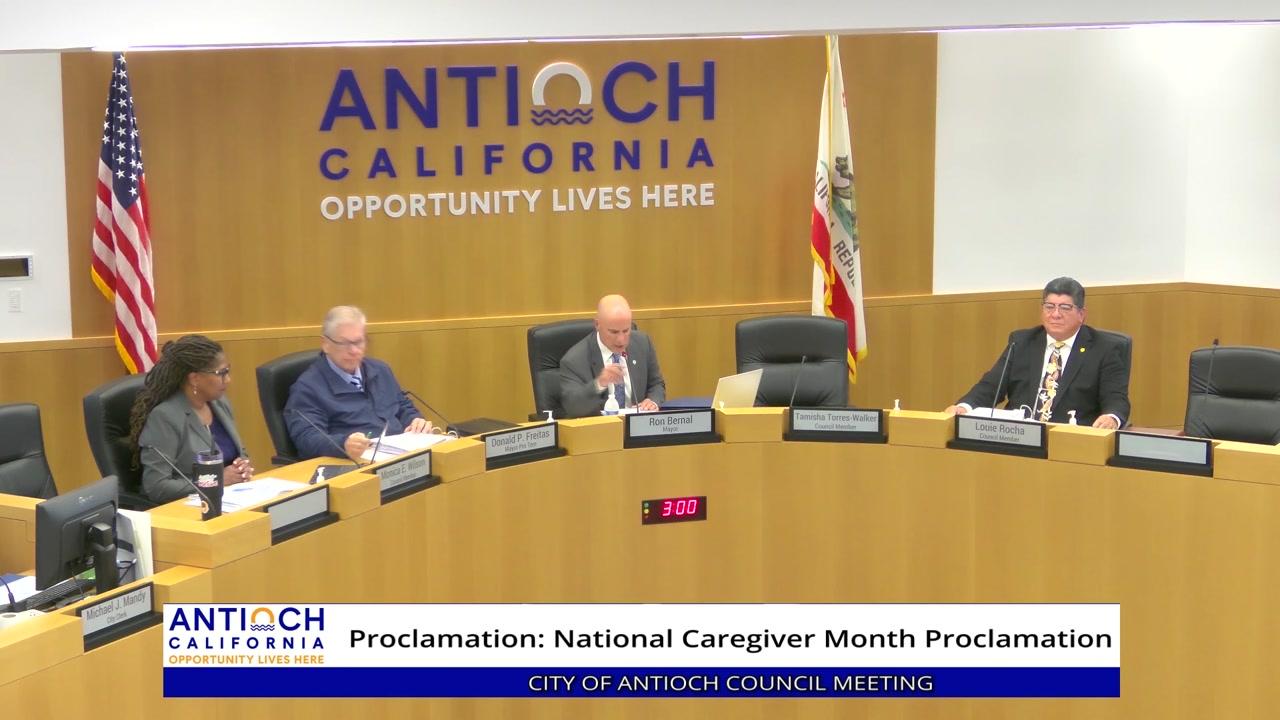
With a Jan. 1, 2027, state ban on watering decorative city turf five weeks away, the Antioch City Council on Nov. 24, 2026, declined to turn off the sprinklers. Instead, it ordered staff to return Dec. 8 with consultant costs, site maps and a request to the state for more time. The council also funded a 20-bed warming center for up to $187,216, named an interim city manager and pressed staff on a roughly $24,800 ad, while the mayor warned of a structural deficit.
- No shutoff, no formal vote on AB 1572 turf compliance. Staff will return Dec. 8 and seek a state extension.
- Up to $187,216 approved, 4-0, for an on-demand, 20-bed warming center at Opportunity Village.
- Cold-weather emergency accepted, 4-0, with reviews every 60 days.
- Ad spending scrutinized: Mayor Pro Tem Donald Freitas questioned a roughly $24,800 ad and city property-tax payments.
- Gabriel A. Gonzalez named interim city manager, 4-0, effective Nov. 30.
- Violence-intervention evaluation: 23 fellows enrolled and concerns about reaching the highest-risk participants.
Turf Deadline Looms, Council Chooses Study
The basics: AB 1572 is a state law that bars irrigating non-functional turf with potable water. Non-functional turf is decorative grass, not grass used for play or recreation. For city property outside state-designated disadvantaged communities, the deadline is 2027. Sites inside those communities have until 2031.
Why it matters: The city has mapped about 461,771 square feet of turf. There is no costed plan for the first deadline, and the city is facing a budget deficit.
Where things stand: Environmental Services Coordinator Cena Shennis laid out the rules:
- Sites irrigated with recycled water are exempt.
- Trees are exempt.
- Whether turf counts as "functional" is assessed area by area.
Staff's options included sprinkler shutoffs, weed abatement, landscape conversion, bioswales and Prop 4 state grants for stormwater projects. The minimum cost estimate was $50,000.
Shennis explained the late start by noting "the Environmental Resources Division was unstaffed for 6 months." She also cautioned that "grants are competitive and not guaranteed." Staff confirmed that simply shutting off the water would meet compliance.
The other side: Council members rejected that route. "So I'm not interested in shutting the water off," said Mayor Pro Tem Donald Freitas. He objected to the late timing and urged two alternatives:
- Using raw water from the Contra Costa Water District canal.
- Using Delta Diablo recycled water.
Freitas also asked staff to "bring the issue to the council with regards to looking at and doing a Proposition 218 vote with regards to the NPDES program stormwater management fee." That process would ask property owners to approve a fee tied to federal stormwater permit requirements.
Councilmember Louie Rocha noted that irrigation is largely off in winter anyway. He opposed spending on consultants now and asked for options that use existing resources.
Mayor Ron Bernal disputed some of the functional-turf designations and floated a January study session. "I think that's the first thing we do tomorrow is apply for an extension while we're doing this," said Bernal.
Freitas acknowledged that a wet-season shutoff would satisfy the state. He paired that with a push for firm timelines. "We can be in compliance if we do that, but also be realistic and say by the end of March we need to have something very definitive," said Freitas.
Public comment: Public commenter Andrew Becker faulted the city for acting late on a deadline known for years. He also raised concerns about funding and assessment districts. "It's incredibly concerning that us as community members, pay our taxes, and we expect results from our city," said Becker. A second commenter, John, sharply criticized the Public Works director and said the staff report buried the affected sites.
Decisions and stakeholder impacts: The council took no formal action. Its direction keeps parks and medians green for now but leaves compliance unresolved. Possible costs fall on the general fund, or on property owners if a Prop 218 fee vote advances. Disadvantaged neighborhoods have until 2031.
What's next: Staff will return Dec. 8 with:
- A list of consultants and their costs.
- GIS maps of the sites outside disadvantaged communities.
- Practices used by peer cities.
- A request to the state for an extension.
A January study session remains possible.
Warming Center Funded as Cold Arrives
Why it matters: Unhoused residents now have an on-demand shelter on cold or rainy nights. Owner costs, liability and the site lease remain unsettled.
Where things stand: On Nov. 20, the council authorized about four weeks of sheltering at the Antioch Water Park, with up to $50,000 from reserves. That action did not include a contract with the Housing Consortium of the East Bay (HCEB).
Darin Lounds, Executive Director of the Housing Consortium of the East Bay, described the new plan:
- Leased modular units with bathrooms and a space for pets.
- Capacity "for up to 20 folks each night."
- Staffing by existing Opportunity Village overnight workers.
- Generator backup.
- Activation at "an overnight low of 40 degrees or lower or rain."
Several costs drew questions:
- Owner compensation: It is being negotiated separately.
- Liability: Lounds said "we're going to be adding the additional scope to that insurance coverage."
- Electrical connection: Staff confirmed the $20,000 hookup falls within the $187,216.
The other side: "I'm not comfortable approving this without knowing what the total cost is going to be," said Bernal. Freitas answered by moving a not-to-exceed amount.
Becker urged the council to keep the property owner involved. He noted the lease expires in April. "A very large part of the conversation needs to be, what does that next lease extension or opportunity look like?" said Becker. He also requested a presentation on the program.
Decisions and stakeholder impacts: Funding of up to $187,216 passed (For: 4 — Bernal, Freitas, Wilson, Rocha; Against: 0; Absent: 1 — Torres-Walker). Freitas moved and Councilmember Monica Wilson seconded. The mayor noted a voting-button mix-up before the result was announced.
The emergency declaration also passed (For: 4, Against: 0, Absent: 1). Rocha moved and Wilson seconded. It extends the city's emergency footing beyond the original four weeks, with reviews every 60 days.
Earlier, public commenter Frank Sterling thanked the people who helped unhoused residents during the prior week's rain. He described a friend whose tent collapsed.
What's next: The water park site opened that night with about 10 people. "We did activate our warming center tonight. It was the first time opening," said Acting City Manager Ana Cortez. Rocha said the effort "just showed how quickly the staff came together."
Ad Spending Draws Fire Amid Deficit
Why it matters: Discretionary spending is under a sharper lens. Bernal said fiscal year 2026 closed with a surplus. "We still are looking at a budget deficit for this fiscal year of $7.7 million," said Bernal. He projected an $11.1M deficit next year.
Bernal attributed the surplus to two one-time factors:
- About 60 vacant positions.
- Nearly $9M in contracts that were not awarded and now roll into the current year.
Where things stand: The council pulled items 17.12, 17.22 and 17.23. It approved the rest of the consent calendar 4-0, on a motion by Wilson seconded by Rocha.
On warrants (item 17.12), Freitas questioned a San Francisco Business Times ad. It cost about $24,800 across two invoices, one dated December 2025. "I cannot for the life of me understand why we would pay $24,800 for this ad," said Freitas. He added: "I just need to understand why, as a public agency, we're paying property taxes."
Freitas also asked about evidence storage, an ARPA payment and historic documents. Staff promised written responses and said no documents were destroyed.
Public comment: Becker criticized the ad, an invoice delay and purchases of ergonomic chairs. Public commenter Melissa said the ad's website had broken links and still listed Kwame Reed as the contact. She asked how results are measured. Becker also asked the council to bring back an AB 1033 opt-in ordinance allowing the sale of accessory dwelling units (ADUs). "AB 1033 literally says that it is an opt-in law," said Becker.
Decisions and stakeholder impacts: Warrants passed 4-0, on a motion by Freitas seconded by Wilson.
Item 17.22, a design amendment with Mark Thomas and Company for full trash capture devices, also passed 4-0. Wilson questioned its growth from $15,000 to about $465,493. Staff said it was the first task order under an on-call agreement.
What's next: Item 17.23 will return with more information. Bernal suggested taking up mid-year budget amendments at the next budget study session.
Violence Intervention Moves In-House
Where things stand: Caroline Glessman, Senior Researcher at Evident Change, reviewed the city's CalVIP IV "Uplifting Peace" grant. It ran from July 2022 to March 2026 with Advance Peace and One Day at a Time.
The program reported:
- 23 fellows enrolled.
- 478 outreach activities.
- 30 conflict responses.
- Self-reported improvements among fellows.
- Mixed trust between police and the community.
During the grant, "there were a total of 116 non-fatal shootings and 33 fatal shootings in Antioch," said Glessman. Shootings rose from 2023 to 2024, then fell from 2024 to 2025.
The other side: The evaluation flagged several challenges:
- Startup roles and staff turnover.
- Service gaps.
- Concerns about reaching the people most directly involved in violence.
It recommended changes to recruitment, data collection, transparency and coordination with police.
What's next: The successor program, Strength Beyond Violence, is funded from April 2026 through March 2029, with quarterly reports to the state. "We made the intentional decision to bring violence intervention services in-house via our violence interrupters who are here," said Alicia Espinoza, Community Engagement Manager.
Wilson credited the absent Torres-Walker with originating the program. "I wish Councilmember Torres-Walker was here because this was really her baby, her child," said Wilson.
New Manager, In-House Plant Tech
Interim city manager: Gabriel A. Gonzalez brings 28 years of municipal experience. He will serve as a CalPERS retired annuitant until a permanent manager is appointed or his service limits are reached. His appointment passed 4-0, on a motion by Rocha seconded by Wilson. Bernal thanked Cortez for about eight months as acting manager.
SCADA technician: The council also created a water treatment SCADA technician classification in the Treatment Plant Employees Association. SCADA is the system that automates the water treatment plant. The vote was 4-0, on a motion by Freitas seconded by Wilson.
The new role replaces one budgeted instrument technician position. "The city currently relies on an outside contractor for SCADA support at an annual cost of approximately $150,000," said Cortez. Staff said that contract will no longer be needed. Freitas asked that future staffing items include organizational charts.
Minor Items
- Proclamations: Five were approved 4-0, honoring:
- Caregiver One Call.
- Cottage Florist's 80th year.
- Lung Cancer Awareness Month.
- Veteran of the Year Gary Ballreich.
- Lifetime Veteran of the Year George Jones, who asked the city to address speeding on his street.
- Closed session: No action was reported from labor negotiations with three employee groups.
- Landfill-adjacent housing: Becker asked for an update on cleanup near about 500 proposed homes by the old landfill. He also asked about Somersville Mall's January vacancy.
- Downtown events: Debbie Blaisure, President of the Downtown Antioch Association, promoted three events:
- Small Business Saturday, Nov. 28.
- A G Street holiday block party, Dec. 5.
- An association meeting, Dec. 15.
Looking Ahead
Applications for three city boards are due Dec. 11. Turf compliance cost data and the extension request return to the council Dec. 8.