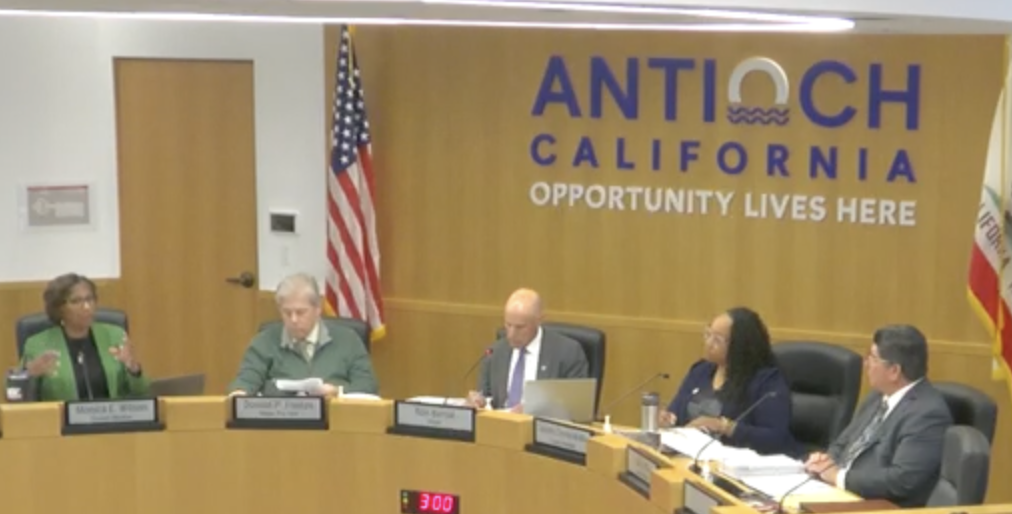
City Council - May 26, 2026 - Meeting
City Council • AntiochMay 26, 2026
Locunity is a independent informational service and is not an official government page for this commission.We use AI-assisted analysis and human editorial review to publish information.
Antioch Closes $10.5M Budget Gap, but a $16M Cliff Awaits Next Year as Downtown Town Square Fight Heats Up
Antioch's City Council worked through a marathon session that revealed how thinly the city is stretched — $10.5 million in budget cuts got the books near breakeven for next year, but a looming $16 million deficit in FY28 means the reprieve is temporary without new revenue. Meanwhile, downtown residents packed the chambers to demand the city seize an $8 million state grant for a town square on a lot that's been vacant for 30 years.
$10.5M in budget cuts narrow Antioch's FY 2026-27 deficit to roughly $1.6M, but council members warn a $16M gap looms next year without new revenue
Police staffing revised to 105 sworn officers from 117, with 12 unfunded trainee positions removed; department currently at 85 with a grueling 18-month hiring pipeline
Council approves $3.1M in housing and homelessness funds, routing $750K to the governor-awarded Home Key Plus project
Residents rally to restore the Beedy Lumberyard as a downtown town square, citing an $8M state park grant; staff will return with state grant analysis at the next meeting
Citywide fee increases add an estimated $1.8M in revenue across police, planning, building, water, and marina services
EPA honors Antioch's desalination plant with the national Aquarius Award
Department rebranded: Public Safety and Community Resources becomes Community Services Department
Budget Survival: $10.5M Cut, $16M More to Go
Antioch's finance team delivered a sobering but methodical update on the FY 2026-27 budget, presenting $10.485 million in adjustments that narrow the remaining deficit to approximately $1.6 million — expected to shrink further to roughly $643,000 with additional reductions still in progress.
Why it matters: Two-thirds of Antioch's general fund flows to public safety. With sales tax revenue stagnant at roughly $20 million and no economic development director on staff, the city's revenue engine is idling while expenses climb. A projected $16 million deficit in FY 2027-28 could force the kind of deep service cuts that reshape what a city government can actually do.
Where things stand: The cuts include removing 12 unfunded police trainee positions ($631,000), reducing the Home Key Plus allocation from $1.2 million to $400,000, trimming APOC training from $75,000 to $50,000, freezing recreation and HR positions for $120,000 in salary savings, and eliminating homeless services expenditures already covered by CDBG. Revenue from the newly adopted master fee schedule adds approximately $1.8 million, and the city will draw $5 million from its budget stabilization fund.
"We've made $10,485,141 in budget adjustments in the budget presented this evening," said Finance Director Dawn Merchant. "As stated, we'll be doing some further tightening."
Mayor Pro Tem Donald Freitas drove the sharpest point of the evening, arguing that cost-cutting alone cannot save the city. He noted that roughly two-thirds of the general fund — approximately $63 million — goes to police and animal services, leaving little room for further reductions without gutting core operations.
"City of Antioch has not had an economic development plan for years," Freitas said. "The takeaway for me is that, yes, we may be at zero, maybe within two or three million dollars. We still have things to work out, but I think we need to absolutely prioritize economic development."
He pointed to stagnant annual sales tax revenue of roughly $20 million and urged the city to hire an economic development director and fund partnerships with groups like the Chamber of Commerce and Downtown Antioch Association.
Councilmember Monica Wilson pressed staff on which frozen positions pose the greatest operational risk, asking for a full assessment.
"Which of the frozen positions create the highest operational risk if we extend them beyond fiscal year 27?" she asked. "If council has an idea of what positions need to come back, we can proactively be thinking how we're going to make adjustments."
Mayor Ron Bernal acknowledged the scale of the work while defending the balance between public safety and other services:
"All other services get one third of the money and the police department gets two thirds of the money." He added: "Taking another $10.5 million is a lot. Then another million dollars, we're at 11.5 million plus the 1.8 in revenue. So there's been some significant work done."
What's next: A final draft budget returns to council June 9, with adoption scheduled for June 23.
Hiring Pipeline: Why 105 Officers Is Ambitious and 117 Is Out of Reach
The police staffing discussion, nested within the budget study session, offered a bracing look at why reaching even 105 officers is a long game.
The basics: Antioch's police department has grown from roughly 50 officers in summer 2024 to 85 currently. The FY27 target is 105 sworn positions — well below the 117-officer aspirational goal, which was shelved because no academy slots are available to absorb 12 additional trainees.
Where things stand: Police Chief Joe Vigil detailed a pipeline that takes approximately 18 months from application to independent patrol. The background check alone runs three months. Ten trainees are currently in academy; eight more slots are reserved for summer sessions, but only eight candidates are in the pool. The department has partnered with academies in Alameda County, Contra Costa County, Sacramento, and Riverside for additional capacity.
The attrition math is sobering. Mayor Ron Bernal pressed the point:
"When you're saying we're trying to get to 105 officers, that would mean that you'd almost have to put 40 through the academy to end up with 20 new officers. Correct?"
The chief confirmed the roughly 50% washout rate through the academy and field training pipeline.
What's next: The 12 deferred positions cannot begin until FY28 at the earliest, contingent on academy availability and recruiting success.
Residents Push for Downtown Town Square at Beedy Lumberyard
The most emotionally charged segment of the evening came during the five-year Capital Improvement Program study session, where six long-time downtown residents rallied for the Beatty Lumberyard — a lot on A Street that's been vacant for 30 years — to be restored to the CIP as a community town square and event space. The speakers cited more than 30 years of community advocacy, previous council commitments, and a currently available $8 million California Statewide Park Development and Community Revitalization Grant.
Why it matters: Downtown Antioch has lacked a central public gathering space for decades. Proponents argue the site — sometimes called "The Yard" — could catalyze economic revitalization, support local businesses, and connect the riverfront to the commercial core. But the city is simultaneously sitting on roughly $15 million in unfunded CIP needs, including deteriorating building roofs and playground equipment.
Where things stand: A California Statewide Park Development and Community Revitalization grant could provide up to $8 million for the project, but the application requires a site designation soon.
Joy Motz cited a 2021 council vote designating the site as green space and described the A Street extension views of the San Joaquin River. Rich Statlander compared the potential to Concord's Todos Santos Plaza and criticized a lack of vision for downtown. Kim Statlander framed the case in public health terms, arguing green space benefits outweigh housing on that parcel.
The other side: Andrew Becker, a public commenter, pushed back firmly, arguing that prioritizing a new park over fixing existing unfunded liabilities — including missing bolts on playground slides at Williamson Ranch Park — would be irresponsible given the city's fiscal constraints. Leslie May suggested a boutique hotel instead.
Councilmember Tamisha Torres-Walker asked Parks Director Shahad Wright to return with information on the grant and the community engagement history. Mayor Ron Bernal and Councilmember Louie Rocha expressed openness to reviewing grant funding but emphasized they were not party to prior council commitments.
What's next: Director Wright indicated he would bring a full presentation on the state park grant at the next council meeting, comparing existing park improvements against new park development options.
Council Approves $3.1M Housing Plan, Redirects $750K for Home Key
The council unanimously approved the FY 2026-27 action plan covering $3.1 million in Community Development Block Grant, Permanent Local Housing Allocation, and housing successor funds. A substantial amendment reallocates $200,000 from the failed Hope Solutions project to housing rehabilitation and redirects $750,000 in housing successor funds to cover the Home Key Plus property acquisition — sparing the general fund.
Why it matters: Using housing successor funds instead of general fund dollars for the Home Key Plus acquisition saves $750,000 from Antioch's already strained budget while advancing permanent supportive housing. Current-year programs served 5,092 individuals at 117% of annual goals, with homelessness services reaching 2,713 people.
Where things stand: Housing Manager Lisa Villalta reported that current CDBG-funded programs served 5,092 individuals through the third quarter of FY26, reaching 117% of annual goals. A substantial amendment adds $200,000 for housing rehabilitation to replace a lost Department of Energy grant.
Matthew Hulse of Contra Costa Senior Legal Services spoke in favor, noting 17,000 seniors live in Antioch with approximately 2,000 at very low income levels and warning of shrinking budgets amid growing need.
The other side: Andrew Becker raised process transparency concerns, opposed the $750,000 transfer, and argued that the developer had not been notified and questioning whether the funds would be structured as a loan or grant. The CDBG consultant clarified that housing successor funds can be either, and that the most expeditious path avoids CDBG's federal environmental review requirements.
Councilmember Tamisha Torres-Walker pressed for answers on developer engagement.
"Why will we vote to give somebody some money that they don't even know they're receiving and don't even know if they can use it on the project?" she asked.
The CDBG consultant clarified that housing successor funds can be structured as either a loan or grant, with the city attorney's office drafting the appropriate agreement. Torres-Walker announced plans to meet independently with the developer to clarify the situation.
Mayor Pro Tem Donald Freitas framed the vote practically: voting no would effectively kill the Home Key project. Separately, Torres-Walker announced during council communications that the governor has confirmed the Home Key Plus award for Antioch. She noted that much of the institutional knowledge about the project left with the former city manager and said she plans to meet with the developer independently to clarify next steps.
Decisions: The council approved all three items — the substantial amendment, the FY 2026-27 action plan, and the housing successor fund allocation — on a 5-0 vote (For: Bernal, Freitas, Rocha, Wilson, Torres-Walker).
$40M in Roadway Projects Lead Five-Year CIP, but $15M Remains Unfunded
Public Works Director Scott Bunting presented the draft five-year Capital Improvement Program for 2026-2031, anchored by $40 million in roadway improvements — including L Street phases, pavement resurfacing, and pedestrian access projects — and $21 million in water system investments covering water main replacements, electrical upgrades, and reservoir work.
The city has secured significant grant funding, including $13 million from Safe Streets for All for L Street phase 2, $2.5 million in Highway Safety Improvement Program funds for signal improvements, and OBAG 3 funding for smart signals. Completed projects include the Amtrak station improvements, downtown Wi-Fi, and the $96 million brackish water desalination facility. New additions include a police real-time crime center, Slatten Ranch Road phase 1, and Carnegie Library renovation.
Still, approximately $15 million in projects remain unfunded across FY 2026-27, including building roofs ($2.7 million-plus), street lighting phases 2 and beyond, and synthetic turf. Mayor Ron Bernal requested a consolidated deferred maintenance report.
Citywide Fee Overhaul Generates $1.8M in New Revenue
Priti Patel of Wilden Financial presented a comprehensive user fee study covering police, animal services, planning, building, code enforcement, public works, water, marina, and recreation fees. The study found wide variation in cost recovery: building permits are already at 99%, but recreation fees recover just 22% of costs.
Staff recommended increases to 148 fees, decreases to 16, and two new fees — an SB 330 preliminary plan application fee and a credit card convenience fee. An annual CPI inflation factor and a full fee study every five years were also recommended.
Decisions: Adopted 5-0 with no public opposition (For: Bernal, Freitas, Rocha, Wilson, Torres-Walker; Against: none).
June Is Pride Month and Gun Violence Awareness Month
Council proclaimed June as both Pride Month and Gun Violence Awareness Month, with presentations from two Contra Costa County organizations.
Nicole Lapointe, Clinical Director of Rainbow Community Center in Concord — the only LGBTQ center in the county — highlighted free and sliding-scale therapy, youth housing services, and an upcoming Pride in the Plaza event.
Hisham Ali Bob, Violence Prevention Program Manager for Contra Costa Health, emphasized the CalVIP partnership with the city and framed gun violence as a public health crisis.
Councilmember Torres-Walker challenged the city to go beyond annual symbolism.
"People have to leave the city to be recognized," she said. "We should be committed to not just a proclamation once a year, but we should be committed to valuing all of our residents."
She also noted the city had long resisted declaring gun violence a public health issue. Several public commenters criticized the council for not inviting local Antioch advocates to receive the proclamations.
Decisions: Approved 5-0 (For: Bernal, Freitas, Rocha, Wilson, Torres-Walker; Against: none).
Minor Items
Consent calendar approved 5-0; Item K (Local Hazard Mitigation Plan) was continued to June 9.
Master fee schedule updated with increases across police, planning, building, public works, water, marina, and miscellaneous categories, projected to add approximately $1.8 million in annual revenue. Approved 5-0.
Treatment Plant Employees Association one-year labor agreement ratified 5-0, providing a 1.5% cost-of-living adjustment and an additional floating holiday, fully funded by the Water Enterprise Fund.
Cannabis business and land use operational guidelines modified to align with the previously amended ordinance. Approved 5-0.
Public Safety and Community Resources Department renamed to Community Services Department on a 5-0 vote, reflecting the department's focus on prevention, intervention, outreach, and housing stabilization rather than enforcement. Director Cabral explained the current name caused confusion among residents and partners who assumed it was enforcement-based. Mayor Pro Tem Freitas moved to adopt "Community Services Department" for simplicity.
EPA Aquarius Award presented by Elizabeth Borwick of EPA Region 9 for Antioch's $96 million brackish water desalination project.
Antioch's first YMCA Youth in Government delegation — 10 students from Antioch and Deer Valley high schools — presented their experience, including drafting a student mental health bill debated in Sacramento. Student Cyrin Kapanda was one of only two California students selected for YMCA National Advocacy Days in Washington, D.C.
Proclamations for Pride Month and Gun Violence Awareness Month approved 5-0. Nicole Lapoint of the Rainbow Community Center and Hisham Alibab of Contra Costa Health Violence Prevention accepted on behalf of their organizations.
General public comment included criticism of Mayor Bernal's leadership, concerns about racial equity tied to the police texting scandal history, complaints about code enforcement fines and homelessness on West 5th and J Street, a presentation from Johnisha Smith of Rebuilding Together on ADU construction training at Antioch High School, and environmental research from Earth Team students on tire and road wear particles near the high school.
Closed session covered performance evaluations for the city attorney and city manager and conference with legal counsel on nine potential cases.