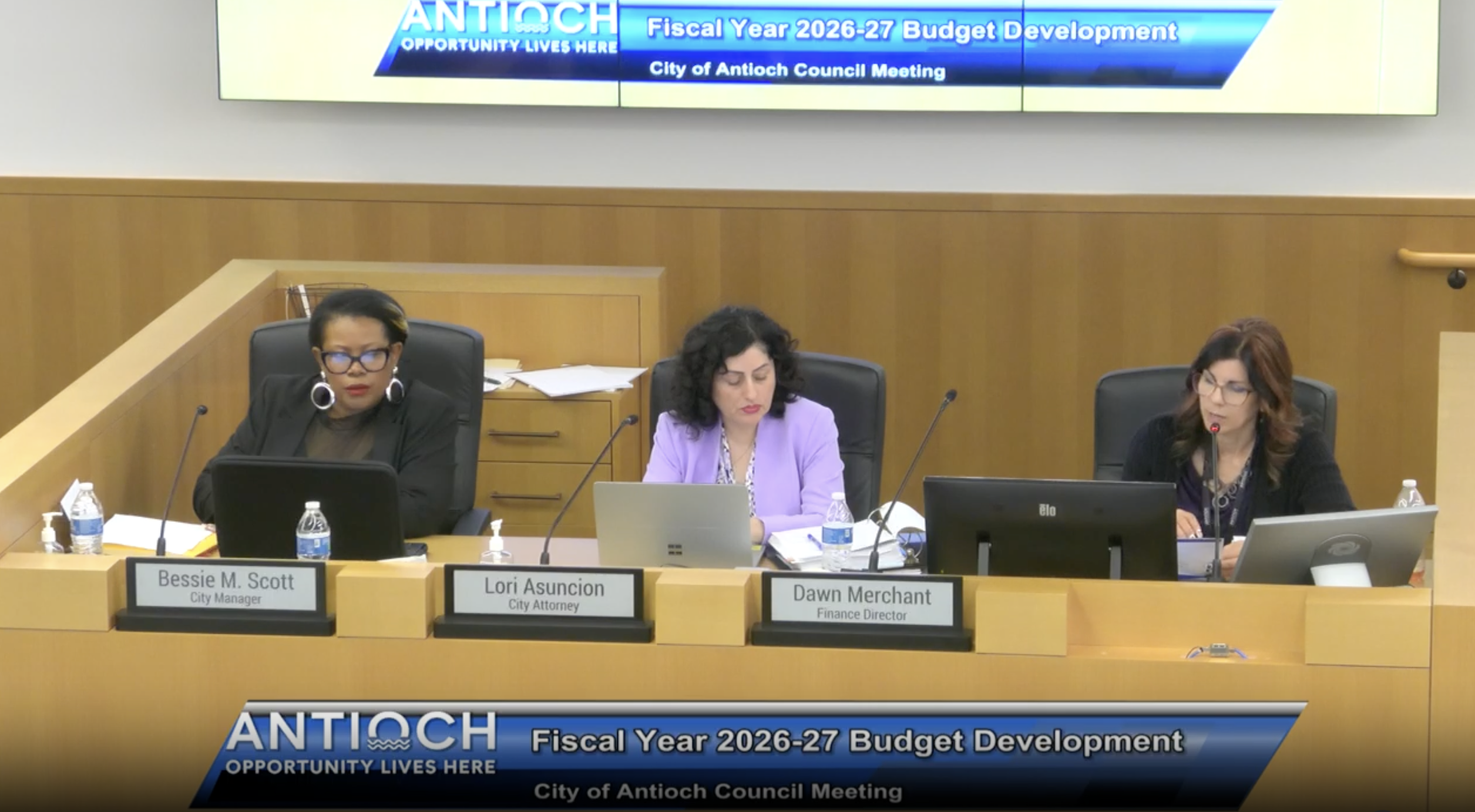
City Council - Apr 28, 2026 - Meeting

City Council - Apr 28, 2026 - Meeting

City CouncilAntiochApril 28, 2026

Sources:

Locunity is a independent informational service and is not an official government page for this commission.We use AI-assisted analysis and human editorial review to publish information.

Council Combs Through Budget Funds as Animal Rescue Coalition Rallies to Keep Services Local

Antioch's City Council held a marathon session April 28 that opened with a granular walk through dozens of special fund budgets — hunting for every available dollar amid a structural deficit — and closed with a unanimous vote to join a regional stormwater compliance program that could save the city millions. In between, a coordinated bloc of six animal rescue organizations packed public comment to fight what they called a quiet move toward county takeover of local animal services, and a technology audit delivered what one council member called "very alarming" findings about the city's disconnected IT systems.

  • Council scrutinizes millions in unspent special fund balances to offset a growing general fund deficit, flagging disability access, abandoned vehicle and landscape district reserves

  • Six animal welfare groups rally against any transfer of Antioch Animal Services to the county, citing a four-officer countywide staffing crisis

  • Technology audit reveals "alarming" manual data entry errors across Finance and HR, with a $250–350K integration roadmap proposed

  • Stormwater compliance JPA approved 5-0, giving Antioch a credit-trading path to meet its 5-acre treatment mandate before a June 2027 deadline

  • Council and police oversight commission set June 15 joint meeting as a second federal settlement agreement takes effect


Budget Funds Under the Microscope

The basics: This was the second half of a special budget study session that began April 21, with Finance Director Dawn Merchant leading the council through roughly 50 pages of special revenue, capital project and internal service fund worksheets for FY 2026-27.

Why it matters: Antioch faces a structural general fund deficit. Millions of dollars sit in restricted special funds — some accumulating for years with minimal spending — while looming obligations in stormwater compliance and retiree health benefits threaten to widen the gap.

Where things stand: The council worked fund by fund, surfacing several pots of money that aren't being spent at the rate they're collected:

  • Disability access fund: $351,000 has accumulated with only about $10,000 spent annually. Mayor Pro Tem Donald Freitas pressed staff to put the money to work: "This is a great source of revenue for a very good cause. And we literally are spending like $10,000 a year, yet the fund is a third of a million. I really would like to have a report come back because I think there is definitely a need with regards to disability enhancements."

  • Abandoned vehicle fund: The council debated whether to transfer a $600,000 balance to police operations in one lump or spread it over two years. Freitas advocated the more cautious $300,000-per-year approach, which staff will incorporate.

  • Asset forfeiture funds: Mayor Ron Bernal urged using more than $100,000 in federal and state forfeiture balances for police training rather than drawing from the general fund. "To the extent that we're looking for money anywhere we can, if we could spend some or all of that money on qualified training, I think it would be good to utilize these funds before we use general fund money," Bernal said.

  • CFD landscape districts: Balances in the 2018 and 2022 Community Facilities Districts have grown to $3.7 million-plus. Bernal questioned why projects aren't keeping pace: "The expectation of those property owners that live in those areas that are paying the CFD taxes every year is their landscaping looks and is maintained at a level that is represented by all this money that's coming in."

  • Solid waste franchise fee: Council reached consensus to reduce the allocation by $100,000 for FY 26-27.

The other side — structural risks ahead: Two obligations drew particular concern. The National Pollutant Discharge Elimination System (NPDES) stormwater fund is projected to go $1 million negative by FY 27-28, with the general fund having never contributed to it. Bernal flagged the urgency:

"That's a big number. That's a big deal in two years. We need to hold up something to say that this is coming."

The city's other post-employment benefits (OPEB) unfunded liability stands at $19.5 million. Freitas urged a future council review of strategies used by other municipalities to address it.

On housing funds, Freitas proposed collaborating with Antioch Unified School District's Big Skills program, which trains students to build accessory dwelling units. Councilmember Tamisha Torres-Walker highlighted the city's existing pre-approved ADU plans and rebate program and asked staff to report back on how many residents are in the pipeline.

What's next: Staff will return with revised fund worksheets incorporating the council's direction, including the two-year abandoned vehicle transfer, disability access spending proposals and updated NPDES projections, as budget deliberations continue toward adoption.


Animal Rescue Coalition: 'Keep It Local'

Why it matters: Six animal welfare organizations delivered coordinated public comments opposing any transition of Antioch Animal Services to Contra Costa County — a move they said was being discussed behind closed doors without public input. The county currently has just four animal control officers for the entire county.

Where things stand: Speakers from K911 Animal Rescue, Friends of Animal Services, Roady's Rescue, K9 Paw Print Rescue, East Bay Animal Rescue and Refuge, and Homeless Animals Response Program (H.A.R.P.) each took the podium with a consistent message: local staff provides personalized care that a stretched county operation cannot replicate, and the city's animal services manager and animal control officer positions remain unfilled.

Public commenter Carolynne Steen, director of Rhodie's Rescue, described a recent weekend incident in which county animal services failed to respond to a 120-pound loose dog because only two officers were on duty for all of Contra Costa County. She said a man in Pittsburg who was attacked by a German shepherd also received no county response.

Public commenter Tiffany Mittelman of K9 Paw Print Rescue, who has 20 years in animal welfare management, called the staffing vacancies "unacceptable" and warned the city was "abdicating" its duty. She argued that properly staffed animal services generates revenue through licensing and enforcement.

Public commenter Nicole of East Bay Animal Rescue and Refuge contrasted the Antioch shelter — where staff knows each animal by name — with what she described as the county shelter's statistical approach, expressing anger about what she called "backdoor talks."

A resident named Melissa praised the shelter's structured volunteer program, and public commenter Karen Kops of H.A.R.P. summarized the coalition's shared position: fill the critical vacancies before considering any structural change.

What's next: No formal agenda item on the transition was before the council, but the organized turnout signals this will become a political flashpoint if staff or council moves the discussion forward.


Tech Audit: Disconnected Systems, Manual Entry, Unused Features

Why it matters: A six-week technology assessment by Tenjumps, a Chicago-based consulting firm, found that city departments rely on manual data entry between Finance and HR systems with high error rates, use overlapping software without integration, and pay for platform features they've never activated.

Where things stand: The assessment interviewed all departments except police and identified three tiers of issues: findings that confirmed what staff already knew, low-hanging fruit for quick wins, and major investments requiring a longer timeline. A proposed one-year roadmap — covering the city clerk's records request system, agenda management, Tyler EPL business licensing migration, automated revenue interfaces, Trimble Unity Maintain for Public Works, HR reporting and contract workflows — is estimated at $250,000–$350,000 with projected hard-cost savings of $47,000 before counting staff time.

City Manager Bessie Scott framed the core problem:

"One of the most alarming findings is the manual entry across critical programs and departments such as Finance and Human Resources. The error rate is astounding." She added that the city pays for capable platforms but the city has "to turn the functions on and have training in the functions in order to actually utilize them."

Mayor Pro Tem Donald Freitas called the findings "very alarming" and pressed staff on how to institutionalize ongoing technology planning. Scott confirmed an IS master plan is being developed.

The other side: Not everyone welcomed every recommendation. Shaun Connelly, the city's water distribution superintendent, used public comment to criticize the proposal to phase out MobileMMS in favor of Unity Maintain, calling the comparison unfair and expressing low confidence in the platform after years of limited progress. Public commenter Mr. Becker took a different tack, welcoming the assessment and asking whether integrated systems could cross-reference business licenses, water bills and use permits to identify non-conforming commercial properties in real time.

What's next: Staff will develop the IS master plan and begin pursuing the roadmap's quick-win items. Councilmember Monica Wilson asked about the timeline for agenda management activation, which is among the features already paid for but never turned on.


Stormwater Credits: A Cheaper Path to Compliance

The basics: Antioch has treated only 0.4 of the 5 acres of impervious surface it must address under its municipal stormwater permit before a June 2027 deadline. The Regional Alternative Compliance (RAC) program creates a credit-trading system: entities that build more green stormwater infrastructure than required can sell excess credits to cities that need them.

Why it matters: Building treatment capacity independently would cost millions. Through the JPA, compliance units cost roughly $270,000 per acre including 20 years of operations and maintenance. Annual JPA costs for Antioch would be approximately $1,300 after initial costs of $2,850. Staff is also pursuing a $2.5 million EPA grant for independent basin construction.

Where things stand: Beth Baldwin of the Contra Costa Clean Water Program presented the program structure, which includes a Community Facilities District for long-term funding and a board composed of participating agencies. Sixteen of 21 Clean Water Program member agencies have expressed interest.

Mayor Pro Tem Donald Freitas, who noted he created the Contra Costa Clean Water Program 35 years ago, praised the initiative and moved approval.

Decisions: Approved 5-0 (For: Bernal, Freitas, Rocha, Torres-Walker, Wilson; Against: none; Absent: none). The vote authorizes JPA participation, appoints the city manager as board member, establishes the CFD and approves the joint community facilities agreement.


Police Oversight: Joint Meeting Set for June 15

Why it matters: The Antioch Police Oversight Commission (APOC) has not yet delivered direct policy recommendations to the council despite being operational, and a second federal settlement agreement was recently filed — increasing the urgency for aligned oversight.

Where things stand: City Manager Bessie Scott reported that a consultant named Manjeet has volunteered to facilitate and will produce a facilitator's guide. The proposed agenda includes an overview of the current APOC ordinance, roles and responsibilities, community outreach expectations, staffing, budget, training needs (including attendance at the Nacole conference), the crosswalk between two federal settlement agreements, and future issues APOC wants to address.

Mayor Pro Tem Donald Freitas was direct about the gap:

"One of the things that I thought was going to happen and for whatever reasons hasn't seemed to happen is getting direct recommendations from APOC to the city council."

He noted the only prior attempt at dialogue during the ordinance discussion "did not go particularly well."

Councilmember Tamisha Torres-Walker asked about training availability through the police department. Councilmember Louie Rocha stressed the need for uniform onboarding practices across all city commissions.

Decisions: Council reached consensus to hold the joint meeting June 15 at 6:30 p.m. at the Antioch Community Center, moved from the originally proposed June 1 date to accommodate scheduling.


Minor Items

  • Proclamations approved 5-0: Council recognized April as American Muslim Appreciation and Awareness Month, honoring the Islamic Center of East Bay and Masjid Abu Bakr Al Sadiq, and declared National Public Safety Telecommunicators Week. Dispatch Manager Stacy Malsom called dispatchers "the calm voice in the middle of chaos" who work 16-hour shifts and give up holidays.

  • Antioch Community Foundation update: Executive Director Keith Archuleta reported $245,000 in annual grants across two funds — the endowed Antioch Fund (~$45,000/year) and the Youth of Promise Fund ($200,000/year from Contra Costa County Probation). The Antioch Fund grant cycle opens May 14, with the information meeting via Zoom that day and applications due June 11. Councilmember Torres-Walker noted the importance of juvenile justice dollars reaching Antioch, which has the highest number of youth in juvenile hall in the county.

  • Housing affordability: Public commenter Aiden Sima, a USC social work student, noted a worker needs $39/hour to afford a two-bedroom apartment in California and urged continued investment in affordable housing. Public commenter Andrew expressed frustration that Antioch did not pursue $736 million in AHSC Round 10 state funding.

  • Crisis response concerns: Public commenter Mary Lutz warned against any cancellation of the Angelo Quinto Community Response Team and questioned alignment with CALVIP funding.

  • Homekey Plus viability: Councilmember Rocha raised concerns about a hotel acquisition, noting the property owner faces potential foreclosure on $17 million in loans. Councilmember Wilson requested a future agenda item on hotels in the city.

  • Councilmember Torres-Walker asked the council to reconsider a September 2023 consent calendar vote that removed the Department of Public Safety and Community Resources from the 800 Second Street building, announced a May 28 downtown specific plan kickoff at 10 a.m. in the council chambers, and recognized Second Chances Month partners.

Council Combs Through Budget Funds as Animal Rescue Coalition Rallies to Keep Services Local | City Council | Locunity