City Council - Apr 21, 2026 - Special Meeting

City Council - Apr 21, 2026 - Special Meeting

City CouncilAntiochApril 21, 2026

Sources:

Locunity is a independent informational service and is not an official government page for this commission.We use AI-assisted analysis and human editorial review to publish information.

Council Defers Most Deficit Cuts, Demands Impact Analysis Before Decisions

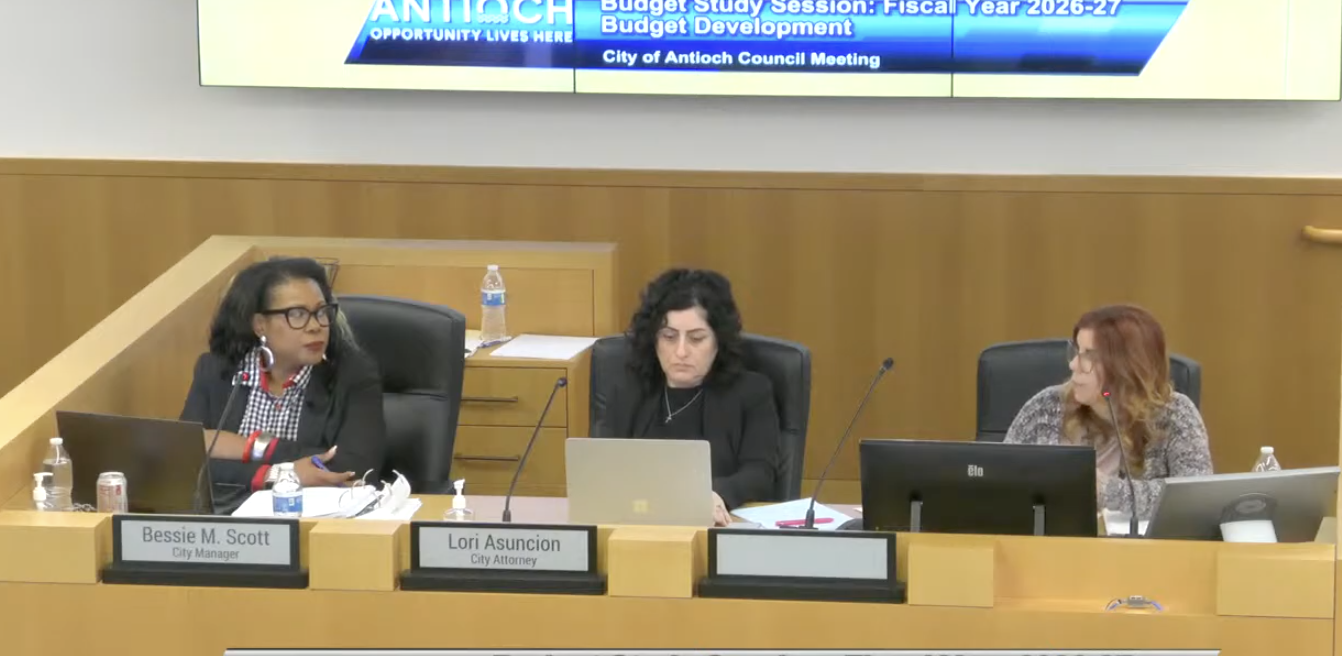
Antioch's City Council spent four hours Tuesday confronting a $13.2 million general fund deficit for the coming fiscal year, ultimately deferring most of the proposed cuts while demanding that staff explain what each reduction would actually mean for city services. A follow-up workshop on the five-year capital improvement program surfaced its own flashpoint: the quiet redesignation of an ARPA-funded building away from its intended community use.

  • $13.2 million deficit confirmed for FY 2026-27; council approves $5 million stabilization transfer but defers 10+ reduction proposals pending operational impact analysis

  • Animal rescue groups rally against shelter cuts as council explores county partnership for spay/neuter services

  • Mayor Pro Tem Freitas calls economic development the only path out, citing five-plus years of inactivity and vacant commercial centers across the city

  • Council removes controversial Rivertown park from the capital plan, pivoting toward revenue-generating mixed-use development downtown

  • Transparency dispute erupts over 800 W. 2nd Street building shifted from community resources to finance offices without council discussion


Dollars Without Context: Council Pushes Back on Bare-Bones Budget Proposals

The basics: Finance Director Dawn Merchant presented "Chart A" — a package of 20-plus deficit reduction proposals totaling $5.36 million in cuts and freezes to chip away at Antioch's $13.2 million general fund deficit for FY 2026-27. After a planned $5 million draw from the budget stabilization fund, the remaining gap sits at approximately $8.2 million; if every proposal were adopted, it would shrink to roughly $2.88 million.

Why it matters: Antioch — a city of nearly 120,000 — faces a structural deficit that position freezes and one-time transfers cannot sustainably close. The decisions made over the next two months will determine whether departments can maintain current service levels or must cut programs that residents rely on daily.

Where things stand: Council members gave consensus on a handful of items:

  • unfreezing an administrative analyst position

  • freezing a quarter of a senior civil engineer position

  • converting a public works inspector

  • freezing a community engagement coordinator

  • adding a policy director related to the Allen settlement

  • freezing a business license representative

  • freezing an accounting specialist.

They approved using the $5 million stabilization fund, preserved Fourth of July, Juneteenth, and National Night Out events, funded 12 additional police trainees at $559,000 to build toward 117 sworn positions, agreed to renegotiate the golf course lease rather than sell, limited special events to three pre-approved ones, and directed staff to explore ending water irrigation agreements with the Antioch Unified School District.

But the larger, harder decisions were sent back for more work. Council deferred action on:

  • animal services manager freeze

  • code enforcement officer freezes

  • Homekey Plus funding

  • post-ARPA funding for the community response team

  • a solid waste franchise fee reduction

  • citywide signage

  • public art restoration

  • vehicle replacement set-aside

  • the water park operations model

The core frustration was bipartisan and blunt: the proposals came with dollar figures but no explanation of what the city would lose.

"I think that's the information that we really need. Otherwise, we're just looking at dollars and cents and not really knowing the impact of operations," said Councilmember Louie Rocha.

Mayor Ron Bernal proposed a layered approach:

"These are what the budget has to have in it. These are non-negotiables. We can't take this out of the budget. And then we layer onto it our priorities of whatever those are as a council."

Councilmember Tamisha Torres-Walker echoed the concern, warning that cuts to code enforcement and homelessness response need context:

"I also want to point out housing and homelessness was one of the priorities and the fact that we're spending millions a year just moving people from corner to corner if we don't have a real solution."

City Manager Bessie Scott acknowledged the structural nature of the crisis.

"Long-range planning and policy priorities need to be set by the council and revenue generation needs to be our top priority in terms of economic and community development," she said.

Scott also noted that some personnel and county negotiation details cannot be discussed publicly.

Decisions: No formal roll-call votes were taken on individual budget proposals; all directions were by consensus. The $5 million stabilization transfer, 12 police trainees, event preservation, golf course renegotiation, and several position freezes received council agreement. More than 10 proposals were deferred for staff to return with impact narratives — modeled on an existing "Attachment D" format — before the next study session.

What's next: Staff will return with detailed operational impact analyses for the deferred items. The council faces a June 30 budget adoption deadline, and the remaining $2.88 million gap (at minimum) still needs to be addressed.


Animal Advocates Sound the Alarm on Shelter Crisis

Five public commenters representing animal rescue organizations turned out to urge the council not to freeze the long-vacant animal services manager position — and to confront a deeper problem: the city's shelter can no longer accept animals or provide basic spay/neuter services.

Why it matters: Chronic understaffing has left Antioch's animal shelter unable to perform core functions, while a feral and abandoned cat crisis has overwhelmed the volunteer rescue groups that have stepped in to fill the gap.

Where things stand: Karen Kops, president of the Homeless Animals Response Program (HARP), described volunteering at animal services since 1996 and watching population growth outpace staffing. Patti Esposito, co-founder of Scruffy to Fluffy Cat Rescue, described finding abandoned friendly cats on every block and urged the mayor to reach out to Contra Costa County for a spay/neuter partnership.

Lisa Kirk of Fix Our Shelters provided the most specific numbers, estimating that contracted cities pay approximately $11.91 per capita to the county — putting Antioch's potential cost at roughly $1.5 million. She attributed the statewide shelter crisis partly to experimental UC Davis policies that eliminated intake and spay/neuter programs for five years.

Jeffrey, a veterinarian, urged the council to think carefully before cutting further, noting that the department has already absorbed significant sacrifices.

The other side: Mayor Pro Tem Donald Freitas was the strongest council voice on the issue, flatly opposing the manager freeze:

"I'm completely opposed to that. I think it's long, long overdue that we have a permanently placed manager."

City Manager Bessie Scott indicated that negotiations with the county on animal services are ongoing but that legal constraints prevent public disclosure of details.

What's next: Council directed staff to return with more information on the animal services manager freeze and county collaboration options.


Freitas: Economic Development Is the Only Way Out

Mayor Pro Tem Donald Freitas delivered the meeting's most extended argument for a strategic pivot, making the case that Antioch's structural deficit cannot be cut away — it has to be outgrown.

Why it matters: Antioch has gone at least five to six years without meaningful economic development activity, according to Freitas, leaving commercial centers shuttered and forcing residents to spend their money in neighboring cities. In a city approaching 120,000 residents, there is no hotel or conference center generating transient occupancy tax revenue.

"From my perspective, the only way we're going to get out of this long term is truly focus on economic development. That means an economic development director or staff who is just focused on changing what we have," Freitas said.

He also pushed back on a purely austerity-driven approach to quality-of-life services.

City Manager Bessie Scott confirmed that two previous candidates for an economic development director position turned down the job, partly due to the city's fiscal challenges. Council also discussed the role of consultant Townsend, which currently focuses on grant writing rather than economic development advocacy.

Councilmember Tamisha Torres-Walker emphasized the potential of community collaboration, noting she has personally raised over $60,000 for city-related community programs:

"If we actually collaborated with the community, it might be a potential that we could raise some of these dollars."

Councilmember Louie Rocha added a data point, identifying approximately $1 million in unfilled general fund positions that haven't even been posted or recruited for — suggesting savings that could be redirected.


ARPA Clock Is Ticking: $1.1 Million Must Be Spent by End of 2026

Finance Director Merchant reported that three ARPA-funded projects remain outstanding: the Angelo Quinto Community Response Team ($1.1 million remaining), small business support ($482,000), and the downtown WiFi project (complete, with payments pending). All ARPA principal must be spent by Dec. 31, 2026, with no extensions — unspent funds go back to the U.S. Department of Treasury.

One bright spot: $992,875 in interest earnings on ARPA funds is unrestricted and has already been allocated via Resolution 2024-159 to renovate the 800 W. 2nd Street building, giving council flexible dollars outside the federal spending rules.


$120 Million Capital Plan Gets Council Review — and a Reckoning

Public Works Director Bunting walked the council through the draft five-year Capital Improvement Program (CIP) covering roadways, water systems, community facilities, parks, and trails.

Why it matters: The CIP reveals roughly $20 million in unfunded projects even as the city grapples with aging infrastructure — 69 traffic signals needing upgrades, 1,700 street lights awaiting LED conversion, and streets that Mayor Pro Tem Donald Freitas said haven't been touched in his neighborhood in 36 years.

"I think your system has failed for at least 36 years that I'm aware of personally, and I'm not the only one," Freitas said of the pavement management program.

Where things stand: Major projects in the pipeline include the L Street beautification and widening ($21 million total, Phase 1 under construction), a $96 million brackish water desalination plant commissioned in September 2025, LED street light conversion north of Highway 4, $2.52 million in traffic signal upgrades via an HSIP grant, County Smart Signals for Lone Tree Way and Summersville/Auto Center corridors ($2.5 million in OBAG funding), and the Jacobson and Marchetti park projects nearing completion.

The Slatten Ranch Road Phase 1 extension (Wild Horse to Wicklow) is partially funded through ECRIFA and East Lone Tree funds but remains $8–$10 million short. A public commenter questioned why that project starts from the Brentwood side rather than near the BART station, arguing the transit area offers higher-density mixed-use opportunities.

Council directed staff to add a Carnegie Library restoration ($200,000 placeholder) and LED street light Phase 2 to the CIP as unfunded placeholders — establishing formal project entries to position them for future grants.


Council Pulls the Plug on Rivertown Park After 26-Year Debate

In one of the meeting's most decisive moments, council reached consensus to remove the unfunded $1.6 million Rivertown Community Space project — the former Beatty lumber yard site — from the capital improvement program entirely.

Why it matters: The site is prime downtown real estate. The pivot from passive park to potential mixed-use development signals a strategic shift toward revenue-generating land use in the Rivertown area.

Mayor Pro Tem Donald Freitas left no ambiguity:

"I am absolutely opposed to this project. I have been opposed to this project for more than 26 years."

He argued the site should support commercial and residential development that generates property and sales tax revenue.

Councilmember Tamisha Torres-Walker noted the project was unfunded and recalled that a previous council had already voted to remove it. She said recent conversations with downtown businesses favor development over a park and proposed that the standing committee discuss future opportunities, including potential mixed-use development.

Councilmember Louie Rocha moved to remove it from the CIP, and all members agreed.

What's next: The standing committee will take up discussion of future uses for the site.


Transparency Clash: Who Gets the 800 W. 2nd Street Building?

Councilmember Tamisha Torres-Walker raised pointed concerns during the CIP discussion when she noticed that the 800 W. 2nd Street building — purchased with ARPA dollars specifically for the Department of Public Safety and Community Resources — now appeared in capital documents as housing Finance and Human Resources instead.

"This is the first time since the former council voted to allocate ARPA dollars to purchase that building specifically for the use of the Department of Public Safety and Community Resources, which the name is changing. I see you squinting," Torres-Walker said.

She emphasized that youth and community members invested time organizing around that space and deserved transparency about any change in its designated use. Councilmember Louie Rocha referenced a September 2025 council vote approving a redesign, but Torres-Walker maintained the original intent was co-location of the community-facing department, not its displacement.

City Manager Scott took responsibility, explaining the space planning was driven by business needs and that she wasn't fully aware of the prior council direction. She agreed to bring back a comprehensive space-planning discussion to a future meeting.


Minor Items

  • Golf course lease renegotiation: Council directed staff to seek higher payments from the golf course operator, currently paying $20,000 per year in base rent while the city spends approximately $500,000 annually on debt service and water for the course.

  • Consultant Townsend: Council discussed the role of the firm, which focuses on grant writing; members questioned whether advocacy and economic development should be part of the scope.

  • Neighborhood traffic calming: 13 new speed bumps are planned as part of the CIP traffic calming program.

  • Utility box artwork and Amtrak station renovation are included in the CIP's community facilities category.

  • Downtown WiFi project is complete with final payments pending.

  • Bicycle garden project near the Antioch Community Center is in the design phase.

Council Defers Most Deficit Cuts, Demands Impact Analysis Before Decisions | City Council | Locunity