
Antioch Council Rejects 'Doomsday' Baseline, Demands Middle-Ground Budget Option
City Council • AntiochOctober 13, 2026
Locunity is an independent informational service and is not an official government page for this commission. All information is sourced from public footage and an analysis of official agendas with the aid of responsible, fact-checked AI. to report an error or omission.
Antioch's City Council spent about two hours on Oct. 13, 2026, picking apart a stripped-down FY 2027-28 budget. The baseline showed a $2.5 million surplus on paper but would close parks and eliminate programs. Members gave staff informal direction instead of voting. In the same marathon meeting, the council revived a standalone Economic Development Department 4-0, while an ethical investment policy died without a second shortly before 1 a.m.
- Baseline budget rejected as a "doomsday" scenario; council wants a middle-ground comparison in November
- Council backs budgeting 105 sworn officers for FY 2027-28, with a March review
- Economic Development Department revived 4-0 with a $19,000 top-step salary and $300,000 for marketing
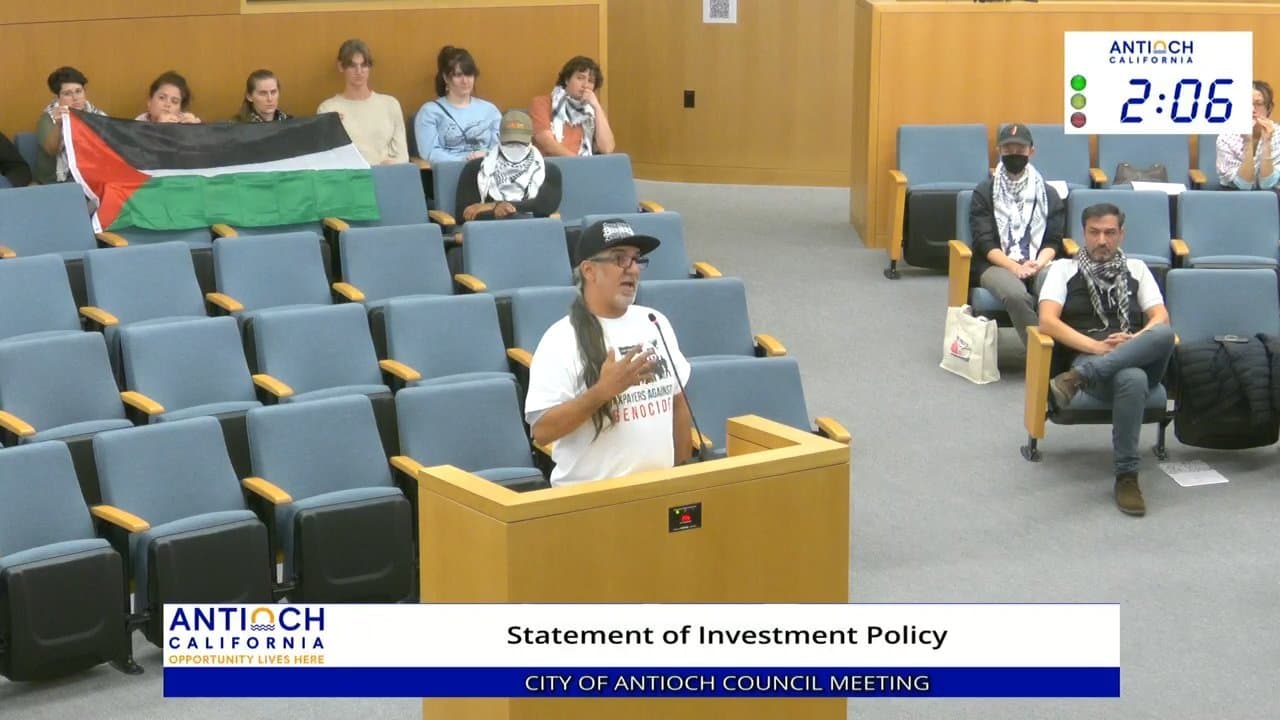
- Ethical investment policy dies for lack of a second despite dozens of supportive speakers
- U.S. Department of Justice (DOJ) ends its agreement with Antioch police; Allen settlement compliance remains partial
- City promises a warming center plan by Oct. 27 as residents press for winter shelter
Budget: Council Rejects the 'Doomsday' Baseline
Why it matters: The special study session on Police and Public Works sets the terms for the FY 2027-28 general fund budget. Council must decide how much reserve spending it will accept to avoid service cuts that could cost more later.
Where things stand: At the council's own direction, staff built a baseline of only legally mandated spending. It reflects full sales tax reductions, a $1.4 million police capital rollover and a $150,000 amendment for Allen settlement monitoring. It also removes 12 police positions and economic development. The result is a $2.5 million surplus. The current-year deficit of about $9.1 million is covered by a $5 million transfer from the budget stabilization fund.
"This pretty much strips the city, legally mandated, down to nothing, as you'll see this evening," said city staff. Finance staff warned that "you can't continually have $15 million and a growing projected deficit each year."
The other side: Members objected that department leaders offered no recommendations, that "legally mandated" was ambiguous and that the framing was alarming. One councilmember said they "viewed this as the doomsday budget" and asked for a vacancy plan. Another said "zero-sum narratives don't often work." A councilmember also raised the risk of a state takeover if deficits persist: "But I don't want to be in receivership." Staff said they followed council direction and offered 5% or 10% reduction scenarios as alternatives.
Police staffing, 105 not 117: The 12 added officers were dropped because the police chief said the department cannot reach 117. Antioch has 85 sworn officers and 14 trainees in academies. The chief described 50% attrition through the hiring pipeline. Staff recommended budgeting the full 105 and returning if more hires materialize. Members worried the public would read 105 as a cap. Staff noted that state law requires reporting of vacancy rates.
Decisions and stakeholder impacts: No vote was taken. By consensus, members said they would:
- Restore streetlight maintenance.
- Keep the encampment cleanup contract and rebid it when it ends.
- Restore $10,000 for graffiti supplies.
- Keep computer set-asides.
- Cut the $1.8 million vehicle replacement set-aside by 50%. A minimum-balance policy for the vehicle fund was also suggested.
Parks remain unresolved. Public Works said a closure would mean turning off irrigation and fencing parks. "I look at these as benefits to the city, not necessarily needs," said the Public Works Director. Council asked for contract details before deciding. During general comment, Leslie May, a public commenter, urged closing the golf course instead of parks.
What's next: At its first November meeting, the council wants staff to present the baseline and a middle-ground version side by side. Members asked for real-life service impacts, a vacancy plan and contract details. "I'd like to see the baseline with the middle ground next to it," said a councilmember. Police staffing will be revisited in March.
Economic Development Department Returns
Why it matters: The council sees a standalone department as its main tool to offset roughly $1.7 million in lost sales tax.
Where things stand: The resolution does four things:
- Reestablishes the department effective immediately, with a director and a specialist.
- Amends the job classification.
- Sets the director's salary range at a $19,000 top step.
- Raises marketing funding to $300,000.
Members softened the certification wording and references to chambers of commerce. They also directed staff to issue a request for qualifications (RFQ) for an executive search firm. Mayor Ron Bernal noted the city's two failed recruitments. Staff said those failures came from the difficulty of finding candidates with the combined skills required.
The other side: Speakers supported economic development but challenged the pay.
- Montserrat Cabral, negotiator for the management bargaining unit, asked for an internal equity review, attention to staffing capacity and a phased plan.
- Dawn, a city finance employee, said a Stockton-level salary would insult the existing executive team. She urged market research for all managers.
- Joe Castro, a public commenter, said matching Stockton's pay requires equitable adjustments for current department heads.
- Andrew Becker, a public commenter, asked why finance staff had not pursued revenue tools such as an enhanced infrastructure financing district (EIFD).
Decisions and stakeholder impacts: Councilmember Donald Freitas moved the resolution and Councilmember Louie Rocha seconded it. It passed (For: 4, Bernal, Freitas, Rocha, Torres-Walker; Against: 0; Absent: 1, Wilson). Recruitment begins now. Managers warned the new salary could cause pay compression, where a new hire's pay approaches or exceeds that of longer-serving department heads.
What's next: Staff will issue the executive search RFQ.
Ethical Investment Policy Stalls After Midnight
Why it matters: Dozens of speakers backed the negotiated policy, but its failure sends it back for a rewrite and further legal review.
Where things stand: Treasurer Jorge Rojas introduced language that staff negotiated with the advocacy group Contra Costa Divest. It added a new Section 4 and a list of prohibited investments in Section 6. Only one current holding, Lockheed Martin, would be affected. To reach the item, the council extended the meeting to midnight and then to 1 a.m., both by 4-0 votes.
Most speakers urged adoption, many citing Gaza. River, a public commenter, thanked staff for the collaborative process. Iyaz, a public commenter, cited casualty figures from Gaza. Frank, a public commenter, called the policy a compromise and asked for a vote that night.
The other side: A commenter identified as Alan opposed deciding after midnight. He questioned the exclusions and asked that any investments the treasurer adds to the prohibited list require council approval. Members raised similar concerns about subjective treasurer determinations, sector definitions based on Bloomberg classifications and the policy's breadth. Staff suggested requiring council approval for additions. One councilmember said they did not support changing the policy now and would stay with the current one.
Decisions and stakeholder impacts: A motion to adopt the policy with the Finance Director's recommended changes died for lack of a second. Advocates leave without a policy despite a negotiated text.
What's next: Staff will return with revised language and a legal clarification of the treasurer's authority.
DOJ Releases Antioch Police; Allen Work Continues
Why it matters: Federal oversight ends, but the state-court Allen settlement still requires policy and training work.
Where things stand: A police consultant reported that the U.S. Department of Justice ended its agreement with the department. The Allen settlement remains in partial compliance in seven of nine areas. Oversight now shifts to semiannual self-assessments. Remaining work includes training, hiring a data analyst, setting early intervention thresholds and adopting new policies. Delayed policy review by the Police Oversight Commission (APOC) is now a bottleneck. The third-quarter report also covered staffing, crime statistics, ShotSpotter gunshot detection and a youth academy. Data from the ABLE program showed a 71.5% drop in use of force.
The other side: A councilmember questioned canceled APOC meetings and requested attendance records.
- Melissa, a public commenter, asked how many ShotSpotter alerts led to solved cases.
- Another commenter cited research questioning ShotSpotter and urged an independent audit.
- Leslie May called the DOJ release suspicious and alleged mayoral interference in the commission's agenda.
What's next: The council may act on the APOC review backlog.
Winter Shelter Pressure Builds Around Delta Landing
Why it matters: Federal cuts threaten county programs, the Safe Parking program ended Sept. 30, and an El Niño winter is approaching.
Where things stand: County staff reported that Delta Landing, the city's shelter site, served 202 households last year. Thirty-seven percent of those who left moved into housing. The city's federal Continuum of Care (CoC) Builds grant application was not selected. Staff expect to learn about encampment resolution funding in mid-November.
Residents pressed for winter shelter. Dean Weber, a public commenter, urged a measurable plan for temporary shelter before winter. Frank Sterling, a public commenter, asked for winter shelter. Another speaker described encampment sweeps and urged the city to stop criminalizing homelessness. One speaker said Delta Landing saved a friend's life and praised its pet accommodations. Another urged local funding to sustain the program.
What's next: Staff promised a warming center and El Niño plan, with operations details, by Oct. 27.
Minor Items
- Private security: Council directed an RFQ for overnight patrols downtown and on city properties, from 10 p.m. to 5 a.m. Members leaned toward a one-year contract with a one-year option and measurable standards. Speakers urged de-escalation training and an "ambassador" model instead of patrol-style guards.
- Pruitt Park: Council accepted concrete and pool resurfacing work 4-0 after learning the work came before the contract amendment. "You need to get approval before the work is done," said a councilmember.
- LED streetlights: Council approved a $4,896 amendment for Bear Electrical and accepted the conversion work 4-0. About 7,000 lights remain unconverted, an unfunded cost of roughly $2.1M.
- Park signage: All bids were rejected 4-0, and staff will reevaluate the project's scope.
- Youth Services Network: Presenters reported 128 interns with 95% completion and about $398,000 in grants to nine nonprofits.
Looking Ahead
The warming center plan is due Oct. 27, and the budget comparison returns at the first November meeting. The Antioch Council of Teens hosts a trunk-or-treat on Oct. 24 and runs a coat drive through Nov. 3.