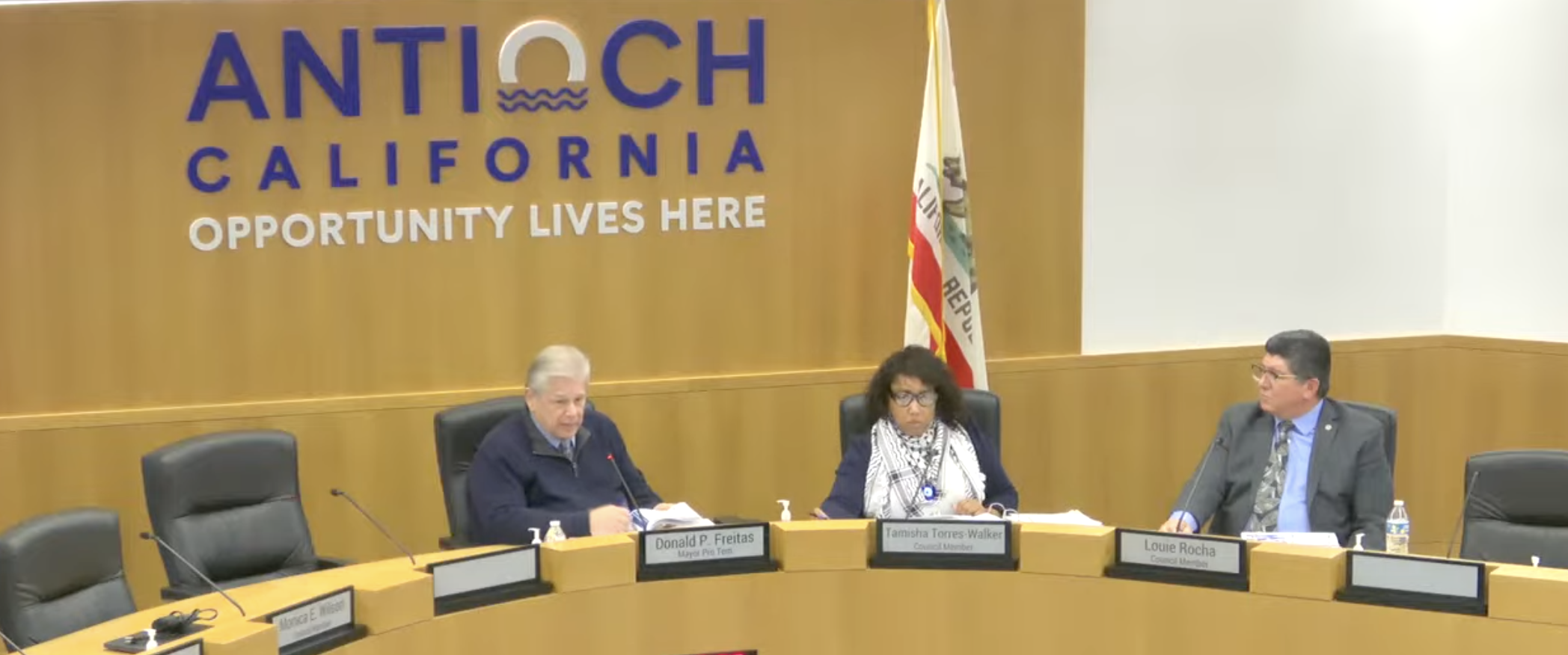
City Council - Jan 27, 2026 - Regular Meeting
City Council • AntiochJanuary 27, 2026
Locunity is a independent informational service and is not an official government page for this commission.We use AI-assisted analysis and human editorial review to publish information.
Council Advances Gun Violence Prevention Framework Amid Calls for Action
The Antioch City Council spent much of its Jan. 27 meeting absorbing a trio of presentations laying out the city's gun violence landscape—data on high-risk corridors, feedback from community forums, and outcomes from a state-funded intervention program—while residents urged leaders to move swiftly from analysis to action. A handful of routine items passed unanimously, and the council punted a City Attorney contract to a future date when all five members are present.
Data-driven gun violence prevention framework delivered to council; staff directed to develop next steps.
Proclamations approved for Human Trafficking Prevention Month and Black History Month.
Traffic calming contract increased; Sycamore Corridor work to go out for bid soon.
ARPA funds reallocated to sustain the Angelo Quinto Community Response Team.
Warming center discussion continues as staff pursues new partnerships after hotel site falls through.
City Attorney employment agreement continued to meeting with full council.
Violence Prevention Takes Center Stage
Three back-to-back presentations gave council members and residents a detailed look at gun violence patterns in Antioch and the city's evolving response.
Hope and Heal Fund delivered a data-driven framework identifying the Sycamore Corridor as a geographic hotspot and recommending community violence interrupters, hospital-based intervention, safe-storage campaigns, and cross-system data tracking. The presenters emphasized that a small number of high-risk individuals drive a disproportionate share of shootings—and that targeted outreach can interrupt cycles of retaliation.
Evident Change shared findings from community forums with adults and youth. Residents described strained police-community relations, gaps in youth programming, and a desire for better coordination among service providers. Youth participants, in particular, voiced concerns about safety at school and in their neighborhoods.
One Day at a Time reported on outcomes from California Violence Intervention and Prevention (CALVIP) grant activities, including direct engagement with high-risk individuals and violence interruption work.
Why it matters: The presentations mark a pivot from general public safety discussion to a structured, evidence-based planning process. Council members signaled they want actionable recommendations—not just more data.
"The question that we will have at the end of the next two presentations is, what are the next steps?" said Mayor Pro Tem Donald Freitas.
Council Member Tamisha Torres-Walker connected the presentations to recent tragedy and her own outreach to affected families: "No child or family or individual should have to be a victim of gun violence in any city, and especially not the city of Antioch."
She asked residents for patience as staff and council work through sensitive issues behind the scenes: "I would like to ask for grace consideration because I know these things aren't easy."
Council Member Louie Rocha highlighted a bright spot: a school-based mental health initiative that dramatically reduced crisis transports. "We saw a significant decrease from in 5150s in the first half of the year down to 2 for the second half of the year," he said.
What's next: Staff and Antioch Police Department command will review the data and return with specific policy and budget recommendations at a future meeting.
Warming Center Effort Hits Snag; Community Pushes for Local Triggers
The city's plan to open a warming center during cold weather hit a roadblock when an initial hotel partner withdrew. Staff reported they are pursuing alternatives.
Public commenters urged the council to adopt activation criteria based on local conditions—not just the county's freeze warning thresholds—pointing to fog, humidity, and overnight temperatures in the mid-30s to low 40s as serious risks for unsheltered residents.
Melissa Case argued for a lower temperature trigger, noting that hypothermia can set in well above freezing when conditions are damp.
Alexander Broom raised the secondary risk of fires started by unsheltered individuals trying to stay warm.
Dean Weber described volunteer efforts delivering soup at night and called for coordination and basic supplies like blankets.
What's next: Staff will continue outreach to potential partners and report back on options. No formal action was taken.
Traffic Calming Contract Expanded
Council approved an increase to a contract for neighborhood traffic calming, with Public Works reporting that Sycamore Corridor improvements will go out for bid soon, followed by James Donlon and West 10th Street projects.
Council Member Torres-Walker noted she has a meeting scheduled to discuss capital improvements citywide: "I do have a meeting coming up in the next week to ask questions about our capital improvements, not just in District 1, but across the city as it relates to traffic calming."
Decisions: Approved 3–0 (2 absent).
ARPA Funds Shifted to Crisis Response Team
Council authorized reallocating eligible American Rescue Plan Act (ARPA) funds to the Felton Institute to sustain the Angelo Quinto Community Response Team, a behavioral health crisis response program.
City Manager Scott explained the constraints of ARPA funding, noting that only previously approved projects can be repurposed—new initiatives are not eligible under federal rules.
Decisions: Approved 3–0 (2 absent).
Records Retention Schedule Adopted
A consultant walked council through a new records retention schedule, updating policies to comply with state requirements and streamline document management. Council members emphasized the importance of preserving historical records even as routine files are destroyed on schedule.
Decisions: Adopted 3–0 (2 absent).
Purchasing Ordinance Finalized
Council adopted the second reading of an ordinance updating several sections of the city's purchasing code. Members indicated they want to revisit reporting and electronic notice enhancements at a future meeting.
Decisions: Adopted 3–0 (2 absent).
Proclamations and Community Announcements
Council approved proclamations for Human Trafficking Prevention Month (January 2026) and Black History Month (February 2026). Mayor Pro Tem Freitas read the Black History Month proclamation aloud; the Human Trafficking proclamation was later presented to a local advocate.
Staff and youth shared announcements about upcoming Parks & Recreation programs, a housing think tank, and other civic events.
The City Clerk announced vacancies on several boards and commissions, with application deadlines approaching.
Minor Items
Consent calendar approved (excluding items J and O) 3–0.
Water system video screened, highlighting desalination and treatment processes; Public Works staff praised for operational excellence.
What to Watch
The council's next steps on gun violence prevention will be closely watched—whether staff returns with budget requests, policy changes, or pilot programs. Warming center negotiations will continue as cold weather persists. And the City Attorney contract will return when the full council is present, a signal that at least some members want broader input on the hire.