
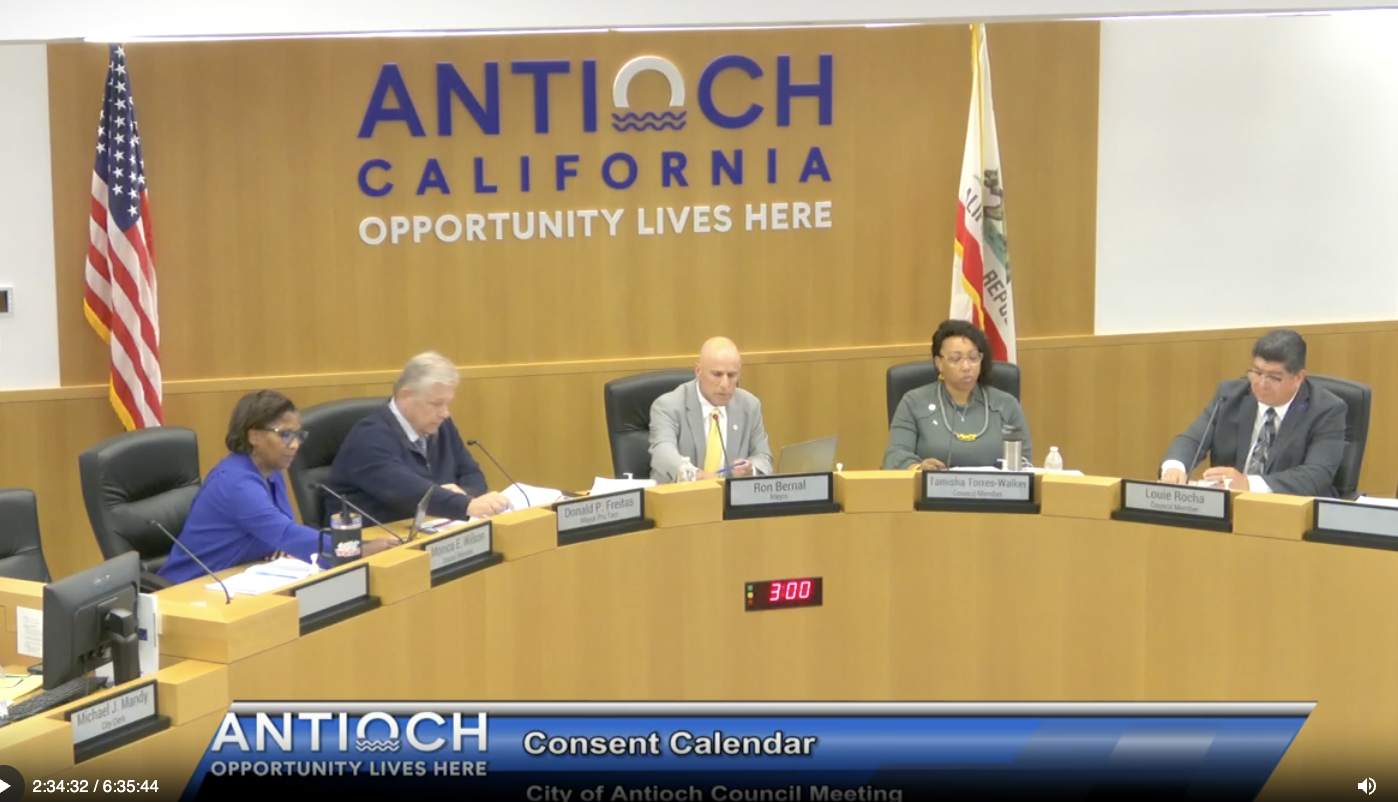
City Council - Jun 23, 2026 - Meeting
City Council • AntiochJune 23, 2026
Locunity is a independent informational service and is not an official government page for this commission.We use AI-assisted analysis and human editorial review to publish information.
Home Key Homeless Housing Decision Delayed as Antioch Wrestles With Budget Crisis
The Antioch City Council spent more than five hours Tuesday night debating how to spend money it doesn't have — on homeless housing, ethical investments, and affordable apartments — before quietly adopting a budget near midnight that projects a $15 million shortfall next year. The marathon session laid bare a city caught between state mandates, community demands, and a general fund that barely grew $300,000 in two years.
- $34.9M Home Key homeless housing award tabled to July 28 after two hours of debate; study session set for June 29 to resolve unanswered financial and legal questions
- Ethical investment working group created targeting Caterpillar, Chevron, and Lockheed Martin after 11 speakers demanded divestment from companies linked to Palestinian destruction
- $50M Hillcrest affordable housing bonds approved 5-0 after previously failing 2-2; council members said state pressure left them no choice
- Mothers and survivors of police violence pleaded to fund the Angelo Quinto Community Response Team amid looming budget cuts
- FY 2026-27 budget adopted 5-0 after midnight with $5M reserve draw and a projected $14.5M+ deficit next fiscal year
Home Key: $34.9M for 84 Units, and a City That Can't Decide
The biggest fight of the night — running past 11 p.m. — was whether Antioch should accept roughly $34.9 million in state Home Key Plus funding to convert the former Comfort Inn into 84 permanent supportive housing units for unhoused residents. The council punted the decision unanimously, scheduling a study session for June 29 at 6 p.m. and pushing the final vote to July 28.
Why it matters: The Mahogany Housing Project would house approximately one-third of Antioch's unhoused population. But the deal comes with a proposed $750,000 capital contribution and up to $1.2 million annually for as long as 15 years in operating subsidies — commitments the city would make while staring down a structural budget deficit that could exceed $15 million next year.
Where things stand: Community Resources Director Montserrat Cabral presented the award's terms, but the council chamber quickly split. Homeless advocate Nicole Gardner criticized the council for relitigating what had already been approved, and housing consultant Andrew Becker corrected a key misconception: "Those 84 individuals represent 33% of your unhoused community." He noted the $1.2 million figure is a ceiling, not an average, and that the developer had not even been invited to the meeting.
Councilmember Tamisha Torres-Walker delivered the evening's most pointed remarks, noting the mayor had failed to follow through on a promise made 18 months earlier: "We have been waiting 18 months for the mayor to come back with an ad hoc committee to talk about solutions to homelessness, and it still has not come back to this council." She argued CDBG funds could cover the city's costs for the first five years and that regional partnerships could reduce general fund exposure further.
The other side: Mayor Pro Tem Donald Freitas laid out the fiscal math in blunt terms: "Our revenues, $99.9 million this year. Proposal, next year's 100 million. And $300,000 for the year after. Our revenues are going up $300,000 in two years." He argued the city cannot responsibly take on a 15-year financial commitment when it is already drawing $5 million from reserves in consecutive years and projecting a $14.5 million-plus deficit. He also raised unresolved questions about the property's default status.
Public commenter Lynette Hart, a 34-year resident, opposed the project, citing Oakland's troubled Home Key experience, the $1.2 million annual cost, and the project's location near the freeway entrance. Joe Mitchell and Sandra raised concerns about insufficient police staffing — fewer than 100 officers for 118,000 residents — and the 50-year commitment. Ankit Panchal, representing the Asian American Hotel Association and APAPA, took a different tack: he urged converting the Comfort Inn to housing while incentivizing new, modern hotel development, noting Antioch hasn't built a new hotel in 30 years.
Councilmember Monica Wilson pushed back on the opposition: "I think it would be a huge mistake if we don't invest in this, because what is going to happen if we don't invest in it?" She cited her work with human trafficking survivors as evidence that housing paired with wraparound services produces better outcomes.
Decisions: The council voted 5-0 to table the item to July 28 and hold a study session on June 29 at 6 p.m. with the California Department of Housing and Community Development, the developer, the property owner, and county representatives.
What's next: The June 29 study session is the pivotal moment. Council members want answers on the property's default status, county support commitments, and how to limit general fund exposure before the July 28 vote. Advocates who want the project to move forward need to demonstrate that the operating costs are manageable; opponents need to offer an alternative beyond the status quo of encampment cleanups.
Divestment Push Wins a Working Group — and a Warning
Eleven speakers from Antioch Divest, Contra Costa Divest, Health Care Workers for Palestine, DSA, and community organizations packed the meeting to demand the city dump its investments in Caterpillar, Chevron, Lockheed Martin, and BP — companies they described as complicit in the destruction of Palestinian communities.
The basics: The city's investment policy had previously failed 2-2. PFM Asset Management advisor Justin Rusuelo returned with three options: company-specific exclusions (divestment), socially responsible investing through negative screening that would expand existing tobacco and alcohol exclusions, and a full ESG framework that could take 9 to 18 months to implement.
Why it matters: Antioch currently holds approximately $5.5 million in bonds from Caterpillar, Chevron, and Lockheed Martin with unrealized losses of about $25,000. Finance Director Merchant clarified that selling now would crystallize those losses.
Where things stand: Dr. Linda Bohara, a physician who has volunteered in the occupied West Bank, described witnessing Caterpillar bulldozers demolishing Palestinian homes. Imam Abu Bakr invoked the legacy of a Holocaust survivor and asked the council to consider what history would say about their investment decisions. Casey, speaking for Contra Costa Divest and DSA, warned that broad ESG and SRI frameworks could create loopholes and demanded BDS-aligned language targeting the specific companies.
Mayor Pro Tem Freitas drew on his 16 years on the Contra Costa Water District retirement committee during apartheid-era divestment to argue for a deliberate, accountable process rather than a reactive one. He called for the council to "adopt a clear ethical investing policy where standards and accountability are a part of this and that within the next six months, we as a council receive reports quarterly."
Councilmember Torres-Walker voted yes but issued a pointed caution: "Government often pacifies people with ad hoc committees and work groups that lead nowhere."
Decisions: The council voted 5-0 to adopt the investment policy and create a working group composed of the city manager, finance director, City Treasurer Jorge Rojas, a PFM representative, and three Antioch Divest representatives. The group will develop an ethical investing policy with quarterly reports and a six-month timeline.
What's next: The working group's first report will be due within the coming months. Whether the group produces real policy change or becomes the kind of delay mechanism Torres-Walker warned about will be the test.
State Pressure Flips Hillcrest Housing Vote From 2-2 to 5-0
A $50 million tax-exempt bond package for the 164-unit Hillcrest Summit Apartments — previously rejected 2-2 with one abstention — sailed through unanimously Tuesday after the California Department of Housing and Community Development essentially told the council it had no choice.
Why it matters: HCD sent a letter warning that rejecting the bonds could jeopardize Antioch's housing element compliance, triggering "builder's remedy" — a state provision that would allow developers to build virtually anything, anywhere in the city, without council control.
Where things stand: Planning Manager Zoe Meredith explained the project sits on one of 10 commercial infill housing overlay sites adopted in 2022. The CMFA bonds carry no financial liability for the city. But Mayor Pro Tem Freitas delivered an extensive critique of the site's design: traffic rated at level F, only 145 parking stalls for 165 units, proximity to a gas station and convenience store, and a four-story monolithic structure at a key entrance to the city. Despite all of this, he concluded: "So tonight, frankly, we have no choice because the alternative is even worse than this."
Councilmember Torres-Walker clarified the vote was specifically on bond issuance, not project approval, and that the city bears no financial liability. Housing consultant Andrew Becker supported the project and explained the bond and tax credit mechanics, noting 60% area median income aligns with Antioch income levels, but criticized the developer for poor community engagement.
Public commenter Crystal Law gave the evening's most personal testimony on housing need, sharing that her family of five pays $2,300 per month for a substandard duplex and has experienced homelessness multiple times. Ralph Hernandez opposed the project, citing strained police resources and overcrowded schools.
Decisions: Approved 5-0 (For: 5, Against: 0, Absent: 0).
What's next: The project proceeds toward construction. Freitas's frustration with state mandates overriding local design standards — shared by several council members — is unlikely to dissipate and may shape how the council approaches future housing overlay sites.
Mothers and Survivors Demand Angelo Quinto Crisis Team Funding
The general public comment period turned into an emotional plea session as multiple speakers — including the mother of Angelo Quinto — urged the council to fully fund the Angelo Quinto Community Response Team, a non-police crisis intervention program born from Quinto's 2021 in-custody death.
Cassandra Quinto Collins, Angelo's mother, told the council how officers asphyxiated her son during a mental health crisis: "I truly believe that if there was a program like the Angelo Community Response Team in place at that time, Angelo would still be alive today."
Katherine Wade recounted the history of police violence in Antioch, including the deaths of Malad Baldwin and Rakim Rucks, and accused specific officers of ongoing misconduct. Frank Sterling shared his own experience of police brutality in 2009 and noted the crisis response team has never harmed anyone and has been supported by every recent police chief. Robert Collins urged the council to fund reforms enshrined in the DOJ consent agreement. Gavin Payton, speaking for the East County NAACP, called on the council to prioritize lives over political games.
No vote was taken on the crisis team's budget, but the speakers' message was clear: as the city navigates its deficit, cutting the response team would betray the community reform movement that followed Quinto's death.
BART Clinic Gets $288K for Weekend Opioid Treatment
Why it matters: The council approved $288,052 in restricted opioid settlement funds to expand services at the BART Programs clinic — which serves more than 640 patients — to weekends and to support uninsured patient navigation. The funds are legally restricted to opioid remediation and cannot be redirected elsewhere.
Where things stand: BART Programs Director Tracy Hearn described extensive reforms under her leadership, including new counseling and nursing staff, 24/7 security, strict narcotics policies, and a partnership with the Angelo Quinto Community Response Team. Mayor Pro Tem Freitas said he has personally observed significant improvement in the area around the clinic. Public commenter Leslie May argued the money should instead go to the crisis response team, but staff clarified the funds cannot legally be used for that purpose.
Decisions: Approved 5-0 (For: 5, Against: 0, Absent: 0).
Resident Exposes Brentwood's Housing Shortfall
Edgar Martinez, an Antioch resident, presented self-researched data from Brentwood's 2024 Housing Element annual progress report showing that Brentwood was assigned more than 1,500 homes by 2031 — including 630-plus affordable units — but issued only 55 single-family permits with zero rental units in 2024. Two rental projects totaling 448 units sit with no building permits despite state approval. Martinez asked the council to formally call on Brentwood and other East County cities to meet their RHNA obligations and to raise the issue at the regional level through ABAG.
The comments underscored a recurring theme: Antioch is absorbing a disproportionate share of the region's affordable housing because neighboring cities are not building their fair share.
Minor Items
- Downtown security contract paused: The Shield Protection private security agreement for downtown parking lots was held over 5-0 to July pending an effectiveness presentation. Councilmember Torres-Walker questioned why the city funds security for privately owned parking lots given budget constraints. The contract expires June 30.
- Consent calendar approved 5-0 minus three pulled items (E, L, M).
- AIPOC meeting minutes held over for production; approved 5-0.
- FY 2026-27 budget adopted 5-0 after midnight with only written public comment. The Successor Agency and Public Financing Authority budgets also passed 5-0.
- Sales Tax Citizens Oversight Committee has five vacancies; applications due June 27.
- Aedes aegypti mosquito pilot: The Contra Costa Mosquito and Vector Control District is weighing a Wolbachia sterile-male release near Harbor Park to combat the invasive species, found locally three consecutive years. Community meeting this Saturday, 10 a.m. to 2 p.m.
- General Plan visioning workshops set for June 30 and July 7 at 6 p.m. at the Antioch Community Center, with an online survey available in English and Spanish.
- Gloria Cannon, a 32-year Diamond Ridge resident, raised concerns about more than 2,000 apartment units approved in Antioch suburbs without adequate public notice.