City Council - May 12, 2026 - Meeting
City Council • AntiochMay 12, 2026
Locunity is a independent informational service and is not an official government page for this commission.We use AI-assisted analysis and human editorial review to publish information.
Shelter Fight, Fee Overhaul, and a BART Warning Define a Marathon Antioch Session
Antioch's three-member council tackled a sweeping review of more than 100 city fees, heard a wave of organized opposition to any move to freeze the animal services manager position, and received a blunt warning from BART that the entire East County rail extension could shut down within months. With Councilmember Tamisha Torres-Walker and Councilmember Monica Wilson absent, every vote of the night passed 3-0.
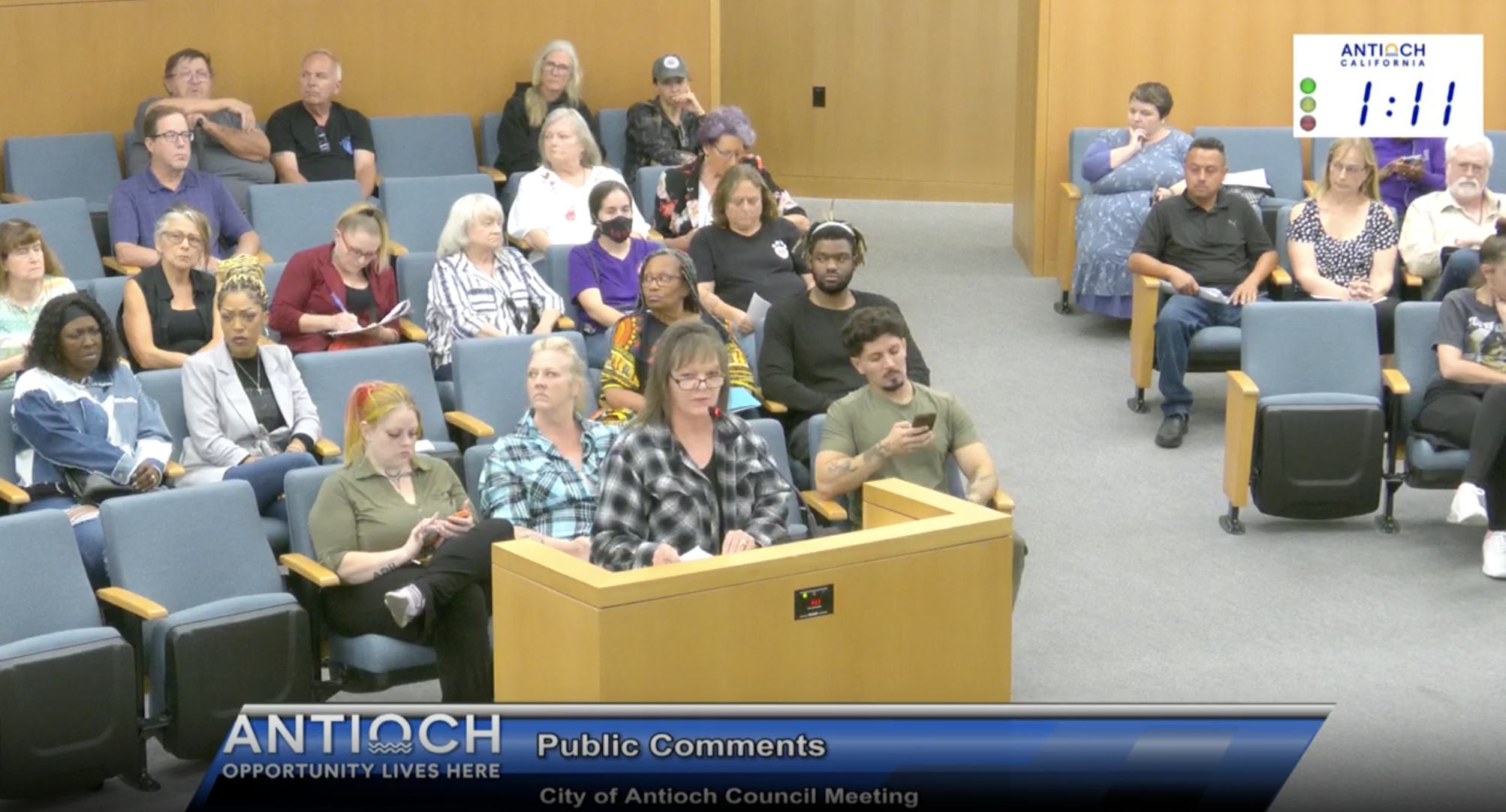
More than a dozen speakers flood council chambers to oppose freezing the animal services manager and any county takeover of the shelter
BART director warns the eBART line to Antioch could close if a half-cent sales-tax measure fails, with a $370M deficit hitting in 50 days
Council walks through 100+ city fees and orders corrections before a May 26 adoption hearing that could recover $1.8M for the general fund
New $7M landscape contract saves $2.4M over the incumbent bid, sparking a debate over long-term contracting practices
FY 26-27 Community Development Block Grant action plan delayed again as advocate warns prior-year federal dollars face expiration, risking a $35M Home Key award
Antioch High students present ADUs they built on campus — available free to qualifying low-income homeowners
Animal Shelter Showdown: Rescue Groups Mobilize Against Staffing Freeze
The most emotional stretch of the night came when speakers from rescue organizations, nonprofits, and neighborhoods lined up to oppose a staff recommendation to freeze the vacant animal services manager position — and to reject any discussion of transferring shelter operations to Contra Costa County.
Why it matters: The manager position has sat empty for roughly 2.5 years. Speakers argued that the vacancy has already weakened partnerships and jeopardized grant funding, and that a county takeover would dismantle a locally controlled shelter built with voter-approved Measure A dollars — one the city is still paying off through the Antioch Public Financing Authority.
Where things stand: Representatives of Roadie's Rescue, K911 Animal Rescue, HARP, Positively Safe, and Fix Our Shelters all spoke, along with individual residents and at least one veterinarian. Their core arguments: the position was created after a grand jury investigation and is essential to accountability; partnerships with Joy Bound (formerly ARF) and Maddie's Fund grants depended on professional management; and local animal control provides faster dangerous-dog response than the county, whose Pinole satellite shelter closed in 2020.
"The animal services manager position was not created arbitrarily. It was recognized as the necessary leadership role following concern and recommendations identified during the grand jury investigation," said Carolynne Steen, Rhodie's Rescue.
Holly Cuciz, co-founder of PAWSitively S.A.F.E., presented cost comparisons between the city's $2.9M shelter budget and an estimated $1.6M county contract, arguing the savings weren't worth the loss of local control and responsiveness to a citywide stray animal crisis.
"I think it's time to clear the air and be transparent with the citizens of Antioch. The ask is really quite simple," said Dr. Jeffrey, a public commenter who demanded the city disclose who is involved in county discussions and what their agenda is.
The other side: One speaker, Patty, broke from the group consensus and advocated for a county takeover, arguing the county has veterinarians on staff and established spay/neuter capacity that Antioch lacks.
Mayor Pro Tem Donald Freitas pushed back hard on the transfer idea.
"It's like saying we're going to go and buy a car and then we're going to let somebody else park it in their car and drive it, but we'll still pay the maintenance on. Doesn't make any sense to me," he said.
Freitas also noted the city had just received a $34.9 million Home Key award from the state.
Decisions: The budget study session itself was deferred to a May 13 special meeting at 4 p.m. due to time constraints. Acting City Manager Ana Cortez confirmed the position freeze was a staff recommendation that council has not acted on. The vote to adjourn the special session passed 3-0 (For: Freitas, Bernal, Rocha; Against: 0, Absent: Torres-Walker, Wilson).
What's next: The full budget discussion continues at the May 13 special meeting. Residents who spoke urged council to fill the position before finalizing the FY 26-27 budget.
BART's Fiscal Cliff Could Erase Antioch's Rail Link
$370M Deficit, 70% Service Cuts, and an eBART Shutdown on the Table
BART Board Director Mark Foley delivered the starkest warning of the evening: without a successful ballot measure, BART will face a $370 million annual operating deficit starting in roughly 50 days — and the entire eBART extension to Antioch could be eliminated.
The basics: Before COVID, BART drew 71% of its operating budget from fares. Ridership has recovered to about 70% of pre-pandemic levels, but commuters ride fewer days per week. Federal and state relief funds are now exhausted.
Why it matters: SB 63 authorized a half-cent sales tax across five BART counties for 12 years, projected to generate about $310M per year — still leaving a $60M-$70M gap. The governor's $560M loan is a bridge, not a solution: BART cannot accept it unless a revenue measure passes.
Where things stand: Without new revenue, BART staff has outlined a Plan B: 70% service reduction, 9 p.m. closures, 30-minute headways, three-line service, 1,200 layoffs, 50% fare and parking increases, and potential station closures. Staff initially recommended closing the 10 lowest-ridership stations, including North Concord and Pittsburgh Center. If cuts go deeper, the entire eBART extension could be shuttered.
"Starting in January, if no additional revenue is identified, we need to find a way to cut $370-odd million from the budget. That would potentially mean a 70% reduction in service," said Director Foley.
Foley noted bright spots — new fare gates recovering $10M in revenue, a 41% drop in crime, 90% customer satisfaction, and the Clipper Start low-income fare program logging more than 200,000 trips per month. But the math remains dire.
"I don't want to sit on the dais at a BART board and close that extension. So my dedication here is to do everything we can to keep East County connected to BART and to keep folks off Highway 4," he said.
Mayor Ron Bernal underscored the regional stakes.
"Cumulatively, this can just be catastrophic to East Contra Costa County if this measure doesn't pass and if we don't find ways of really continuing to build up our transportation system out here," he said.
What's next: Signature collection for a November ballot measure is underway. The council took no formal action; the item was informational.
$1.8M Fee Overhaul Heads to May 26 After Page-by-Page Council Review
Walden Financial Services consultant Preeti Patel walked the three-member council through a comprehensive user fee study covering police, animal services, planning, building, code enforcement, public works, marina, recreation, and engineering fees — the city's first full review in years.
Why it matters: Acting City Manager Ana Cortez urged the the city council to increase the fees as proposed because it would allow the city to incorparate nearly $1.8 million into the budget.
"[It] will help offset our deficit," said Cortez.
Where things stand: The study used staff time estimates, salary and benefit data, overhead allocation, and productive-hour calculations to measure full cost recovery for each service. The council reviewed items line by line, flagging issues including:
Bicycle registration reduced from a suggested $25 to $10 to encourage participation
New card room permit fee removed because Antioch's ordinance prohibits new card rooms
CCW permit fees flagged as confusingly worded; staff directed to clarify
Building permit pool/reroof fees that appeared to show $40,000-$60,000 charges — staff clarified these are valuation inputs, not actual fees
Shopping cart impound fee jumping from $53 to $550
Marina fees barely increased; council requested a competitiveness comparison with neighboring marinas
Mayor Pro Tem Donald Freitas pushed for more frequent reviews.
"For us, particularly the financial situation we find ourselves in, we need to institutionalize this so that whoever is on council will get the most current information possible," he said, advocating for fee studies every three years.
What's next: Staff will bring a corrected fee schedule to the May 26 public hearing for formal adoption.
$7M Landscape Contract Saves $2.4M, Ignites Debate Over Contract Terms
Council awarded a five-year landscape maintenance contract to Elite Maintenance and Tree Service — selected from five proposals — at $7M total, comprising a three-year base ($4.18M) and two optional years ($2.85M). The incumbent, TerraCare, bid $9.4M.
"That underscores my reason for having competition. That's a $2.2 million difference between the existing contractor and a new contractor," said Mayor Pro Tem Donald Freitas.
Freitas requested a June agenda item to discuss the merits of shorter contract terms to ensure continued competitive bidding. (The actual spread between bids was $2.4M.)
Public commenter Mr. Becker questioned whether coverage areas were complete and criticized oversight under the prior contractor. Staff confirmed public works supervisors would monitor both work quality and contract administration.
Decisions: Passed 3-0 (For: Freitas, Bernal, Rocha; Against: 0, Absent: Torres-Walker, Wilson).
CDBG Dollars at Risk as Action Plan Hearing Delayed Again
The public hearing on the FY 26-27 Community Development Block Grant (CDBG) annual action plan was opened and immediately continued to May 26.
Why it matters: Public commenter Mr. Becker warned that prior-year CDBG funds face a 2026 expenditure deadline, and a Home Key project cannot begin design without unlocking those dollars. He also criticized the draft action plan for prioritizing Habitat for Humanity housing rehabilitation over low permanent supportive housing, which Contra Costa County identified as the area of greatest need.
Mayor Pro Tem Donald Freitas explained the CDBG subcommittee had been unable to achieve quorum and the federal allocation was not known until May 10. He directed staff to schedule a subcommittee meeting for May 22 to develop recommendations before the May 26 council vote.
Decisions: Continuance passed 3-0 (For: Freitas, Bernal, Rocha; Against: 0, Absent: Torres-Walker, Wilson).
Antioch High Students Build Tiny Homes for Low-Income Residents
Dylan Howell, a teacher at Antioch High School, presented the Big Skills / Rebuilding Together Accessory Dwelling Unit (ADU) program, in which four learning leaders (ages 18-20) and 25 senior students spend the full school year constructing 8-by-20-foot accessory dwelling units complete with a bedroom, bathroom, and kitchen.
The units are available free to qualifying low-income homeowners or for roughly $100,000 otherwise. One student, Will, announced he will continue into a four-month paid program in Oakland with a $10,000 stipend and a diploma. Another, Jelani, plans to attend Lincoln Tech in Colorado for electrical training.
Mayor Pro Tem Donald Freitas praised the program's evolution from basic wood shop to real construction. Mr. Becker suggested connecting the program with the city's inclusionary housing ordinance, which allows ADUs on religious sites and surplus city properties.
New State Laws Could Fast-Track Housing, Bypass CEQA
Special Counsel Derek Cole briefed council on AB 130 and SB 131, two trailer bills that streamline the California Environmental Quality Act for housing projects. AB 130 creates exemptions for projects under roughly 20 acres that meet density thresholds — 10 units per acre in suburban areas, 15 in metropolitan — and conform to the general plan and zoning. SB 131 expands the ability to rely on prior environmental analyses.
Mayor Pro Tem Donald Freitas expressed concern about liability exposure, traffic impacts at intersections already at level F, and the burden on staff to make rapid determinations. Cole noted existing state immunities protect cities from most liability. Senior Planner Kevin Scudero explained that current housing element sites typically use Section 15183 community plan exemptions, with CEQA consultants paid by developers.
Decisions: Received and filed, 3-0 (For: Freitas, Bernal, Rocha; Against: 0, Absent: Torres-Walker, Wilson). Freitas requested staff training and proactive notification when qualifying projects enter the pipeline.
Minor Items
Parks and Recreation Commission appointments: Nicole Gardner (partial term), Jim Thor, Ellen Greggs, and Dorothy Ellis (reappointment as chair) all approved 3-0, restoring the commission's quorum for the first time in months.
SB 707 technology disruption policy adopted 3-0, giving the city up to one hour to resolve Internet or telephonic outages during meetings before council must decide whether to continue or adjourn. A drafting error referencing "City of Banning" was corrected to "City of Antioch." Starting in July, Antioch must allow two-way remote public participation.
Proclamations approved for National Police Week (May 10-16), National Public Works Week (May 17-23), and Mental Health Awareness Month (May 2026, permanent). Mental health honorees included the Felton Institute's Angelo Quinto Community Response Team, A3 Contra Costa Health, and NAMI Contra Costa. NAMI CEO Gigi Crowder announced plans to expand crisis intervention training for Antioch police using a city civic engagement grant.
Closed session: Council gave direction to staff on labor negotiations with multiple employee organizations; no reportable action.
Taco truck permit dispute: Rafael Trejo, owner of Tacos Elazador, told council he was ordered to vacate his Lowe's location for 30 days to reapply for a permit despite having all required documentation, putting his business and eight employees at risk.
2026 Antioch Community Mental Health Fair announced by Queen Adupoku of Royal Emotional Care, planned for Sept. 19 at Empire Business Park.
"Mayor at the Market": Mayor Bernal announced he will be at the Antioch farmers market on May 24 from 10 a.m. to noon.