City Council - Apr 14, 2026 - Meeting

City Council - Apr 14, 2026 - Meeting

City CouncilAntiochApril 14, 2026

Sources:

Locunity is a independent informational service and is not an official government page for this commission.We use AI-assisted analysis and human editorial review to publish information.

Council Rejects Affordable Housing Financing in Rare Rebuke of State Mandate

Antioch's city council killed tax-exempt bond financing for a 165-unit affordable housing project in a fractured 2-2-1 vote, then heard a developer warn that two more linked projects totaling 300-plus units could die next — all while the city celebrated real progress housing its most vulnerable residents and launched the first general plan update in 23 years.

  • Hillcrest Summit Apartments financing fails 2-2-1 after Mayor Pro Tem blasts design around a 24/7 gas station and calls state mandates "a gun to our head"

  • Developer warns 300+ affordable units at risk as Buchanan Crossing TEFRA hearing opens amid procedural fallout from the Hillcrest rejection

  • CORE outreach team cleared Antioch's legacy encampment, housing 190 people with 98% staying housed — but county warns federal cuts could unravel the system

  • Nine residents appointed to General Plan Advisory Committee, launching Antioch's first comprehensive land-use rewrite since 2003

  • Police Oversight Commission fully staffed with unanimous appointment of former councilmember Emanuel Solis Jr.

  • City overhauls SeeClickFix platform after audit uncovers service requests unanswered since 2018


Affordable Housing Clash: Hillcrest Financing Fails, Developer Says Both Projects Could Die

The night's most consequential action came not from a yes vote but from a failed one. The council conducted a Tax Equity and Fiscal Responsibility Act (TEFRA) public hearing — required under federal tax law before issuing tax-exempt bonds — for up to $50 million in revenue bonds to finance Hillcrest Summit Apartments, a 165-unit affordable housing project at Hillcrest Avenue and East Tregales Road developed by Cypress Equity Investments.

Why it matters: The project was already approved ministerially under the city's Commercial Infill Housing Overlay District, adopted in 2022. The council had no authority to alter the design or deny the project itself — only to decide whether Antioch would serve as the "host" government for the tax-exempt bond issuance through the California Municipal Finance Authority.

Where things stand: Mayor Pro Tem Donald Freitas led the opposition, arguing the four-story building wraps around a 24/7 gas station and car wash, creating public safety hazards. He cited 145 parking stalls for 165 units and predicted level-F traffic on Hillcrest Avenue and Shattuck Drive. Quoting HCD correspondence to Concord as evidence of state overreach, he called the situation "a gun to our head."

"I am very, very unhappy that the state legislature is shoving down these regulations and not helping us at the local level," Freitas said.

He then turned to the developer: "Shame on you for building this type of project. Shame on you."

Mayor Ron Bernal expressed his own displeasure with the aesthetics, describing the elevations as "really stark." He also noted the California Municipal Finance Authority (CMFA) would grant only about $13,000 to the city from a $50 million bond sale, with minimal property tax revenue.

The other side: A representative from Cypress Equity Investments argued the project was designed within the city's own zoning and code.

"165 affordable units serve a critical community need," the developer said, noting the project complied with all applicable regulations.

Decisions: The motion failed 2-2-1 (Yes: Bernal and Rocha; No: Freitas and Wilson; Abstain: Torres-Walker). CMFA representative Jared Suzuki noted the county or state could serve as an alternative host approver.

Buchanan Crossing: "If We Don't Get Approval, We Lose Both Projects"

The Hillcrest rejection immediately complicated the next item: a separate TEFRA hearing for Buchanan Crossing, a $43 million bond issuance for a multi-family rental project at 3210 Buchanan Road by Standard Communities. Lori Asuncion, the city attorney, advised that the Hillcrest vote had also failed to approve a JPA membership agreement needed for subsequent TEFRA items.

Tommy Atlee of Standard Communities made an urgent case, warning the council that Buchanan Crossing and a linked project called Lakeview Center share excavation logistics — meaning losing one kills both.

"If we don't get approval, we lose both projects because the way that we are working on our contract with our general contractor, if we can't close in the next two months, we're going to lose our pricing," Atlee said.

He emphasized the projects would include deeply affordable units accessible to minimum-wage workers.

"Someone who is making minimum wage, 20 bucks an hour, will be able to afford our project on 30% of rent," he said.

During public comment, newly appointed GPAC member James Becker, also Antioch Chamber of Commerce chair, challenged the 60% AMI threshold as too high for a community predominantly under 50% AMI, questioning whether the development truly serves the most vulnerable.

What's next: The transcript cuts off during public comment on Buchanan Crossing, so the final vote outcome is unknown. The fate of both projects — which would deliver 64 deeply affordable (30% AMI) units and dozens more at 50% AMI — hangs on whether the council can approve financing before state tax credit deadlines expire.


Encampment Cleared, 98% Stayed Housed — But Federal Cuts Loom

Two back-to-back presentations painted a picture of meaningful local progress on homelessness shadowed by threats from Washington and Sacramento.

The basics: Antioch's Coordinated Outreach, Referral, and Engagement (CORE) program, run by H3, served nearly 400 participants in the first half of the fiscal year with more than 5,700 services. The team cleared the legacy unhoused encampment — 48 residents — in August 2025, transitioning all to Opportunity Village at the Executive Inn. Staff reported 98% of individuals who exited to stable housing remained housed. Key barriers included pets (70-plus dogs at the encampment), lack of income (56% had none at intake), document readiness, and substance use.

Why it matters: The Opportunity Village lease ends January 2027. The Encampment Resolution Grant expires in 2028. Without continued funding or new shelter capacity, gains could reverse.

Councilmember Tamisha Torres-Walker highlighted the connection between encampments and human trafficking, noting the CORE team encounters

"individuals who are being trafficked oftentimes in encampment situations where people prey on them for survival."

County: $45.50 an Hour to Afford a Two-Bedroom

Jamie Schecter of Contra Costa Health, Housing and Homeless Services presented county-wide data showing 14,000-plus people served — a 40% increase since 2020 — and a 40% decrease in Antioch's point-in-time count. But she delivered a stark warning:

"Workers need to earn $45.50 to afford a two-bedroom apartment in Contra Costa County."

She cautioned that HUD policy shifts, potential Medicaid and SNAP cuts from H.R. 1, and the state halving HHAP funding from $1 billion to $500 million all threaten the system.

"The federal impacts from H.R. 1 to Medicaid and to SNAP are going to hit our folks hard," Schecter said, noting almost 80% of people using crisis response services have a disabling condition.

Torres-Walker pressed on why Antioch hasn't pursued funding as aggressively as neighboring cities.

"The city of Antioch has passed up three Homekey application opportunities. The city of Richmond has gotten three encampment resolution grants, and we're still on our first one," she said.

Schecter mentioned flex funds as an innovation some cities are piloting.

What's next: The council received both presentations as informational items. No action was taken, but the Opportunity Village lease expiration in January 2027 and potential federal cuts create urgent planning deadlines.


First General Plan Update Since 2003 Gets Its Committee

The council unanimously appointed nine residents to the General Plan Advisory Committee, launching Antioch's first comprehensive land-use rewrite in more than two decades.

Why it matters: Antioch's current general plan dates to 2003. The city has since grown into Contra Costa County's second-largest city, with unresolved questions about open space, economic development, and housing that the new plan will address through approximately 2046.

The committee includes two planning commissioners (Courtney Jones and Kevin Riley), five at-large members (James Becker, Edgar Alejandro Martinez, Sean McCauley, Radonna Means, and J.R. Wilson), and two alternates (Vongo Wesi and Desiree Coronado). All were approved 5-0 individually.

Where things stand: Appointees struck themes of economic development, local jobs, and equity. Sean McCauley stressed the need to bring jobs to Antioch, noting residents currently commute three to four hours daily. During public comment, Stephen dePaschalis of Save Mount Diablo advocated for open space protection, particularly in the Sand Creek area near Black Diamond Mines, citing Measure T's 79% landslide victory as evidence of resident support for conservation.

Mayor Pro Tem Donald Freitas raised Form 700 disclosure requirements and conflict-of-interest recusal obligations.

"If you are a property owner, you have to recuse yourself from discussions," he said, noting one applicant is a developer.

The city attorney confirmed FPPC standards apply.

What's next: The committee will meet approximately monthly for an estimated two-to-three-year process. Freitas noted he served as mayor during the creation of the current 2003 general plan.


Police Oversight Commission Now Fully Staffed

Mayor Ron Bernal nominated Emanuel Solis Jr., a lifelong Antioch resident and former city councilmember, for the final vacancy on the Antioch Police Oversight Commission. The partial term runs through November 2026.

"I think the common thread is people believe that we deserve the best," Solis said. "We may not be seen as the best community out there, but we should expect the best because I think we deserve the best."

Councilmember Tamisha Torres-Walker, who identified herself as a victim of state-sanctioned violence by Antioch police, pressed Solis directly:

"What would you say to victims like myself, others here in the audience, and others watching today about what do you believe would be different about your thinking today on this commission than years ago when you were up here in our position?"

She urged him to champion diversity training, outside training for the commission, and independent community engagement not dependent on the police department.

Decisions: Approved 5-0. The seven-member commission is now fully staffed and empowered to begin oversight operations.


City Discovers Years-Old Unanswered Service Requests

GIS Coordinator Brandon Peters presented a comprehensive assessment of the SeeClickFix citizen reporting platform, ordered by Bessie Marie Scott, the city manager, after prolonged complaints. The audit found no service level agreements communicated to residents, departments processing requests in silos with excessive handoffs, and some requests dating back to 2018 left unaddressed.

Improvements include new SLAs, integration with Trimble Unity Maintain for automated work-order routing, a live dashboard for real-time monitoring, and department-level accountability "agencies." The police department's community service officers have also begun using the platform proactively.

Mayor Pro Tem Donald Freitas expressed concern about extended response times and requested quarterly progress updates. Councilmember Monica Wilson asked about handling requests outside city jurisdiction — such as PG&E or Comcast issues — and Peters explained new automated responses and an FAQ page will redirect residents appropriately.


Minor Items

  • Fish screen monitoring contract ($594,180 to Environmental Science Associates) approved 4-1, with Mayor Pro Tem Freitas dissenting over the five-year, up to $900,000 total commitment during the city's budget deficit. Staff confirmed the monitoring is mandated by California Fish and Wildlife and funded from the water enterprise fund, not the general fund.

  • Water treatment plant valve replacement contract ($545,342) approved 5-0 after a contract exhibit correction.

  • Cannabis equity grant accepted 5-0. The state-funded grant will assess whether people criminalized by the War on Drugs can access Antioch's cannabis industry. Councilmember Torres-Walker clarified the grant evaluates access at all levels — cultivation, dispensary operation, and employment. She and Mayor Pro Tem Freitas noted their first cannabis site visit was scheduled for the following day.

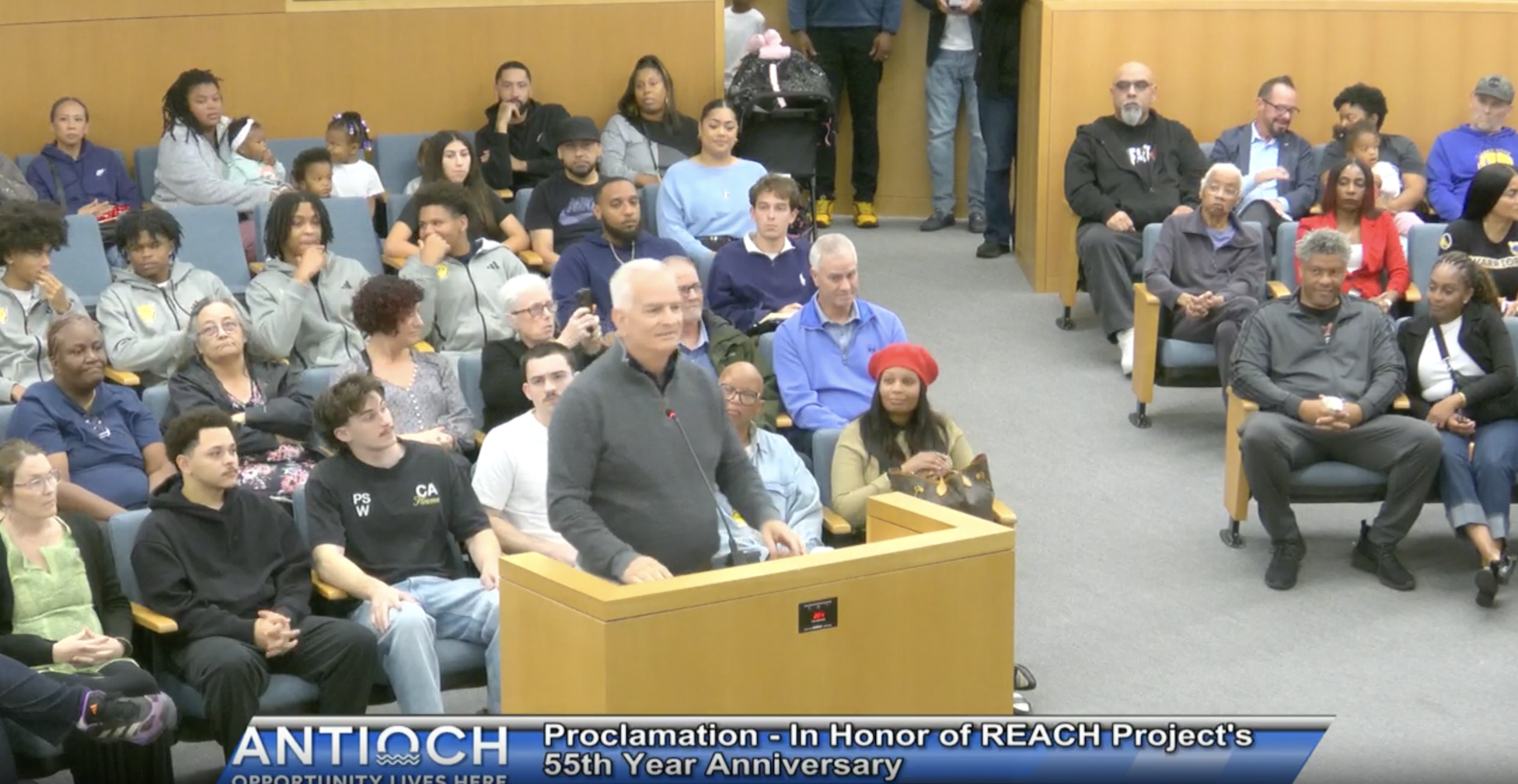
  • Four proclamations approved 5-0: the REACH Project honored for 55 years of youth counseling; Cornerstone Christian School celebrated for girls' and boys' CIF basketball state championships — Councilmember Rocha noted the boys' title is only the second state championship in Antioch history since 1910; Animal Control Appreciation Week recognized Cat Cottle and staff; and Arbor Day proclaimed with Holy Rosary Catholic School principal Melissa Ortiz Gray describing their longstanding tree-planting partnership at Pruitt Community Park.

  • Animal shelter advocate Lisa Kirk of Fix Our Shelters urged the council during public comment to fund spay/neuter clinics, warning that Contra Costa County Animal Services stopped assisting Antioch residents — shifting the burden to volunteers and nonprofits managing an estimated 450,000 cats countywide.

  • Sales Tax Citizens Oversight Committee has five vacancies open with a May 1 deadline.