Antioch Switches Fuel Supplier, Doubles Fuel Budget to $1.25M
City Council • AntiochOctober 1, 2026
Locunity is an independent informational service and is not an official government page for this commission. All information is sourced from public footage and an analysis of official agendas with the aid of responsible, fact-checked AI. to report an error or omission.
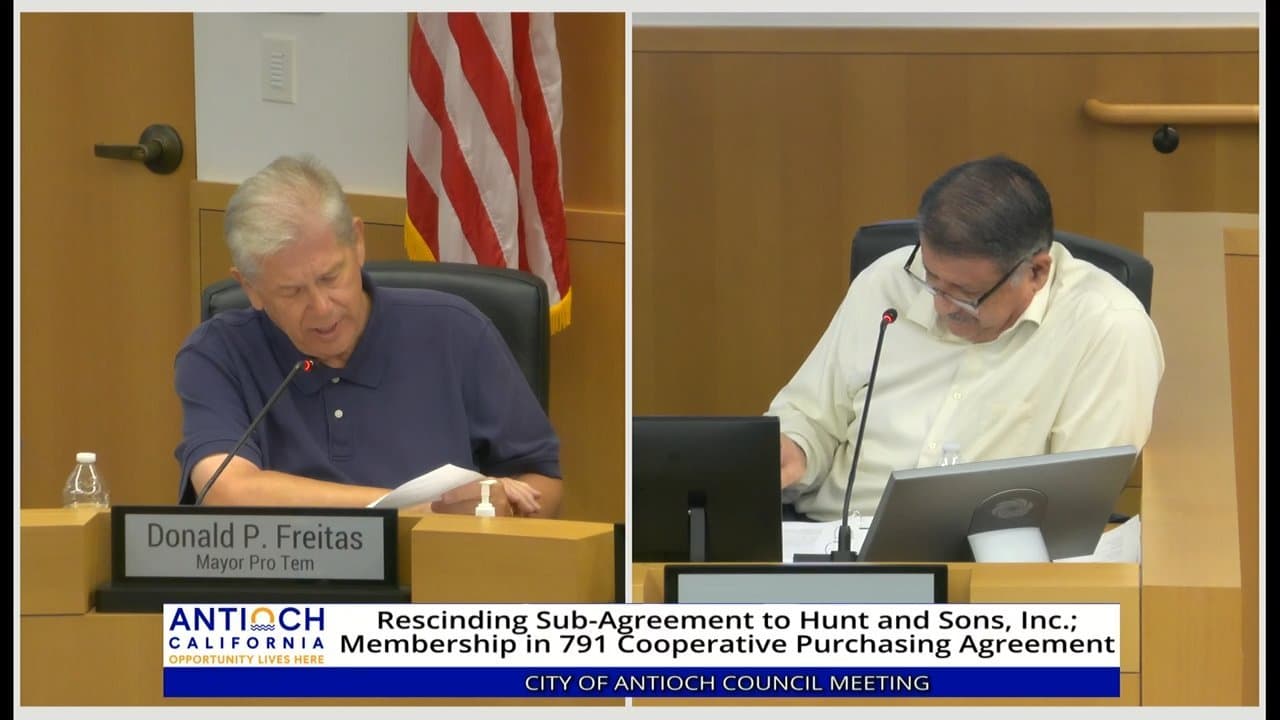
Antioch will buy its fuel through a Texas-based purchasing cooperative under a deal that could run seven years without a new competitive bid. At an Oct. 1, 2026, special meeting, the City Council voted 3-1 to sign with Pinnacle Petroleum, raise the fuel budget by $650,000 and pay $228,705.61 to a vendor that never met the city's insurance terms. Mayor Pro Tem Donald Freitas cast the lone no vote on both items, warning that the city's purchasing controls are failing.
- Pinnacle Petroleum fuel deal approved 3-1: four years plus three optional one-year extensions, capped at $1.25M a year
- Fuel budget rises $650,000 as unleaded jumps 75% and diesel 121% in nine months
- $228,705.61 paid to Hunt and Sons for fuel delivered under a contract the city never executed
- Freitas calls for a purchasing review and questions why fuel was accepted without required insurance
Texas Co-op Deal Replaces Failed Fuel Contract
The basics: The council approved five actions in one motion. It rescinded the Hunt and Sons award, joined the 791 Cooperative Purchasing Program under Antioch Municipal Code 3-14.12, approved a Pinnacle Petroleum agreement for unleaded and diesel fuel, and authorized a $650,000 budget amendment with matching revenue billed to departments. Cooperative purchasing lets the city buy through an existing co-op agreement instead of running its own bid.
Why it matters: The contract could run up to seven years at up to $1.25M a year. Most fuel costs land on the general fund, so the increase deepens a deficit the city is already managing.
Where things stand: Staff said fuel prices have surged and there is talk of $10-a-gallon diesel by year's end, which would exhaust the $600,000 FY 2026-27 fuel budget.
“Unleaded fuel has gone up 75% and diesel has gone up 121% over the last 9 months,” said the Deputy Public Works Director.
Staff said a SourceWell quote from Mansfield Oil came in higher, so they chose Pinnacle. Pinnacle has submitted its certificate of insurance and two endorsements and agreed in writing to the city's insurance terms. The contract also includes a termination-for-convenience clause, and the city does not have to exercise any extensions. Asked whether deliveries could start before all paperwork arrives, the deputy director said, “No, it's not going to start until we get everything.”
The other side: Freitas acknowledged the emergency. He argued the city manager could have used emergency powers for a short contract and then sought bids. He called the $1.25M figure “excessive … and very speculative,” noting first-quarter fuel costs were about $229,000. He projected the worst case at $900,000 to $1M.
He urged the city to “enter into a 6-month or 1-year contract so that we could actually go out to bid and see competitively what is out there.” When staff noted that past bids drew few vendors, Freitas replied, “3 or 4 vendors is better than one.”
He also questioned the co-op's Texas-specific terms: a Texas franchise tax certification, governance under the Texas Local Government Code and the Central Texas Council of Governments, and Texas workers' compensation. Staff said Assistant City Attorney Scott Thorn reviewed the co-op, compared it with Minnesota-based SourceWell, and confirmed that California insurance requirements sit in the sub-agreement. “It's a co-op that's based in Texas, but it's available to all 50 states,” the deputy director said.
Price oversight gap: Staff said discounts can be renegotiated against the OPUS fuel-price benchmark, but the city has not yet subscribed. “We're going to have to sign up for the OPUS program in order to have access to that information,” the deputy director said. Freitas asked staff to name who will be responsible, warning, “If nobody has that responsibility, then we're going to end up paying premium prices.”
The budget hit: Staff described the authorization as a ceiling, not a commitment. “This is an as-needed purchase. We don't have to spend that money,” the deputy director said. Mayor Ron Bernal confirmed that only enterprise funds pay outside the general fund, and staff agreed spending is trending toward $900,000. “That means the general fund deficit will increase on account of the increase in fuel costs,” Bernal said.
Councilmember Monica Wilson flagged a Sept. 4 Pinnacle effective date that overlapped with Hunt and Sons deliveries through Sept. 24. “I just didn't want us double paying for something,” she said. Staff offered to change it to the current date, but it is unclear whether the final motion included that change.
Decisions and stakeholder impacts: The motion by Wilson, seconded by Councilmember Tamisha Torres-Walker, passed (For: 3, Bernal, Torres-Walker, Wilson; Against: 1, Freitas; Absent: 1, Councilmember Louie Rocha). Pinnacle gains a multiyear municipal customer. General fund departments will absorb most of the higher costs through internal billing. Resident-facing services that depend on city vehicles regain a stable fuel supply.
City Pays for Fuel It Never Contracted For
Why it matters: For nearly three months, the city accepted fuel without the insurance endorsements it requires. That raised liability questions and renewed calls for tighter purchasing controls.
Where things stand: The item returned from the Sept. 22 meeting. Acting City Manager Cortez said the original Hunt and Sons contract expired June 30. During renewal, a larger firm that described itself as self-insured acquired the company. Hunt and Sons provided a certificate of insurance but never the required endorsements, and the city suspended deliveries Sept. 24.
The deputy director said the city never executed the contract. “They signed it, but we haven't because they never produced the endorsements,” he said. The payment, not to exceed $228,705.61, comes from the vehicle maintenance internal service fund and requires no new money. Asked by Freitas why the city should pay at all, the deputy director answered, “Because we took fuel and we used it.”
The other side: Freitas cited the risk of an explosion or injury and asked whether other contracts share the same flaw. “If we did not have all the insurance certificates, why in God's name did we move forward?” he asked.
He renewed his roughly two-year push for centralized purchasing. “It's a policy issue that I think needs to be reviewed and investigated by staff and the City Attorney's Office and come back to us,” he said.
Wilson asked whether payment could be read as accepting the contract. “I think that they certainly could make that argument,” the City Attorney said. She added that documented requests and emergency processes are “good evidence on our side” that it was not. Bernal confirmed that no late fees have been billed.
Two public commenters pushed back. One faulted the absence of the Public Works head, the noon meeting time and a failure to foresee rising fuel prices at budget hearings. A second questioned how staff kept negotiating past the due-diligence period. She also recalled an assistant city attorney's earlier assurance of no liability.
Decisions and stakeholder impacts: The motion by Torres-Walker, seconded by Wilson, passed (For: 3, Bernal, Torres-Walker, Wilson; Against: 1, Freitas; Absent: 1, Rocha). Hunt and Sons gets paid, and the city's legal exposure rests on its paper trail.
Minor Items
- Fuel stopgap: Since Sept. 24, city gas cards and an at-cost Delta Diablo arrangement have kept city vehicles running, limited to Delta Diablo's weekday working hours.
- Public comment rules: The city attorney said state law bars general public comment at special meetings, and Torres-Walker called the agenda format misleading. The city attorney pledged to fix future agendas.
- Closed session: Council discussed one potential case involving possible Labor Code 1102.5 and Fair Employment and Housing Act violations, with nothing reported out.
- Idling and EVs: Commenters questioned police car idling and take-home vehicles. One urged the city to pursue a state EV charger rebate program opening Oct. 7.
Looking Ahead
Cortez offered to report fuel spending at monthly budget reviews, and the finance director's fiscal year closeout in November offers another checkpoint. Watch for staff to name who will monitor OPUS pricing, and for the purchasing policy review Freitas requested.