City Council - Mar 10, 2026 - Meeting
City Council • AntiochMarch 10, 2026
Locunity is a independent informational service and is not an official government page for this commission.We use AI-assisted analysis and human editorial review to publish information.
Council Delays Affordable Housing Mandate as $13.6M Budget Deficit Looms
Antioch's City Council confronted the widening gap between its ambitions and its wallet, receiving a draft budget projecting a $13.6 million deficit while punting on a proposed inclusionary housing ordinance that advocates say the city desperately needs. Meanwhile, a $34.9 million state grant that could convert a blighted hotel into 85 units of permanent supportive housing moved closer to approval.
$13.6M deficit projected for FY27; staff warns spending is unsustainable as reserves drop from 43% to 35%
Inclusionary housing ordinance delayed 4-1 after two-hour debate; will be folded into General Plan process, leaving no affordable housing mandate for at least 6-12 months
$34.9M Home Key Plus grant for 85 permanent supportive housing units at former Comfort Inn nears state approval; loan committee meets March 12
12 organizations rally for 20% affordability requirement; Carpenters union and housing advocates push council to go further than proposed 15%
Pruitt Waterpark repairs approved despite calls to divest from facility losing $1M+ annually
Park district begins planning $10-15M lagoon replacement while youth swim programs train 3,000 students
$13.6 Million Hole: Antioch's Budget Picture Gets Starker
The basics: Finance Director Dawn Merchant presented a one-year budget for FY2026-27 — a departure from the typical two-year cycle — because of the city's structural deficit. The city brought in roughly $100 million in revenue last year but spent $11.4 million more than it collected. Next year's gap grows to $13.6 million.
Why it matters: The city is burning through reserves to stay afloat. The unassigned general fund balance is projected to slide from 43.83% of revenues to 35.31% — still above the danger zone, but trending the wrong direction. Unfunded pension and retiree health liabilities (OPEB) total approximately $171 million, a long-term obligation that dwarfs the annual gap.
Where things stand: Personnel costs consume 60% of the FY27 budget, with police services alone representing 57-60% of all general fund spending. The department is authorized for 105 sworn officers but carries roughly 20 vacancies; the council's stated priority is 117 officers, which would add approximately $2.9 million to the budget. Councilmember Tamisha Torres-Walker pressed for transparency on what that number actually means: "The clarification publicly makes sense because when we say 117, people think body, like 117 patrol officers on the street," she said, noting that only about 80 of the 117 would be patrol.
A $5 million annual draw from the Budget Stabilization Fund — seeded by Measure W sales tax revenue — covers part of the gap. The remaining $8.6 million comes straight from reserves.
Mayor Pro Tem Donald Freitas challenged staff on the dissonance between large reported fund balances and ongoing deficits: "It's very difficult publicly to say, well, we have $42.6 million at the end of the fiscal year, but we also have a deficit. It doesn't make sense."
Merchant offered a blunt assessment of the path forward: "The deficit continues to be astronomical. We need to continue to engage in significant program and service reductions review and how to align that with council priorities." She added that a user fee study underway would yield only modest help — "It's definitely not going to be anywhere near 11 million. If we're lucky, maybe half a million."
Councilmember Monica Wilson asked about grants by department and the status of a Section 115 Trust for unfunded liabilities. Mayor Ron Bernal summarized the challenge for the public: "There's a projected $11.3 million deficit for the upcoming year, which may or may not mean a lot to folks. But when we have a little bit less than $100 million in revenues, that's a significant amount of money."
One public commenter, Melissa, suggested the city explore pension reform modeled on San Jose's Measures B and F, reduce police overtime by leveraging civilians and community advocates, and invest in technology to reduce personnel costs.
What's next: Staff will return with a prioritized mitigation options chart. Residents should expect difficult conversations about service cuts and revenue over the next several months as the budget moves toward adoption.
Affordable Housing Mandate Shelved After Marathon Hearing
Why it matters: Sixty percent of Antioch residents are rent-burdened, and the city leads Contra Costa County in homelessness. Fourteen of 19 jurisdictions in the county already have inclusionary housing ordinances. The delay means no affordable housing requirement for market-rate developments for at least 6-12 months — and possibly longer.
Where things stand: Greg Goodfellow of PlaceWorks presented the proposed ordinance, which would require 15% affordable units (10% very low income, 5% low income) in new developments of five or more units. Developers who opt out would pay an in-lieu fee of $202,500 per unbuilt unit into a new Housing Trust Fund.
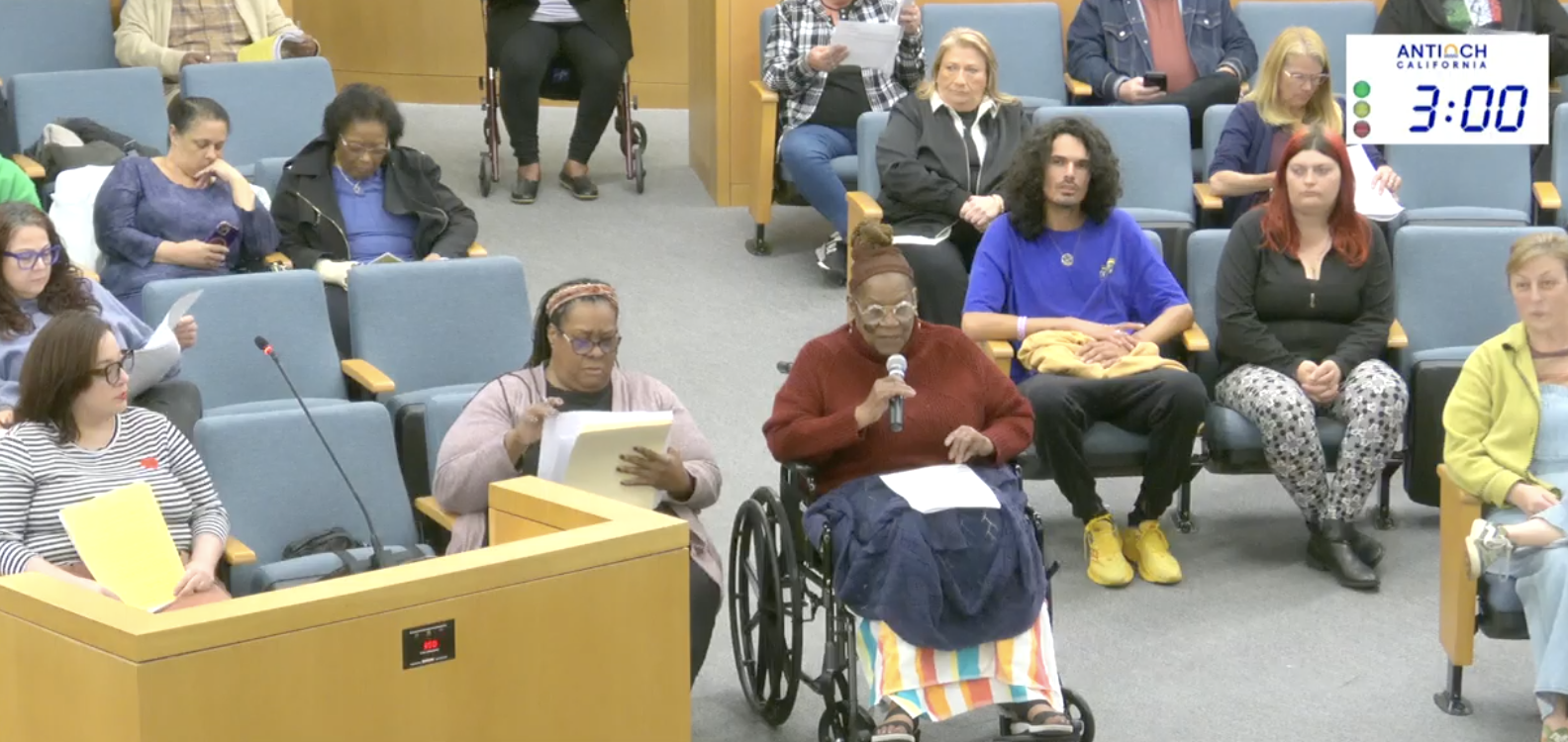
A coalition of 12 organizations — including East Bay Housing Organizations, Rising Juntos, Public Advocates, and Carpenters Local 152 — showed up in force, supporting the ordinance but pushing the council to go further. Joey Flegel-Mishlove of East Bay Housing Organizations told the council that the coalition recommends increasing the requirement to 20% and adding provisions for extremely low income households and a land donation option: "Sixty percent of Antioch residents are rent-burdened and 14 of 19 Contra Costa jurisdictions already have IHOs."
Cecilia Perez of Rising Juntos urged the 20% target, citing the housing needs of working families, seniors, immigrants, and those on fixed incomes. Pastor Josie of Antioch Seventh Day Adventist Church spoke about the moral dimensions of the housing crisis.
Anthony Carroll of Carpenters Local 152 said his union supports the ordinance overall but requested a continuance on the Housing Trust Fund component to negotiate labor standards requiring prevailing wages and apprenticeship on trust fund projects: "We'd like to have discussions with the city about a labor standards resolution."
The other side: A public commenter identified as Mr. Jordan argued the ordinance violates the Fifth and Fourteenth Amendments and constitutes an illegal taking of private property. He warned costs would be passed to first-time homebuyers: "The cost of including affordable housing units is passed on to the market rate buyers, making homeownership less attainable."
Mayor Pro Tem Freitas raised extensive concerns about staffing costs to administer the ordinance, traffic impacts including Level F conditions on Lone Tree Way, and the fact that neighboring cities require only 5-9% affordability. He argued the ordinance should not be adopted in isolation: "No one on this council or you out there, because we need to take a comprehensive view about how all of these things are going to impact our community. And to do this piecemeal is wrong."
Mayor Bernal echoed the concern about regulatory complexity, noting the city doesn't yet understand how current state housing legislation affects Antioch, let alone adding another layer.
Councilmember Louie Rocha asked questions about implementation but ultimately supported the continuance. Interim Director David Storer noted the land use element of the General Plan could be addressed within 6-12 months.
Decisions: Councilmember Torres-Walker cast the lone dissenting vote, pushing back against delay with urgency: "Antioch has the highest rate of homelessness in the county. We had the highest rate of evictions during the pandemic when we were not supposed to be evicting." The final vote was 4-1 to continue the ordinance off calendar and fold it into the General Plan land use element process, with Freitas making the motion and Rocha seconding.
What's next: The ordinance will be revisited as part of the General Plan update. Mayor Bernal and Mayor Pro Tem Freitas were appointed to the General Plan Advisory Committee on a 4-0 vote (Torres-Walker absent for that vote).
$34.9 Million Homeless Housing Grant Nears State Approval
Why it matters: If awarded, the Home Key Plus grant would convert the former Comfort Inn at 2436 Mahogany Way into 85 units of permanent supportive housing — the largest single investment in permanent supportive housing in Antioch's history — at an annual city cost of $1.2 million. Advocates call it a 5x return on residents' state tax contributions under Proposition 1.
Where things stand: Interim Director David Storer and Puneet of CSH Mahogany Housing reported that the California Department of Housing and Community Development has recommended the project for award. The internal loan committee was expected to meet March 12 to make a final decision. The city's environmental (NEPA) review for its $750,000 CDBG contribution is underway. CSH has already received a Home Key Plus award in Sacramento and has a Round 3 project under construction in Oakland.
The 2025 Point-in-Time count found 246 unsheltered individuals in Antioch — down 31% from 413 — but the need remains acute. The project would include 24/7 security, a gated community design, and case management services.
Public comment was passionate. A commenter named Nicole urged council support, noting millions already spent on abatement and emergency services for unhoused residents: "How much money have we already spent on police calls, on cleanups, on abatement? This is a solution." She named specific individuals — Raheem Koh and Tyrone Marshall — who died while homeless in the community.
Councilmember Rocha emphasized this as a long-term solution versus the cycle of temporary encampment relocations. Andrew Becker echoed support from the public.
Decisions: Council received and filed the update, 5-0.
What's next: The HCD loan committee decision is expected within weeks.
Code Enforcement Gets a Reboot
City Manager Bessie Scott framed the division's new approach: "Code enforcement is fundamentally about prevention and compliance. It is not about punishment. It is about maintaining community standards that protect the quality of life for our residents."
Interim Code Enforcement Manager Sunny reported that since the October operational assessment, the nine-member division (authorized for 12) has completed more than 2,060 inspections and closed over 1,000 cases. The unit shifted from static geographic beats to a thematic, corridor-based model targeting high-traffic areas including Lone Tree, Raley's, Sycamore Square, and Delta Fair Plaza, with expanded evening and weekend hours. A six-night street vendor enforcement action in February contacted 81 vendors and issued 64 warnings focused on education, not fines.
Council discussion touched on uniforms (balancing approachability with officer safety), the need for a vacant property registration program (Oakland's model was cited), and whether the city's $1,000 maximum fine per violation is sufficient. Torres-Walker pressed on coordination with Caltrans and railroad companies to maintain rights-of-way near city corridors. A public commenter raised concerns about racial bias in enforcement and auto repair activity on J Street.
Contra Loma Lagoon Replacement: Community Input Starts This Summer
East Bay Regional Park District Director Colin Coffey told the council that repair attempts on the long-closed Contra Loma lagoon revealed structural failures requiring a full $10-15 million replacement. A "Plan C" — potentially a traditional pool — is being developed, with community forums planned for this summer as part of the district's broader master planning process.
The closure turned into an unexpected opportunity. Lifeguard Manager Pete De Quincey described how partnerships with Antioch Unified School District expanded swim instruction from 500 students at the lagoon to 3,000 students at Deer Valley and Antioch High pools last year. Student-led CPR certification programs at Dozier-Libby, Park Middle School, and elementary schools have trained more than 1,700 students — a peer instruction model De Quincey called a first in the nation.
Mayor Pro Tem Freitas pressed for a faster replacement timeline, reflecting resident frustration over the years-long closure.
Minor Items
Consent calendar approved 5-0 after five items (H, J, K, L, M) were pulled for separate discussion.
Traffic calming project notice of completion accepted 5-0; residents requested expansion to additional streets.
Pruitt Waterpark pool resurfacing and concrete improvements approved 5-0. Public commenter John Trisuto argued the park lost its school field-trip revenue when water slides broke and should receive no further investment. Other commenters noted the facility loses $500,000-$1 million or more annually from the general fund. Torres-Walker supported the repairs to prevent liability and further decline but called for a broader conversation about the park's management model.
CalVIP Cohort 5 grant for violence prevention accepted 5-0.
Municipal Pooling Authority JPA agreement renewed 5-0; Linda Cox of MPA reported the insurance pool is now over 90% funded and premiums are declining as the city recovers from prior litigation.
Lakeview Center and Buchanan Crossings CFD annexation appeals both continued off calendar for staff and appellants to negotiate.
National Prescription Drug Abuse Awareness Month proclaimed; Danielle Aubin of Bay Area Community Resources presented on fentanyl overdose trends in Contra Costa County. DEA Take Back Day is April 26.
Closed session on significant litigation exposure concluded with no reportable action per City Attorney Lori Asuncion.
General public comment: Debbie Blazier of the Downtown Antioch Association announced upcoming downtown events. Jim Becker of the Antioch Chamber of Commerce promoted Chamber events and the Chamber Cares $500 vandalism repair grants. Crystal Law criticized the council's progress on homelessness and economic development. A public commenter named Melissa gave the council an "F" on economic development and urged proactive business recruitment.