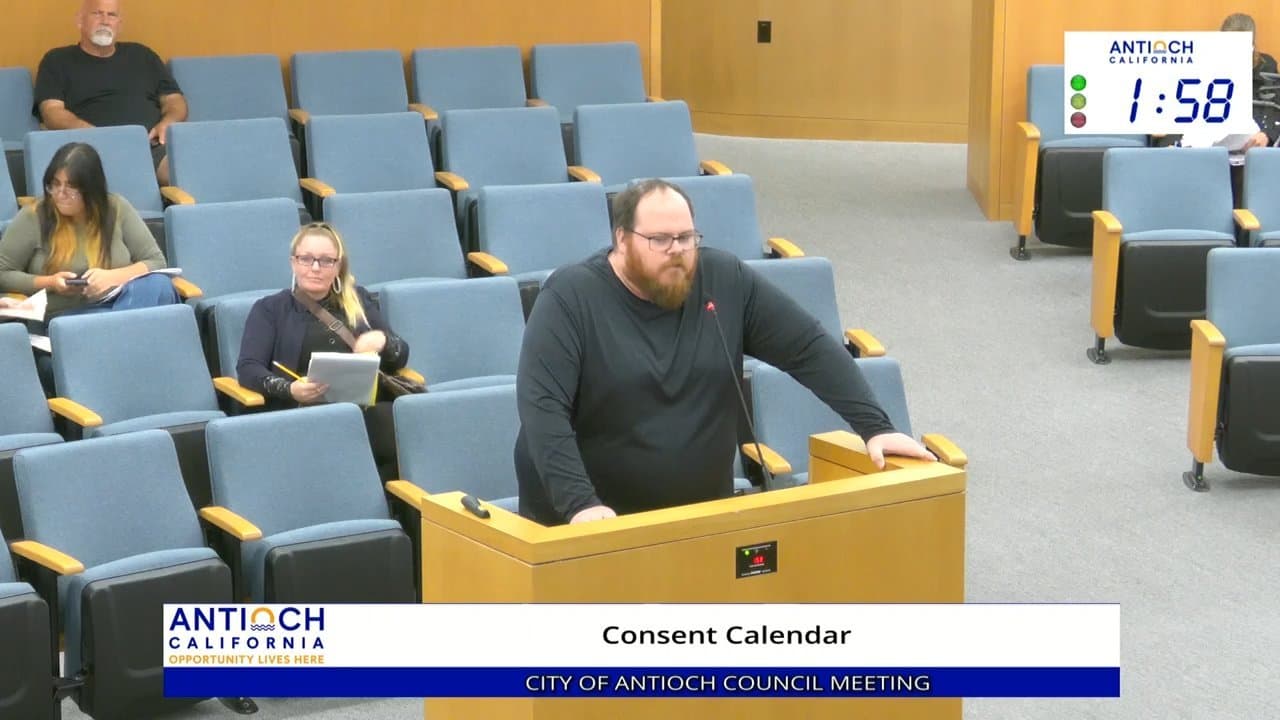
City Council - Sep 22, 2026 - Meeting
City Council • AntiochSeptember 22, 2026
Locunity is an independent informational service and is not an official government page for this commission. All information is sourced from public footage and an analysis of official agendas with the aid of responsible, fact-checked AI. to report an error or omission.
Council Backs Standalone Economic Development Department as Commercial Vacancies Mount
Antioch's City Council signaled its most aggressive economic development pivot in years, unanimously directing staff to build a standalone department with a competitively paid director after two failed recruitment attempts. The same meeting saw council members defer an emergency fuel purchase over an insurance debacle, demand a citywide security RFP, and face an impassioned public push to save the nearly century-old El Campanil Theater before a church sale closes escrow.
- Council directs staff to create a standalone Economic Development Department with competitive salary, departmental budget, and recruitment RFP — due back Oct. 13
- Emergency $500,000 fuel authorization deferred after Mayor Pro Tem Freitas refused to approve continued deliveries from a vendor that can't prove insurance compliance
- Seven speakers urge council to save El Campanil Theater before Sept. 29 church sale; Assemblymember Avila-Farias' office pledges support
- Downtown security RFP ordered with expanded citywide scope after crime rises following lapsed contract
- Two Pruitt Water Park change orders ($141,267) approved amid sharp public criticism comparing spending to rejected Homekey housing
- Torres Walker asks council to reconsider Homekey Plus, saying HCD is still holding funds despite the city's formal rejection
Antioch Finally Goes All-In on Economic Development
The meeting's longest and most consequential discussion ended with a clear consensus: Antioch needs a standalone Economic Development Department with a dedicated director — not a split role, not a side hustle for an assistant city manager.
The basics: Acting City Manager Anna Cortez presented two options — a dedicated economic development director or an 80/20 assistant city manager model that would pair administrative leadership with business recruitment. The discussion touched on organizational structure, salary benchmarking, recruitment strategy, and the depth of Antioch's commercial crisis.
Why it matters: Two prior executive searches failed because Antioch's salary is the lowest among nine comparable jurisdictions — by $30,000 to $45,000. Meanwhile, commercial vacancies are spreading across the city. Mayor Pro Tem Donald Freitas compared Antioch unfavorably to Garden Grove, a city of 170,000 with a $198 million budget and 11 economic development staff.
Where things stand: Freitas initially advocated for the combined assistant city manager/economic development director model, arguing it would give the position authority to cut through departmental silos and provide continuity of leadership. He noted Antioch last had a combined position in the late 1990s.
But Councilmember Monica Wilson shut the door firmly: "I am in the camp of a standalone. Because we've done it multiple times. We've had, oh, this person's economic development and the administrative manager, or this person's economic development and — and it hasn't worked out."
Councilmember Tamisha Torres Walker echoed Wilson's position. Freitas ultimately conceded, pivoting to salary: "I will support a stand-by-itself economic development department. I do think that the salary has to be reviewed to make us competitive with a knowledgeable, experienced person."
Mayor Ron Bernal stressed the quality of the hire matters as much as the structure: "It can't be a person who always wanted to be an economic development director. It's got to be somebody who really is well-versed, well-connected, hunter, marketer."
The other side: Former Councilmember Alan Payton, who originally proposed the combined model, clarified it was intended as a temporary bridge until an assistant city manager is hired, then would revert to 100% economic development.
Public commenters were emphatic. Mr. Becker painted a bleak picture of Antioch's commercial landscape: "Every business, every commercial property is going up for sale in the city of Antioch. Every single one." He cited the Foodmax on Lone Tree going up for sale and an entire medical campus sitting vacant. Melissa Case called for 100% dedicated positions and urged the city to stop settling for less than excellence.
What's next: Staff will return Oct. 13 with a job description, competitive salary range using Stockton as a benchmark, departmental budget, organizational chart, and recruitment RFP. Staff was also instructed to update the outdated classification description and clarify title hierarchy.
Fuel Contract Dispute Exposes Procurement Gaps
A straightforward request for $500,000 in emergency fuel purchasing authority became a case study in what happens when vendor compliance falls through the cracks.
The basics: Public Works Director Scott Bunting explained that the city's fuel vendor, Hunt and Sons — approved by council in April 2026 through a Sacramento Coalition of Governments cooperative agreement — was acquired by Phillips 66 and subsequently failed to provide required insurance documentation. Since July 1, the city has continued receiving fuel to maintain fleet operations, accumulating approximately $175,000 in unpaid invoices through Aug. 31.
Why it matters: The city has been accepting deliveries from a vendor it cannot verify is insured, potentially exposing Antioch to uninsured liability. The situation also highlights the absence of a centralized purchasing function.
Where things stand: Mayor Pro Tem Freitas was unsparing: "I'm very uncomfortable with having more deliveries from Hunt and Son or Phillips 66 or whoever they are, but I do realize we need fuel." He went further, calling for systemic reform: "I think the City of Antioch needs a purchasing officer who oversees this, works with the departments, works with the attorney's office. I just find this completely unacceptable."
Torres Walker proposed separating the issues — paying the outstanding invoices for fuel already received while immediately stopping further deliveries from the noncompliant vendor. Acting City Manager Cortez agreed to use emergency procurement provisions in the municipal code to secure a replacement.
The other side: Mr. Becker questioned the timeline, noting public records suggest the Phillips 66 merger occurred in 2023, raising questions about how long the compliance gap existed. Melissa Case pressed on staff accountability: who verified compliance before the contract, who monitored it afterward, and why wasn't the problem immediately addressed?
Decisions: Council voted 4-0 (Councilmember Louie Rocha absent) to defer the item to Oct. 1, directing staff to return with total outstanding invoices, an explanation of emergency procurement provisions, and an update on the replacement vendor contract.
Residents Pack Meeting to Save El Campanil Theater
Seven speakers descended on public comment with a single message: the council must act before the nearly century-old El Campanil Theater is sold to Movement Church, with escrow reportedly closing around Sept. 29.
Why it matters: The theater received more than $750,000 in public restoration funds over the years and serves as a rare arts and LGBTQ+ community venue in downtown Antioch. Local business owners say its loss would undercut the economic vitality of the surrounding commercial district.
Where things stand: Michael Selby asked the city attorney to file a stay or injunction while investigating the legality of the 2023 sale, noting the property was originally sold for approximately $800,000 and is now in escrow for $1.5 million. He argued the public restoration funds should be repaid.
Warren Lutz reported the church is still $141,500 short of its financing target. He urged the council to begin historic landmark designation, explore acquisition, and hire an experienced theater operator. He pointed to the city's roughly $28 million in general fund reserves above its 20% minimum policy, and directly asked the mayor to place the theater on a future agenda.
Kayla Turnage, a field representative for Assemblymember Avila-Farias, told the council the assemblymember stands with the community and offered her office's assistance. Michael Gabrielson, a downtown business owner, warned of cascading economic damage to nearby restaurants and shops. Angela Richardson brought a 2004 newspaper documenting the community restoration effort and reported a sold-out U.S. Air Force Band concert the previous night.
Despite the urgency, the theater has never been placed on a formal council agenda. The mayor controls the agenda and has not scheduled open-session discussion, despite multiple council members expressing concern. Torres Walker addressed the issue during end-of-meeting communications, defending the conversations council members have had while pushing back against assertions of inaction: "A conversation in itself is an action. It's an action that wasn't taken during the pandemic when the El Campanil Theater was struggling. It's an action that didn't take place in 2023 when the El Campanil Theater went on the market and was sold."
What's next: No formal council action was taken. Residents and advocates are watching whether the mayor will agendize the item before the reported Sept. 29 escrow deadline.
Downtown Security RFP Gets Citywide Scope
Council directed staff to return Oct. 13 with a draft RFP for private security services — but expanded the scope well beyond the original downtown focus.
Why it matters: Mayor Pro Tem Freitas reported that "crime has risen since the services were stopped," referencing the expiration of the prior private security contract. About 30 participants at two business outreach sessions identified 10 p.m. to 5 a.m. as the critical coverage window.
Where things stand: Acting City Manager Cortez presented findings from outreach at the Downtown Antioch Association meeting (Aug. 19) and Chamber of Commerce Lunch and Learn (Sept. 2). Business concerns ranged from security hours and patrol locations to parking enforcement, lighting, homelessness, and cleanliness.
Torres Walker pushed for a more comprehensive approach, requesting a fully drafted RFP to workshop and proposing an ad hoc committee to replace the standing committee for direct stakeholder dialogue. She also raised the concept of business improvement districts with policing overlays. Wilson asked for the security proposal to be presented alongside police department crime data to see the full picture. Mayor Bernal noted the need for flexibility to cover other city locations like the water treatment plant and City Park.
The other side: Crystal Law opposed private security as wasteful, arguing guards cannot legally intervene and that police do a better job. Mr. Becker demanded accountability for the prior security contract: "We had reports that showed pictures of buildings that don't even seem to be in downtown. We paid dollars to this contractor. We are owed an explanation as a community."
What's next: Staff will return Oct. 13 with a draft RFP incorporating the broader citywide scope.
Water Park Change Orders Approved Amid Homekey Comparisons
Two Pruitt Water Park contract amendments totaling $141,267 passed 4-0, but not before drawing some of the meeting's sharpest public criticism.
Why it matters: The amendments — $78,233 for concrete improvements and ADA compliance (Topline Engineers) and $63,034 for island removal to address lifeguard sight-line issues (Adams Pool Solutions) — represent the latest in a series of scope changes that public commenters say reflect inadequate staff planning.
Where things stand: Public Works Director Bunting explained that the concrete work was necessitated by unexpected coping changes on the sports pool and that the island had been a known sight-line problem. Torres Walker pressed on why the island wasn't addressed in the original scope; Bunting acknowledged it should have been.
Mr. Becker questioned the pattern of escalating amendments: "These contract amendments — our second, third, fourth, fifth — that are becoming 100% over what the initial contract approval was. Where does it stop?" On item R, he suggested hiring an additional lifeguard as a cheaper alternative to demolishing the island.
Crystal Law drew the meeting's most pointed comparison, contrasting the council's willingness to approve water park spending with its rejection of Homekey supportive housing funding.
Decisions: Both items passed 4-0. Torres Walker noted for the record that her vote on item Q was recorded as yes by the system when she intended to abstain; the city attorney confirmed the minutes would reflect the correction.
Torres Walker Pushes to Revive Homekey Plus
During council communications, Torres Walker made the meeting's most significant future-agenda request: she asked the council to reconsider the previously rejected Homekey Plus supportive housing project.
Why it matters: Torres Walker reported that the state's Department of Housing and Community Development continues to support the project and is holding funds despite receiving Antioch's formal rejection letter. She said the city's potential financial commitment has been significantly reduced from the original $18 million through conversations with regional partners.
"Although they did receive a letter of rejection from the City of Antioch, they are willing to continue to hold on to these funds because they believe that this is still a viable project and they still would like to work with the City of Antioch," Torres Walker said.
She also requested updates on the Encampment Task Force, blight and illegal dumping enforcement, El Niño preparedness including warming shelters, return of 800 West 2nd St. to the Department of Public Safety and Community Resources for youth programs, and reassessment of the Downtown Standing Committee structure.
Police Ethics Training Gets National Recognition
Antioch Police Department received a Compass Leader certificate for adopting Ethicards, a research-backed weekly micro-ethics training program used by approximately 150 departments nationwide.
The basics: Lieutenant Franco Cesar and Professor Bradley Strauser, founder of Compass Ethics and professor of military ethics at the Naval Postgraduate School, presented the program. It uses app-driven scenario cards for five-minute weekly briefing discussions, replacing the traditional eight-hour annual model that research shows has minimal impact.
Strauser explained the difference in measurable terms: traditional ethics training shows a 0.08 effect factor, while the continuous micro-session model produces a 1.16 improvement in moral judgment. "Just by Chief Vigil's guys having a conversation at the start of their shift about, hey, what would you do? Just a little conversation, just a few minutes. With that, we see real gains."
Torres Walker asked whether the program can reach officers already set in their ways, and probed the department's history: "Historically, based on experience, we know that that doesn't always lead to ethical policing." Staff indicated Ethicards analytics would be included in quarterly council reports alongside the ABLE program metrics.
Minor Items
- Consent calendar approved 4-0 (items J, N, Q, R pulled for separate discussion).
- Treasurer's Report (July 2026) approved 4-0 after Mayor Pro Tem Freitas pulled it to request color-printed copies.
- Non-subdivision improvement agreement approved 4-0, closing a gap that allowed developers of non-subdivided projects (e.g., rental townhome complexes) to avoid posting completion bonds.
- FY 2025-26 CAPER approved 4-0 with no public comment, satisfying HUD reporting requirements for federal community development block grant spending.
- Chaplin and Hill Investigative Services contract amendment ($250,000 increase) approved 4-0; the original $150,000 contract has now reached $650,000 across amendments, reflecting ongoing demand for independent internal affairs investigations at Antioch PD.
- Confidential Unit tentative agreement ratified 4-0, providing a 3% cost-of-living adjustment requiring a $123,103 general fund budget amendment not included in the adopted FY 2026-27 budget.
- Proclamations approved 4-0: Childhood Cancer Awareness Month honored Denise Rundall and her organization Dylan's Dream; Hispanic Heritage Month recognized Milena Dada of El Timpano, a community newsroom serving Spanish-speaking and Maya-Mam indigenous immigrants.
- Crystal Law criticized the Police Commission as inactive, urging the mayor to refocus it on community trust-building in the Sycamore Corridor rather than reviewing crime statistics.
- Navik asked about El Niño flooding preparedness, citing overwhelmed storm drains and delays clearing clogged gutters after just one day of rain.
- Councilmember Torres Walker reported on a CDBG meeting and a Green Empowerment Zone opportunity, urging city participation in clean energy manufacturing initiatives.
- Councilmember Wilson reported Delta Diablo received the 2025 Gold Peak Performance Award from the National Association of Clean Water Agencies for 100% compliance with its federal wastewater discharge permit.
- Mayor Bernal observed a moment of silence for Dominic Ferrari and Caden Kyle, two Liberty High School seniors killed in a car accident.
- No reportable action from closed session on labor negotiator discussions.
Councilmember Louie Rocha was absent for the entire meeting. All votes were 4-0.