City Council - Jun 29, 2026 - Special Meeting

City Council - Jun 29, 2026 - Special Meeting

City CouncilAntiochJune 29, 2026

Sources:

Locunity is a independent informational service and is not an official government page for this commission.We use AI-assisted analysis and human editorial review to publish information.

Antioch Weighs $34.9M State Grant to Convert Motel Into Supportive Housing

Antioch's City Council held a nearly three-hour special study session Monday night to dissect a conditional $34.9 million Home Key Plus award that would convert the distressed Antioch Inn into 84 units of permanent supportive housing — the largest single housing investment the city has ever been offered. The July 28 vote will determine whether Antioch commits to the project or walks away with no clear alternative.

  • $34.9M state grant on the line as council prepares July 28 decision on converting the former Comfort Inn into permanent supportive housing for veterans, youth and chronically homeless residents

  • Richmond officials warn of hidden costs, sharing their own Home Key conversion experience — 18 change orders, $2M in unexpected rehabilitation spending

  • Fiscal clash emerges over whether the city's $1.2M annual operating commitment would gut funding for eight nonprofits already serving nearly 2,700 residents

  • Property in financial distress: the Antioch Inn carries a notice of default, roughly $173,000 in delinquent hotel taxes and 15% nightly occupancy

  • Over a dozen public commenters — including formerly homeless residents, veterans and nonprofit leaders — overwhelmingly urged the council to accept the grant


$34.9M Bet on Permanent Housing

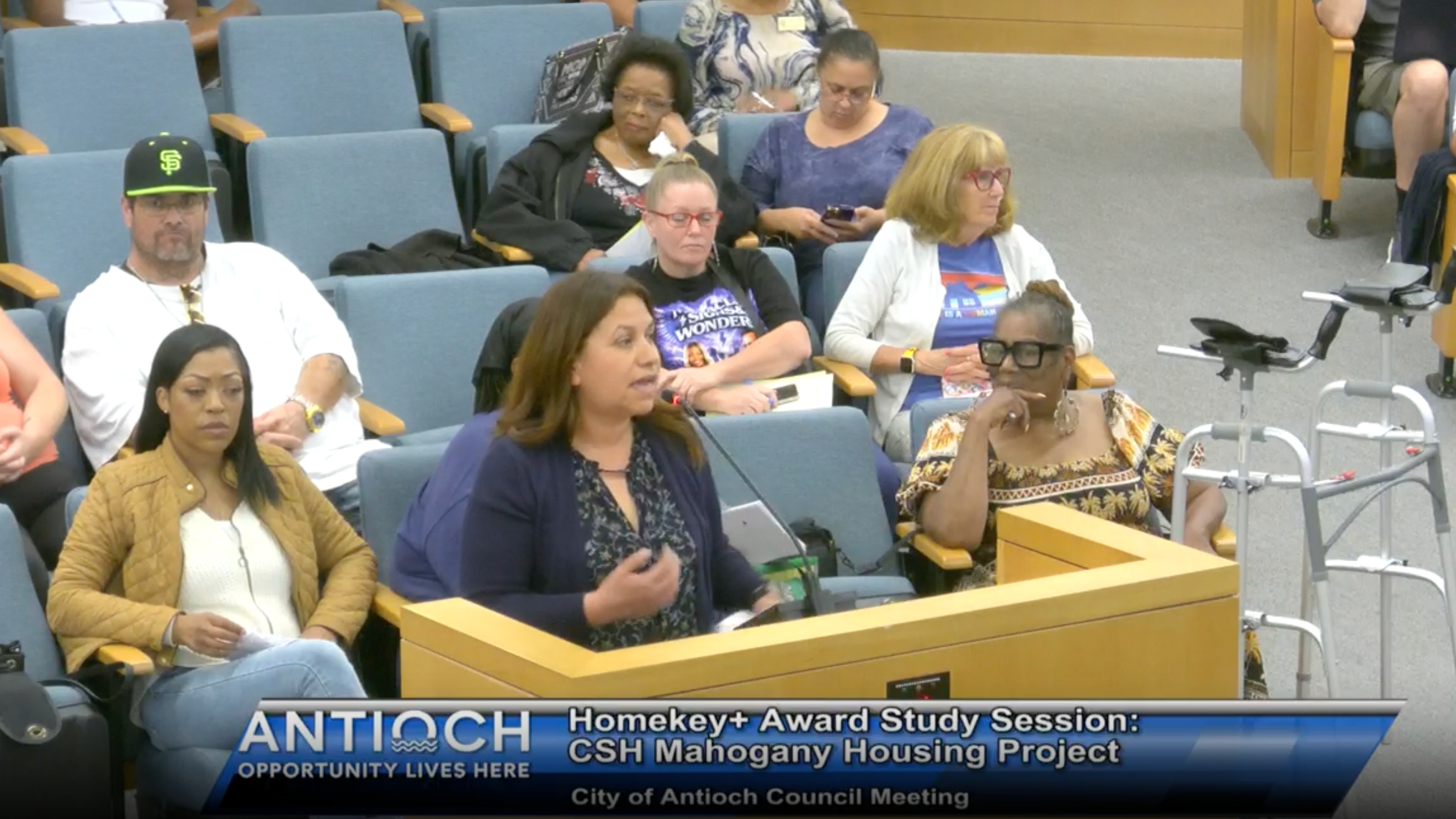
The Antioch City Council convened a special study session to examine a conditional Home Key Plus award from the California Department of Housing and Community Development that would fund the acquisition and rehabilitation of the 119-room Antioch Inn into 84 permanent supportive housing units.

The basics: Home Key Plus is a state program that provides capital and operating funds for converting existing buildings — typically motels and hotels — into permanent supportive housing for people experiencing chronic homelessness. The conditional award includes approximately $27.5 million for acquisition and rehabilitation and $7 million in operating funds over 10 years. California Supportive Housing (CSH) is the developer; Lutheran Social Services is the service provider.

Why it matters: Antioch has the largest unsheltered population in East Contra Costa County. The 84 units would be dedicated to three populations — 21 for veterans, 21 for transition-age youth (ages 18–24), and the remainder for chronically homeless individuals, plus one on-site manager unit. The city's financial commitment: a one-time $750,000 capital contribution from Housing Successor Funds and an annual operating subsidy of up to $1.2 million.

Where things stand: Mayor Ron Bernal framed the session's stakes directly:

"We're getting to the point where we're going to be executing documents that will formally commit us to the project. And so that's the reason for this study session."

CSH President and CEO Punit Bhargava outlined the unit breakdown and confirmed the project would include 24/7 security with gated access:

"We'll also have access control. We have it as a gated community. So you are making sure that residents or actual guests of those residents are coming in and they have rules and regulations for those guests as well."

CSH has built a 15% construction contingency into the budget and confirmed it will comply with the city's project stabilization agreement requiring union labor on city-initiated projects over $1 million. Bhargava said CSH would handle the bulk of administrative and reporting duties, with the city's role estimated at 10–20% of one staff person's time.

What's next: The item returns to council on July 28, 2026, when members will vote either to execute the standard agreement committing the city to the project or to rescind the prior authorization resolution, forfeiting the $34.9 million award.


Richmond Shares Hard-Won Lessons

Unexpected Costs and Ground-Lease Structure

Richmond City Manager Sasha Curl and Community Development Director Lina Velasco presented their city's comparable Home Key conversion — a 50-unit motel transformed into 48 permanent supportive housing studios under a 55-year ground lease with developer Novin Development and Trinity Center.

Why it matters: Richmond's per-unit cost, including operations, stands at $526,000 — compared to an average $798,000 for new construction in Contra Costa County. But the project revealed significant surprises: water intrusion requiring replacement of an entire rear wall, mold remediation and rot in the tower, producing 18 change orders and an additional $2 million in council-approved spending.

Curl emphasized the critical importance of third-party construction oversight:

"Having the project looked at through the construction management lens, especially reviewing the change orders, because especially with inflation the way that it is now, that compounds the necessity for contractors to look for opportunities for change orders."

Richmond hired both a financial consultant and outside legal counsel to negotiate the deal structure and retained a third-party construction management advisor specifically to review change orders — a cautionary playbook for Antioch.

Curl also framed the broader policy rationale:

"When residents want encampments abated, part of our policies and our requirements are that we offer housing before the encampments are abated. So in terms of residents wanting the built environment clean, this is a tool to help us do that."

Occupancy for Richmond's project will be determined through the county's Coordinated Entry System, with local prioritization for Richmond residents established in collaboration with the county. Hope Solutions will provide wraparound services, and Richmond is planning for 24-hour security initially.


The Funding Squeeze: Who Loses?

Housing Successor Funds vs. Existing Nonprofits

The sharpest exchange of the evening centered on how Antioch would pay the $1.2 million annual operating subsidy and what programs might be cut as a result.

Why it matters: The city currently allocates approximately $500,000 annually in Housing Successor Funds to eight community-based organizations — including Shelter Inc., Shower Ministry, Winter Nights Shelter and Facing Homelessness — serving roughly 2,688 residents. Those funds are projected to run out in two to three years regardless of the Home Key decision. Separately, the city's entire CDBG public service allocation of $127,500 funds 13 nonprofit organizations serving approximately 1,655 residents through programs including CASA for Foster Youth, Family Justice Center, Senior Legal Services, Dentist on Wheels, Meals on Wheels and Opportunity Junction.

Where things stand: Mayor Pro Tem Donald Freitas pressed the fiscal tradeoff hard:

"And so for me, that is a significant number. And I suspect that if Home Key went forward, we're talking about approximately 84 people versus 4,343."

He also warned the annual obligation could grow beyond $1.2 million once staff oversight and reporting costs are factored in.

Freitas also insisted all pending documents be reviewed by the city attorney's office before any signing authority is granted, citing the council's fiduciary responsibility.

The other side: Councilmember Tamisha Torres-Walker pushed back forcefully against what she characterized as a conflation of two separate funding streams.

"I don't remember anybody saying to recommend stripping CDBG dollars from the 13 CBOs who are providing direct services to residents in Antioch that are outside of the housing and homelessness section," she said, establishing that only Housing Successor Funds — not the broader CDBG public service allocation — would be affected.

CDBG and Housing Consultant Teresa House confirmed the distinction: CDBG public service funds currently do not serve homeless populations — those were shifted to Housing Successor Funds six years ago. Permanent Local Housing Allocation (PLHA) funds average about $350,000 annually from the state but have restricted uses. Additional city staffing costs for project oversight and reporting have not yet been evaluated.

Torres-Walker also announced she had been meeting with state and federal legislators and described plans for a regional dialogue:

"The supervisors have committed to work with myself and the assembly member based on our collective availability to actually host East County Regional Housing and Homelessness Dialogue because homelessness is bigger than just individuals with mental health and disabilities and veterans."

Councilmember Monica Wilson requested a side-by-side cost comparison and demanded a "Plan B":

"I haven't heard anything about a Plan B. So many people are talking about the cost of this program, I've yet to hear any. What is the strategy if this doesn't happen?"


A Property in Distress

Default, Delinquent Taxes and Acquisition Questions

Council members and the public raised pointed questions about the financial condition of the Antioch Inn itself.

The basics: A notice of default has been filed on the property, though the assistant city attorney clarified this is distinct from foreclosure — it is the first step in the process, giving the borrower time to cure the debt. The lender is aware of the Home Key Plus application and has expressed a desire to assist.

Where things stand: Project consultant Andrew Becker, an Antioch resident since 1996, provided key financial context: the current owner acquired the property in 2017 and invested $6 million in renovations. Since 2017, the owner has paid close to $800,000 in TOT.

The outstanding delinquent amounts are approximately $173,000 in transit occupancy tax (quarters three and four of 2024 forward) and $23,000 in water fees. Occupancy has dropped to 15–17% nightly since the Comfort Inn flag was removed in December. Staff indicated a standard escrow process would address outstanding debts, but further legal analysis on how the city would be "made whole" is needed.

Mayor Pro Tem Donald Freitas zeroed in on the risk:

"So there may be foreclosure. There is approximately $400,000 or more in delinquent taxes before the property is even sold."

The other side: Public commenter Mark Jordan, a real estate broker, cautioned that Bay Area hotel values have dropped substantially and characterized the owner as looking for a "lifeboat" in public money. He did acknowledge that a state audit found Home Key to be one of the better-performing homelessness programs.


The Public Speaks — Overwhelmingly in Favor

More than a dozen speakers addressed the council during public comment, and the sentiment was heavily one-directional: accept the $34.9 million.

Why it matters: Speakers included nonprofit leaders, formerly homeless residents, a veteran and community advocates who collectively argued there is no "Plan B" if the council rejects the grant — and that the city's financial exposure is a fraction of what it would receive.

Gigi Crowder, CEO of NAMI Contra Costa, described her organization's unfunded "Leave No One Behind" program serving unsheltered individuals with severe mental illness in East County. She argued the council should not turn away $34.9 million when the city only needs to contribute approximately $2 million, and highlighted racial disparities in evictions during the pandemic.

Vicki Proctor, who was homeless for 18 years, described sleeping in abandoned cars and abandoned houses. She urged the council to "search your hearts" and put themselves in the shoes of unhoused residents, calling Home Key a "blessing."

Lauren Dalbert, a veteran who was unhoused twice, drew connections between racial disparities and the lack of services, noting that without VA resources, he would still be homeless.

Flori Paniagua, founder of Team Jesus Outreach Ministries, offered a notable shift: she came to the meeting opposed to the project but changed her mind after hearing the presentations. She cautioned about budget realities but concluded that if the funding gap can be closed with other sources, the project should proceed — and offered her organization's food services.

Several speakers identified additional funding sources the city could pursue, including a $900 million Governor Newsom homelessness trailer bill announced that day and a $193 million HUD grant opportunity.

Dr. Kimberly Payton raised racial equity concerns, noting 48% of unhoused people in Antioch are people of color and questioning whether inaction is intentional given those demographics.

Manuel (Manny) Soliz, Jr., a former council member, struck a more cautious tone, urging the council to explore regional partnerships with wealthier communities and warning against long-term fiscal commitments that future councils would inherit. He noted Richmond benefits from Chevron tax revenue that Antioch does not have.

Councilmember Louie Rocha asked detailed questions about service models and case manager ratios, and clarified the city's payment timeline:

"My understanding is that the first payment that the city would have to look at most likely would be like in November of 2027. That's beyond the current budget that we just adopted."

Becker closed the evening with a deeply personal note, sharing that his father, a Navy veteran, died unhoused in Los Angeles:

"He had been buried six months at Riverside National Cemetery, a member of the Navy, but unhoused in Los Angeles, and a John Doe until he was claimed and then buried with nobody there at graveside."


Minor Items

  • Closed session: The council met in closed session on labor negotiations under Government Code Section 54957.6. No reportable action was taken.

  • Adjournment: The special meeting adjourned on a 5-0 roll call vote (For: 5 — Councilmember Rocha, Councilmember Torres-Walker, Councilmember Wilson, Mayor Pro Tem Freitas, Mayor Bernal; Against: 0; Absent: 0).


Looking Ahead: The decisive vote comes July 28, 2026, when the council will either execute the standard agreement committing Antioch to the Home Key Plus project or rescind the prior authorization resolution and forfeit the $34.9 million state award. Staff was directed to coordinate with CSH, have the city attorney review pending documents including a relocation agreement and signature authority, and prepare the cost comparison and "Plan B" analysis requested by Councilmember Wilson.

Antioch Weighs $34.9M State Grant to Convert Motel Into Supportive Housing | City Council | Locunity