Council Adopts Bike Plan for Solano Avenue on 4-1 Vote After Marathon Debate
City Council • AlbanyJuly 7, 2026
Locunity is an independent informational service and is not an official government page for this commission. All information is sourced from public footage and an analysis of official agendas with the aid of responsible, fact-checked AI. to report an error or omission.
Albany's City Council logged its most contentious vote of the year Monday night, approving a citywide active transportation plan that puts a protected bikeway on the city's main commercial strip — then pivoted to place a street tree and streetlighting tax on the November ballot and patch a gap in ranked choice voting law.
- Protected bike lane coming to Solano Avenue as council adopts Active Transportation Plan 4-1, with Vice Mayor Hansen-Romero dissenting over feasibility concerns
- $89/year parcel tax for trees and streetlights headed to November ballot after unanimous council vote; council signals intent to shift tree maintenance from homeowners to the city
- Ranked choice voting code fix introduced to allow canceling uncontested elections, potentially saving over $100,000; returns for second reading
- Parks master plan addendum adopted with sand volleyball language added to two parks after years of community advocacy
- 40+ public commenters pack the bike lane debate, split between safety advocates invoking a child's death and business owners warning of parking and access losses
A Protected Bikeway on Albany's Main Street
The basics: The Active Transportation Plan replaces Albany's 2012/2019 plan and covers the full pedestrian and bicycle network. The flashpoint: including Solano Avenue — the city's primary commercial corridor — in the biking network with a protected uphill bikeway, known as a cycle track.
Why it matters: The plan sets Albany's policy direction for $20M-plus in future pedestrian and cycling infrastructure and makes the city eligible for county and state transportation grants. The Solano component would eventually trigger a $30–50M streetscape project — though full design is still years away.
Where things stand: Justin Fried, transportation staff, presented a detailed analysis showing the concept: a shared bicycle/vehicle lane with parallel parking westbound (downhill) and a protected bicycle lane with angle parking eastbound (uphill). Staff said parking impact would be 0–10%, fire department access could be accommodated with 15-foot travel lanes, and curb extensions could still be integrated.
"I do want to emphasize that while I'll go into greater detail on what was studied and is represented in the plan, this is a planning document and if adopted, it will serve as a starting point for development of a Solano streetscape project," said Justin Fried, transportation staff.
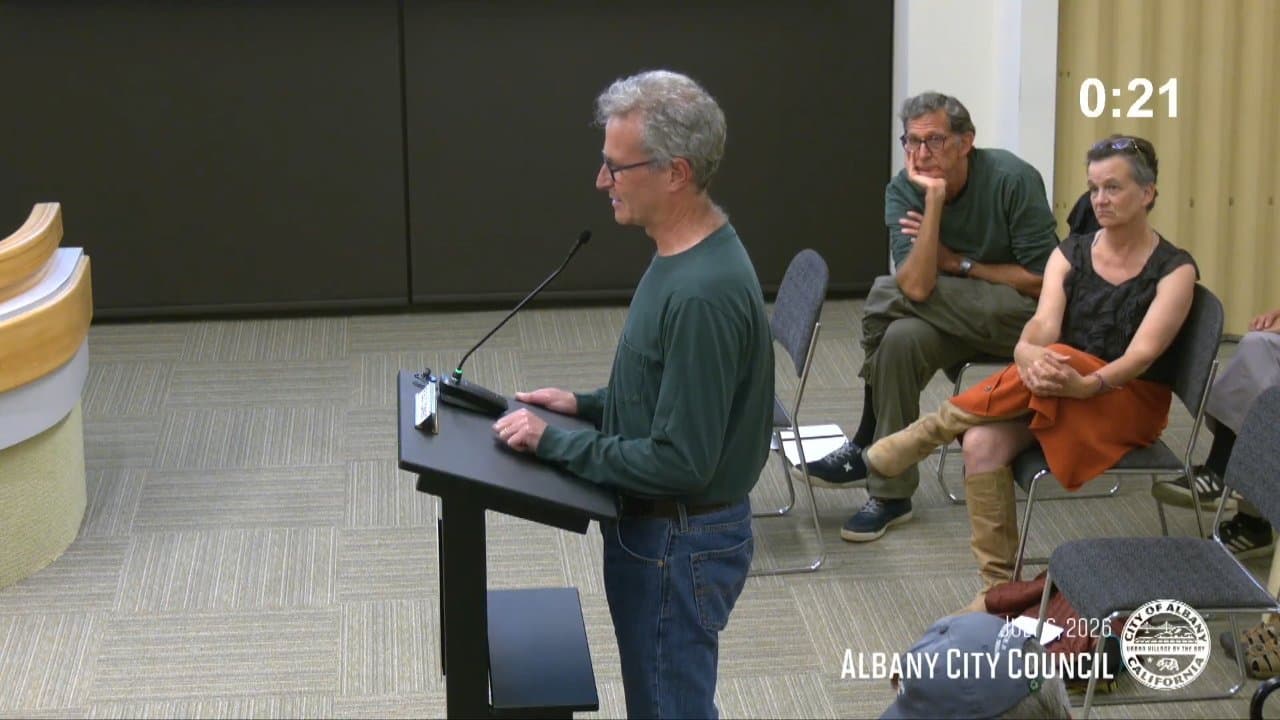
Over 40 public commenters spoke, roughly split between supporters and opponents.
Safety vs. Access: The Community Divide
Supporters cited safety, climate action, equity, and economic benefits. Lena Shulman, an 11-year-old public commenter, told the council kids can't drive and need safe infrastructure to reach shops and restaurants. Jonah Bush, a car-free father and public commenter, invoked a recent child bike collision at Ocean View Elementary and urged the council to approve the plan in full. Daniel Anis, advocacy manager for Bike East Bay, asked the council to respect the thousands of public comments already gathered and noted the plan is a recommendation, not a final project approval. Former Mayor Nick Pilch called it an equity issue, arguing that denying cycling infrastructure denies equity to residents who can't afford cars.
Opponents raised concerns about parking loss, emergency vehicle access, pedestrian safety near the bike lane, and business impacts. Todd Abbott, a business owner and Chamber of Commerce/Solano Association board member, argued a one-way cycle track cannot deliver safety for all ages and skill levels. Bryce Nesbitt, a self-described urbanist cyclist and public commenter, warned the lane could damage Solano's vibrancy and advocated for alternative routes with an evaluation mechanism. Dawn Kawamoto, a public commenter, argued that people with disabilities exiting parked cars would step directly into the bike lane and face approaching cyclists.
Council Weighs In
Councilmember John Anthony Miki delivered an extensive urbanist analysis in support, acknowledging he had his own doubts initially. "As an urbanist, I have questioned whether or not the bicycle lane is the right move. Frankly, until I saw the latest version of the cross section, I wasn't necessarily ready to move forward with it," he said. Miki pushed back on cost misconceptions, noting the $30–50M estimate applies to any streetscape option — with or without a bike lane. "We are in the concept plan stage as opposed to the not even 5% design drawings, let alone 30% design drawings," he added, calling the project a 50-year investment.
Councilmember Robin D. López spoke passionately about safety through a racial equity lens, sharing a personal connection to a child injured on Solano and drawing on his experience growing up as a young brown cyclist in Richmond. "Anyone who's ever lived in Black or brown skin — you want to be in high-visible places where people see you if shit pops off," he said.
Councilmember Preston Jordan connected the climate stakes to personal experience: "Last week my daughter, who's in basic combat training, had heat stroke which would not have occurred without climate change." He invoked AARP's support for bike facilities to counter the narrative that they harm seniors, and moved the final resolution with two amendments: adding the Cerrito Creek pedestrian connection project to the priority list and including the Key Route/Portland and Thousand Oaks intersections as bicycle priorities.
The other side: Vice Mayor Jennifer Hansen-Romero cast the lone dissenting vote, expressing concern about fitting too much into Solano Avenue's narrow right-of-way and questioning feasibility without a property line survey. "I can support the active transportation plan, but just not a bike lane on Solano," she said.
Decisions: The council adopted Resolution 2026-52 on a 4-1 vote (For: Jordan, López, Miki, McQuaid; Against: Hansen-Romero). Jordan's two amendments — Cerrito Creek and the Key Route intersections — were included.
What's next: Adoption makes Solano Avenue eligible for grant funding, but the actual streetscape project requires full design, additional public process, and years of development before construction.
$89/Year Parcel Tax for Trees and Lights Headed to Voters
Why it matters: If voters approve the measure in November 2026, Albany would generate roughly $775,000 annually — creating the city's first dedicated funding stream for two long-deferred needs: street tree stewardship and street lighting upgrades.
Where things stand: Devorah Zauderer, Public Works program manager, presented the proposal: a special parcel tax levied at $0.0354 per lot square foot, or about $89 per year for a 2,500-square-foot parcel. The measure includes a 3% annual CPI escalator, a rate cap for parcels over 500,000 square feet, and exemptions for low-income occupants. Revenue would fund loan repayment for two near-term capital street lighting projects — expanding intersection lighting from seven to 13 intersections on Solano Avenue from Key Route to Tulare — along with building out the urban forestry program per the city's Street Tree Management Plan.
The other side: Karen Holzmeister, a public commenter, cautioned the council about cumulative tax burden, citing new managed care charges of up to $400 per year for families on top of state and county measures. Dawn Kawamoto, a public commenter, asked whether any of the funds would go toward bike lanes on Solano; staff confirmed they would not. Howard McNinney, a public commenter, asked whether the tax would fund the city assuming street tree maintenance, referencing the management plan's recommendations modeled on El Cerrito and Berkeley.
Councilmember Preston Jordan questioned why the street tree policy ordinance — which would transfer maintenance responsibility from property owners to the city — was not included in the ballot measure itself. Staff and the city manager explained the policy would come separately so the council could adapt it over time without needing voter approval for changes. Jordan then moved a companion resolution: "It is the intent of the council for the street tree policy to come to it, should this measure pass, for changing the municipal code to move responsibility for maintaining the street trees from the adjacent property owner to the city."
Decisions: Both the parcel tax resolution (2026-51) and the street tree policy intent motion passed unanimously, 5-0.
What's next: The measure goes before Albany voters in November 2026.
Ranked Choice Voting Fix Could Save $100K on Uncontested Races
The basics: Albany adopted ranked choice voting in 2022, but the municipal code lacked language allowing the council to cancel an election when the number of qualified candidates equals or is fewer than available seats — a standard provision in most election codes.
Why it matters: With four school board seats on the November ballot, the fix could save the city or school district roughly $100,000 by avoiding an unnecessary election if races go uncontested.
Where things stand: Ordinance 2026-04 adds Section 7-1.10 and amends Section 7-3.4 of the Albany Municipal Code. Dawn Kawamoto, a public commenter, expressed concern the change was being rushed. Staff explained this is the standard two-reading introduction process.
Councilmember Preston Jordan noted the potential savings: "This potentially could save either the city or the school district on the order of $100,000." Councilmember John Anthony Miki clarified that "waive first reading" simply means not reading the full ordinance text aloud — not skipping procedural steps.
Decisions: The motion to introduce and waive first reading passed 5-0.
What's next: The ordinance returns for second reading and adoption at the next meeting.
Parks Plan Updated: Sand Volleyball Finally Gets Its Day
Why it matters: The addendum updates park planning priorities based on 664 survey responses and in-person mapping sessions, directing future capital investment. It may finally resolve a years-long community push for sand volleyball courts.
Where things stand: Consultant Groundworks presented findings: 50% of respondents visit parks weekly; top improvement priorities are shade and seating (38%), maintenance (26%), and expanded open space. The addendum identified Ohlone Greenway, Peggy Thompson Pierce Street Park, and Key Route Median as top priority parks for new programming, and flagged the area under I-80 as a large potential space for sports including sand volleyball and skate parks.
Despite sand volleyball being the original impetus for the study, community response for it was lower than expected — and it was not explicitly cited in the addendum for the two parks where staff reports said it would be included. Councilmember Preston Jordan pressed staff on the gap: "Given it was the impetus for the project, I'm kind of surprised that it didn't result with citing the sand volleyball court." He moved the resolution with amendments to add the words "sand volleyball" to both Peggy Thompson and the Ohlone Greenway guidance pages.
Councilmember Robin D. López praised the community outreach data: "You all are doing some of the work that people are still trying to figure out — identifying what do we need to make our park master plan more robust and more inclusive of the needs of our community."
The Parks Commission chair clarified that teenage girls originally requested volleyball facilities and that demand exists for both sand and court volleyball.
Decisions: Resolution 2026-49 passed 5-0 with the sand volleyball amendments.
Minor Items
- Consent calendar approved 5-0, including meeting minutes, $2.15M in payroll, $1.97M in bills, a CDBG cooperation agreement (Reso 2026-47) securing continued federal community development funding, an Urban 37 fire inspection contract for $150,000 (Reso 2026-48), and an Arts Committee resignation.
- Delinquent solid waste accounts — roughly 30 — approved for placement on the Alameda County property tax roll after five rounds of notification (Reso 2026-50, 5-0).
- RotaCare Free Clinic honored with a proclamation recognizing 6,933 medical visits to 3,655 uninsured patients since 2013; Mayor Peggy McQuaid read the proclamation honoring founding Medical Director Dr. Pate Thompson. Judy Kerr of Albany Rotary accepted.
- Public commenters raised climate fleet conversion (Nick Peterson, Albany Climate Action Coalition), Golden Gate Fields park planning (Jing Wu), and Measure D zoning interpretation (Howard McNinney).
- City manager reported council election nominations open July 13 for two seats; Brighton Avenue sewer project beginning construction; National Night Out block party registration open.
- Meeting adjourned in memory of Alameda County Supervisor Scott Hagerty.