
Supervisors Demand Public Report After ICE Episode at Highland Hospital
Board of Supervisors • Alameda CountyOctober 27, 2026
Locunity is an independent informational service and is not an official government page for this commission. All information is sourced from public footage and an analysis of official agendas with the aid of responsible, fact-checked AI. to report an error or omission.
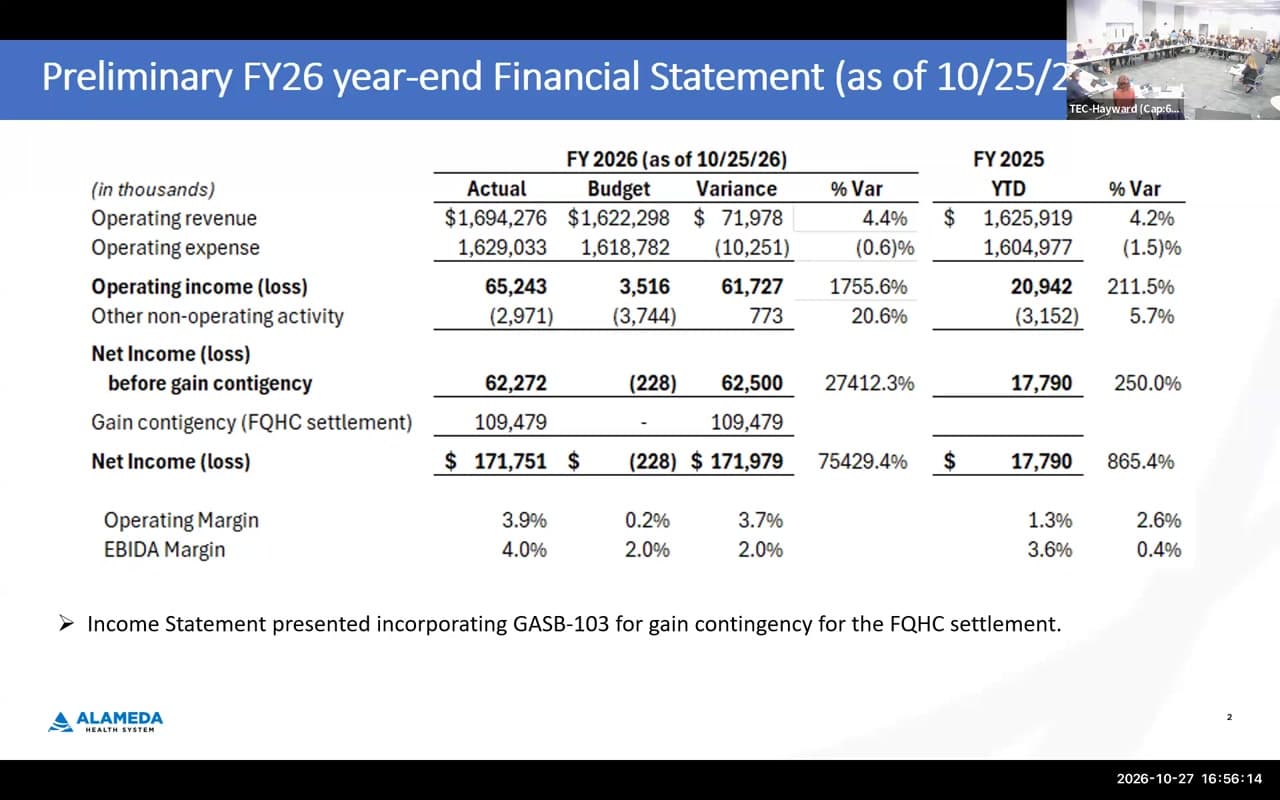
Alameda County's ICE-free zones policy faced its first major test at Highland Hospital. On Oct. 27, 2026, about 30 nurses, doctors, union members and rapid-response advocates told a joint special meeting of the Board of Supervisors and the Alameda Health System (AHS) Board of Trustees that the policy failed. Supervisors took no vote but asked AHS for a public, written incident report within roughly 30 days, on the same night AHS reported a $62.3M surplus built on one-time cash and projected steep losses ahead.
- Public incident report requested after AHS said it never received warrant documentation for a patient in ICE custody
- About 30 public commenters condemned AHS's handling of ICE, citing missed prenatal and clinic appointments
- $62.3M FY26 surplus came mostly from settlements, with losses projected to reach $123M by FY29
- St. Rose Hospital awaits a delayed $38M intergovernmental transfer as AHS raises its credit line to $25M
- Behavioral health program preserved but moving to Fairmont in November over clinician objections
- Supervisors pressed AHS to speed a delayed efficiency study tied to $19.3M in county funding
Highland's ICE Test: Protocols Under Fire
Why it matters: The Highland episode put the county's ICE-free zones policy and AHS's protocols under state law SB 81 to their first real test. The follow-up review could change warrant checks, staff training and the role of law enforcement at AHS and other county properties.
Where things stand: AHS CEO James Jackson opened the item by reading a staff letter about masked protesters near AHS property. Associate General Counsel Kayla Bowen then walked through the system's protocols. They include a 24/7 administrator-on-call escalation process, "badge buddies," staff training and a procedure for patients in custody that includes asking officials to step out of rooms.
Bowen said ICE vehicles were moved from the Arcade Garage to the hospital's sally port, supervised by sheriff's deputies, to limit contact with patients and staff. She said AHS was not aware of any "staging" prohibited under the county's ICE-free zones policy.
"We provide care based on medical need, regardless of immigration status or whether a patient is in law enforcement custody," said Bowen.
The other side: "Under what grounds did ICE have this person in their custody?" asked Supervisor, District 5 Nikki Fortunato Bas. Bowen replied that AHS requested documentation, received none, and that the validity of arrests is a matter for the courts. Fortunato Bas said she had earlier been told a warrant existed. "We could have kept that person somehow from getting into ICE's hands, and that's completely unacceptable to me," she said.
The patient's attorney, Nicholas, an attorney with Asilah, praised hospital staff but disputed the custody basis. "When the patient was brought into the hospital, there was no judicial warrant, there was no administrative warrant," he said. Jackson countered that "there was never any intent to collude."
Decisions and stakeholder impacts: The board took no formal vote. "I'd like a written report on what the facts are so we're all clear on the facts," said Supervisor, District 4 Nate Miley. He also asked AHS to explain why the episode happened and what corrective actions it will take. Supervisor, District 2 Elisa Marquez and Board Vice President Lena Tam concurred. Marquez pledged to strengthen the policy, including at Eastmont Mall. "I agree that there's a lot of lessons to be learned," said Tam.
Fortunato Bas listed what she wants to see: training, scenario drills, collaboration with frontline workers, rules for security conduct and clarity on roles. An AHS trustee offered a critical incident review. Miley asked that it be made public and presented to a county committee, and a trustee pledged to de-identify the details and move "as fast as possible." Board President David Haubert backed the review but added, "I want to be cautious of unintended consequences."
What's next: AHS's report is expected within roughly 30 days. The full protocols are in Attachment 5.
Frontline Workers Contradict Administrators
Why it matters: The roughly 30 speakers were mostly clinicians, union members and organized rapid-response groups. Their testimony added a cost argument to the policy fight: patients who are afraid of ICE skip care.
Where things stand: Speakers included members of SEIU 1021, the Asilah Rapid Response Network, Street Level Health Project, Sudu for Solidarity, the ICE Out of Dublin Coalition and ACORD. Many described what they saw differently than administrators did. Their accounts are allegations as stated by the speakers.
Claire Chalmers, a Highland ICU nurse, said nurses were untrained and that county property was used for staging under the county's own definition. A county health care worker of 35 years, identified as David, said logs showed 23 ICE vehicles across 30 shift changes in a restricted dock area, which he called staging. Iman Khalil, an AHS respiratory therapist, said most staff feel AHS protected ICE.
The human cost came up again and again. Nora Goodfriend-Coven of Friends of La Peña said half of her clinician daughter's pregnant clients missed prenatal appointments. A nurse practitioner said clinic no-shows rose during ICE surges. Gabby Weimer, a Highland emergency medicine resident, said residents had repeatedly asked for simulation training.
Several speakers objected to Jackson opening the item with a single staff letter about protesters. They said observers were peaceful and did not block entrances.
The demands: Speakers called for full enforcement of SB 81, adoption of the Los Angeles County model, scenario-based training, a process that involves clinicians, authority for staff to remove ICE from patient rooms and stronger county oversight of AHS. Bridget Ruiz Rivezo, policy director for Oakland Councilmember Charlene Wong, urged full SB 81 implementation and public protocols.
From the patient's side, attorney Nicholas urged a simple fix: "An ask for a judicial warrant when somebody's brought in is very important." One speaker urged a general strike. Miley later disagreed with calls for "any means necessary."
AHS Surplus Masks a Steep Fiscal Cliff
Why it matters: AHS's finances drive taxpayer exposure through the county treasury, which effectively covers the system's negative cash. The CFO's projections would breach the county credit agreement by FY29.
Where things stand: AHS Chief Financial Officer Kim Miranda reported FY26 net income of $62.3M before a gain contingency. "We are actually coming in $62.5 million better than budget," she said. Most of that came from one-time money: a federally qualified health center (FQHC) settlement worth a $109.5M gain, with $51.8M in cash received. A realignment pickup, the managed care organization (MCO) tax and lower pension liabilities also helped. The audit slipped, with preliminary financials due to the county Nov. 13 and the final report Dec. 14.
The first quarter of FY27 came in $13.6M short: $9.2M in net income against a $22.8M budget. Miranda tied the gap to $19.3M in expected county support that has not arrived. Labor costs ran under budget, with about 400 open requisitions.
The fiscal cliff: Miranda projected losses of $27.9M in FY27, $95M in FY28 and $123M in FY29, when the MCO tax ends and the effects of the federal HR 1 law grow. A $123M loss, she said, "will then put us over the terms of the permanent agreement" for the net negative balance, the county's arrangement for covering AHS cash shortfalls. Asked about reserves, she said AHS has none. "Do I have a contingency plan? No. Will I be able to model things? Yes," she said, citing new Strategas planning software.
The county's stake: A presentation attributed to retired county official Pat O'Connell traced the credit agreement's history. It began as a way to repay a negative treasury balance that exceeded $200M and was most recently amended in March 2026. AHS's cash balance has since turned positive.
County Administrator Susan Muranishi listed the other ties between the two agencies: a $200M line of credit with intra-year flexibility, a lease under renegotiation, about $47M a year in debt service on the acute tower, and Measure A and AA transfers. AHS receives 75% of those funds, totaling $195M in 2025-26. Miley said AHS has a positive net worth "for the first time in many years, I think at least 15 years," but added, "I'm thinking the glass is half empty at the moment." Haubert asked for a balance sheet alongside future income statements.
St. Rose on the clock: The federal Centers for Medicare & Medicaid Services (CMS) has not approved St. Rose Hospital's SB 1100 intergovernmental transfer. The delay forced AHS to remove a $9.5M donation from its FY26 books and raise its credit line to the hospital to $25M. St. Rose needs the $38M transfer to break even and is projected to exhaust its credit line by February.
Marquez called the hospital "critical not only to District 2 but the entire region," noted the district's repeated $1M contributions and offered to help fundraise. Jackson cited surgical expansion, ancillary services, an Epic electronic medical records launch in February 2027 and a possible midwife- and doula-led return of the suspended birthing center.
Behavioral Health Program Moves, Efficiency Study Lags
Why it matters: These decisions shape AHS's costs and behavioral health capacity during a budget squeeze. Haubert also tied them directly to voter trust in county health taxes.
Where things stand: AHS had planned to close its intensive outpatient and partial hospitalization program (IOP/PHP). After a joint ad hoc process, the program was restructured and will instead move from Highland to the Fairmont campus between Nov. 1 and mid-November. "We have successfully placed all of the employees and reassigned them," said AHS Chief Human Resource Officer Jet Chapman, referring to about 11 or 12 workers. She acknowledged some patients are reluctant to switch campuses.
The other side: Nettie Washington, speaking for IOP clinicians, called the move chaotic. She said telecom and IT staff had not been consulted, questioned why the date is fixed and why services must leave Highland's wraparound care, and asked for a delay.
The lease: General Services Agency Director Kim Gasway said the county's lease to AHS, about $1 a year, will be extended 30 years and expanded to include the Highland Care Pavilion. AHS acts in November and the board in December to meet the timeline of a state TIFA grant for a dental clinic.
Efficiency study: The $19.3M county package included about $17M to offset reductions in force, $900,000 for four months of IOP/PHP and funding for an efficiency study. AHS Chief of Public Affairs and Community Engagement Officer Jeanette Dong said a draft scope is complete and a selection committee that includes labor is forming. ACME has confirmed, and SEIU is pending.
"There's no bad time to start saving money," said Haubert. Jackson said AHS cannot sole-source the contract but has "assurances that the funds, once the RFP goes out, will be made available." He estimated four to six months to complete the study. Haubert warned that voters weighing Measures W, A and AA are watching: "If they don't see us do everything we can to be efficient with the dollars they give us, they're going to stop giving it."
Decisions and stakeholder impacts: The board took no action. Patients and IOP staff face a fast move, and labor gains a seat on study selection. Miley urged that the study be completed by March to May 2027, with results returning to a joint meeting.
Minor Items
- AHS governance and SB 1400: The item was skipped and will be continued, with no date set.
- Audit timeline: Preliminary FY26 financials go to the county Nov. 13, and the final report Dec. 14.
- Stanford repayments: Marquez asked about St. Rose's repayments to Stanford, including a $16.1M prepayment.
- Frontline efficiency work: Dr. Lily Andolker, Highland chief of hospital medicine, said efficiency work is already underway.
Looking Ahead
Watch for AHS's public incident report in roughly 30 days, the lease amendment in November and December, and the rescheduled SB 1400 governance discussion, where Miley plans to raise the board's governance model.