
Board of Supervisors - Jun 30, 2026 - Regular Meeting

Board of Supervisors - Jun 30, 2026 - Regular Meeting

Board of SupervisorsAlameda CountyJune 30, 2026

Sources:

Locunity is a independent informational service and is not an official government page for this commission.We use AI-assisted analysis and human editorial review to publish information.

Board Receives Historic Reparations Report, Splits on $2.4M Surveillance Contract

The Alameda County Board of Supervisors held a marathon session Tuesday that bookended two defining questions for the county's future: how to repair systemic harm against Black residents, and how far to extend law enforcement's digital reach into unincorporated communities. The board unanimously accepted a 220-page reparations report and created a standing committee to begin implementation, then divided sharply — 3-2 — over a consolidated surveillance technology contract with Flock Group that had drawn nearly 50 public speakers and revealed unauthorized data sharing to out-of-state agencies.


  • Board unanimously receives reparations commission's 44-recommendation final report and creates a permanent standing committee to oversee implementation

  • $2.4M Flock surveillance contract combining license plate readers, cameras, and drones approved 3-2 after disclosure of 140 unauthorized data queries

  • Castlewood water district dissolution advances, but $1.4M funding mechanism fails to clear 4/5 supermajority

  • Foster youth residential care contract with The REFUGE limited to 12 months; competitive bidding ordered

  • Timothy Flanagan, former Solano County CIO, unanimously selected as Alameda County's next Chief Information Officer


From Study to Action: Reparations Commission Delivers 44 Recommendations

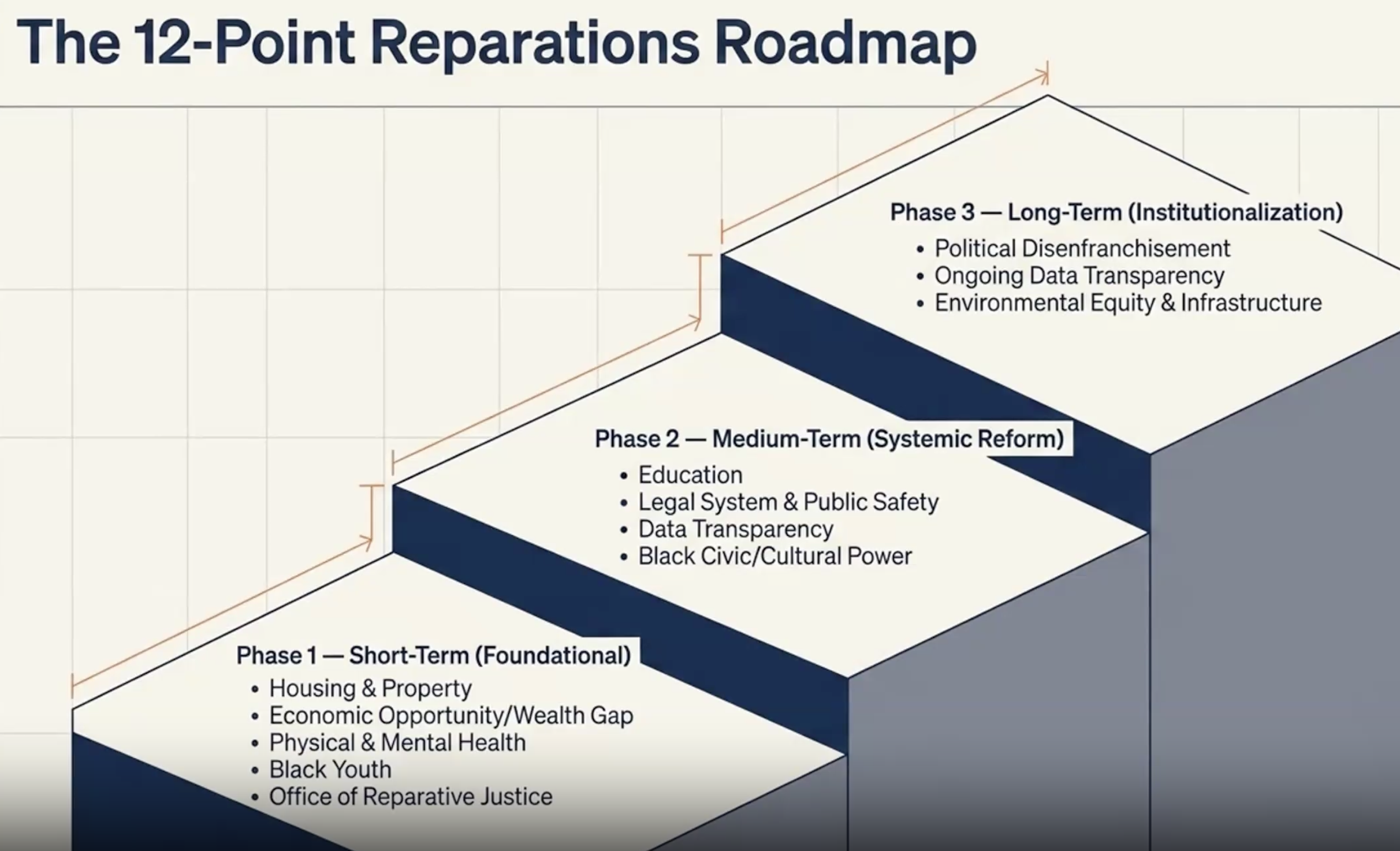
The Alameda County Reparations Commission formally closed its three-year mandate Tuesday, handing the Board of Supervisors a final report spanning 12 policy areas — from housing and economic opportunity to criminal justice and youth development — and 44 specific recommendations for county action.

Why it matters: Alameda County is among the first counties nationally to advance from a study commission to a permanent implementation body on local reparations. The commission, established in March 2023, conducted 22 community events across all five supervisorial districts, gathering input from more than 400 respondents. Its survey data found 83% experienced systemic harm, 66% reported biased police stops, and 60% encountered housing barriers.

Where things stand: The commission operated on a $500,000 budget and spent $441,754. Reparations Commission Chair Debra Gore presented a phased implementation plan and delivered one of the meeting's most forceful arguments for continued action.

"You cannot say the clock has run out on a harm that is still showing up in the county's data today," she said.

Vice Chair Larry McClendon detailed the commission's fiscal stewardship, while commissioners Brandon Sash and Octavia Berry delivered personal testimonials connecting their own experiences to the systemic patterns documented in the report.

A recorded video of former supervisor Keith Carson's 2023 remarks provided constitutional and historical context for the commission's founding, underscoring the institutional continuity of the effort.

Supervisor Nate Miley, District 4, who co-authored the commission's creation, spoke with visible emotion.

"This to me is very personal, being an African American. I'm so proud of these people because they did such a great job," he said.

Over 30 public speakers testified in support. Derek Barnes, an Oakland resident, cited specific disparities: 54% of Black households are rent-burdened and Black residents make up 70% of Oakland's unhoused population. Keith Brown, Executive Secretary-Treasurer of the Alameda Labor Council, said the action plan aligns with labor values and career pathways for Black workers. Angela Andrews, a Hayward City Council member, thanked the commissioners and Miley for their leadership.

Decisions: The board voted unanimously to receive the report, sunset the commission effective June 30, 2026, and establish a Reparations Standing Committee co-chaired by Miley and Supervisor Elisa Marquez.

What's next: The standing committee will begin work on an equity assessment of existing county programs and develop a timeline for prioritizing the 44 recommendations.


Surveillance Showdown: Flock Contract Passes 3-2 After Data Breach Disclosure

A $2.4 million bridge contract consolidating three Flock Group technologies — automated license plate readers, pan-tilt-zoom cameras, and AeroDome drone first responder — passed on a 3-2 vote that exposed deep divisions on the board over civil liberties, immigrant safety, and the pace of law enforcement technology adoption.

The basics: The contract bundles three existing agreements into a single vendor relationship with Flock Safety, a Georgia-based surveillance technology company already operating in 14 incorporated cities in Alameda County. The agreement covers unincorporated areas served by the Sheriff's Office.

Why it matters: The vote came after Commander Dave Blanchard disclosed that weekly audits discovered 140 unauthorized out-of-state data queries — representing 0.08% of 6.4 million entries — from two law enforcement agencies with data-sharing access. The Sheriff's Office responded by suspending all sharing and reducing connected agencies from 346 to 123 California-only partners. Sergeant Coley presented case studies including a child kidnapping prevention, a shooting suspect identification, and stolen vehicle recoveries to illustrate operational value.

Deputy County Counsel Clay Christensen reviewed 10 recommended amendments submitted by Secure Justice, a privacy advocacy group, and stated most were already addressed through contractual hierarchy provisions in the agreement.

The other side: Opposition coalesced around privacy concerns, immigration enforcement risks, and the adequacy of the board's review. Supervisor Nikki Fortunato Bas, District 5, voted no, arguing the combined contract deserved more scrutiny.

"I don't think that two business days is an adequate amount of time to review a very significant contract that is accepted, expanding and combining technologies that could be part of a surveillance platform for this county," she said.

Supervisor Elisa Marquez also voted no, pushing to incorporate Secure Justice's recommendations before approval rather than deferring them to a future RFP.

Among public commenters, Brian Hofer, the Chair and Executive Directorof Secure Justice, argued that if inapplicable contract provisions exist, they should be deleted, citing Richmond's $290,000 liquidated damages clause and Oakland's $200,000 penalty as precedents Flock has accepted elsewhere. Musa Tariq of CAIR urged rejection, arguing mass surveillance disproportionately harms Black residents and documented cases of ALPR abuse including tracking women seeking reproductive care.

Supporters were equally vocal. Colin Cavanaugh, a Castlewood HOA member, reported an 80% crime reduction since installing Flock cameras five years ago. Edward Escobar, founder of a coalition for community engagement, argued unincorporated residents deserve the same safety tools as incorporated cities that already use Flock, noting no deportations have resulted from the camera data.

Sheriff Yesenia Sanchez defended her office's transparency on the data sharing violations and expressed frustration at repeated delays.

"Do we continue to push this out and push it out and push it out? Where does it end? I am working as a good partner. Where does that partnership come in from the other side?" she said.

Decisions: Board President David Haubert offered a substitute motion to approve the contract as presented, with direction to incorporate remaining recommendations into the upcoming RFP process. The substitute motion passed 3-2 (For: Haubert, Tam, Miley; Against: Marquez, Fortunato Bas).

What's next: Outstanding privacy and oversight concerns are expected to shape the terms of the next competitive RFP for surveillance technology services.


Castlewood Water Crisis: Policy Moves Forward, Money Does Not

The board advanced policy direction to dissolve the Castlewood County Service Area and begin negotiations with the City of Pleasanton to assume water and sewer services for approximately 250 homes near Pleasanton — but the $1.4 million inter-account loan needed to backfill the system's deficit failed to clear the required four-fifths supermajority.

Why it matters: Castlewood homeowners are caught between aging infrastructure, disputed rate increases, and a county that says the self-funded service area can no longer sustain itself. Public Works Agency Director Daniel Woldesenbet presented the item seeking authorization for a zero-interest inter-account loan to cover the shortfall.

Where things stand: Four members of the Castlewood Property Owners Association testified against the item. Rick Hammel, the association's president, cited backup generators that remain unconnected, hour-long response times from a maintenance contractor based in Morgan Hill, and the county's refusal to discuss operational issues until the $1.4 million is resolved. Mike Mitchell, the association's vice president, argued the CSA was financially sound before 2021, characterized the 172% rate increase followed by the $1.4 million demand as destructive, and urged the board to vote no or abstain.

Supervisor Nate Miley abstained, calling for more negotiation.

"I'm going to be abstaining on this item because I just don't feel that there's been enough conversation to get this resolved. And I think that's what needs to take place," he said.

Board President David Haubert also pushed back.

"I'm also going to vote no on this item, at least on items A through E," he said, calling for more dialogue with residents.

Decisions: The board bifurcated the vote. Policy items A through E — including dissolution direction and Pleasanton negotiations — passed 3-1-1 (For: Márquez, Tam, Fortunato Bas; Against: Haubert; Abstain: Miley). Appropriation items F and G failed with the same 3-1-1 tally because they required a four-fifths supermajority. The inter-account loan remains unfunded.

What's next: The LAFCO dissolution process will proceed, but the financial gap leaves 250 households without a clear resolution for the $1.4 million in disputed water system costs.


Foster Youth Contract Shortened, Competitive Bidding Ordered

The board approved only a 12-month extension — not the requested two years — of an $8.8 million sole-source contract with The REFUGE, which provides short-term residential therapeutic care for foster youth ages 12 to 17, including survivors of sex trafficking.

Why it matters: Supervisor Nikki Fortunato Bas questioned why the contract was sole-sourced and noted the lack of intake data in the results-based accountability report.

"I'd like to make a motion to extend the contract with The REFUGE for six months and conduct an RFP so that organizations that also provide these services have an opportunity to bid," she said.

Social Services Agency Director Andrea Ford confirmed The REFUGE has served 152 female youth since 2024. Vice President Lena Tam noted The REFUGE holds a unique license as a short-term residential therapeutic program serving sexually trafficked youth. GSA Director Kimberly Gasway explained the county's RFP process typically takes four to six months, including outreach requirements, selection committees, and potential protest periods.

The board ultimately settled on a 12-month extension with a concurrent RFP and updates to the Social Services Committee. The motion passed unanimously (For: 5, Against: 0).

What's next: The competitive RFP could expand the number of available providers and beds for foster youth residential therapeutic care countywide.


Minor Items

  • New CIO selected: The board unanimously chose Timothy Flanagan as Alameda County's next Chief Information Officer, effective Sept. 13, 2026. Flanagan most recently served as CIO and Registrar of Voters in Solano County, with prior public-sector IT experience in Marin and Ventura counties. Board President Haubert thanked interim ITD leadership under Ram Gurumuthi.

  • $49.5M transitional housing pool: Probation Department amendments to the transitional housing services pool were approved. Supervisor Miley recused himself under the Levine Act due to a campaign contribution from a vendor-connected individual.

  • Mass motion: Over 60 routine items covering health contracts, public assistance, fire services, and capital projects — totaling hundreds of millions of dollars — were approved via mass motion.

  • Salary ordinances: A salary ordinance for legal assistant and attorney assistant classifications was adopted on second reading; a separate ordinance for Sheriff's non-sworn management classifications passed first reading.

  • Reparations Commission commendation: The board formally commended all members of the Reparations Commission for three years of service as the body sunsetted.

Board Receives Historic Reparations Report, Splits on $2.4M Surveillance Contract | Board of Supervisors | Locunity