Supervisors Sit for Ethics Training; County Flags $600M Federal Exposure
Board of Supervisors • Alameda CountyNovember 24, 2026
Locunity is an independent informational service and is not an official government page for this commission. All information is sourced from public footage and an analysis of official agendas with the aid of responsible, fact-checked AI. to report an error or omission.
Alameda County's Board of Supervisors spent its Nov. 24, 2026, special meeting not voting, but learning the rules that govern how it votes, spends and communicates. Two state-mandated trainings, one on ethics and one on county finance, filled the session. A single question from Supervisor, District 4, Nate Miley surfaced the day's most consequential number: at least $600 million in federal funding flowing through county programs.
- AB 1234 ethics refresher covered conflicts of interest, the $630 gift limit, Brown Act and public records duties.
- Outside counsel warned that even social media "likes" can create open-meeting risks.
- New SB 827 fiscal training debuted, with a Jan. 1, 2028 deadline for sitting officials.
- County faces $1.3 billion in deferred capital needs, trainers told supervisors.
- At least $600 million in county funding comes from federal sources, administrator estimates.
Ethics 101, Biennial Edition
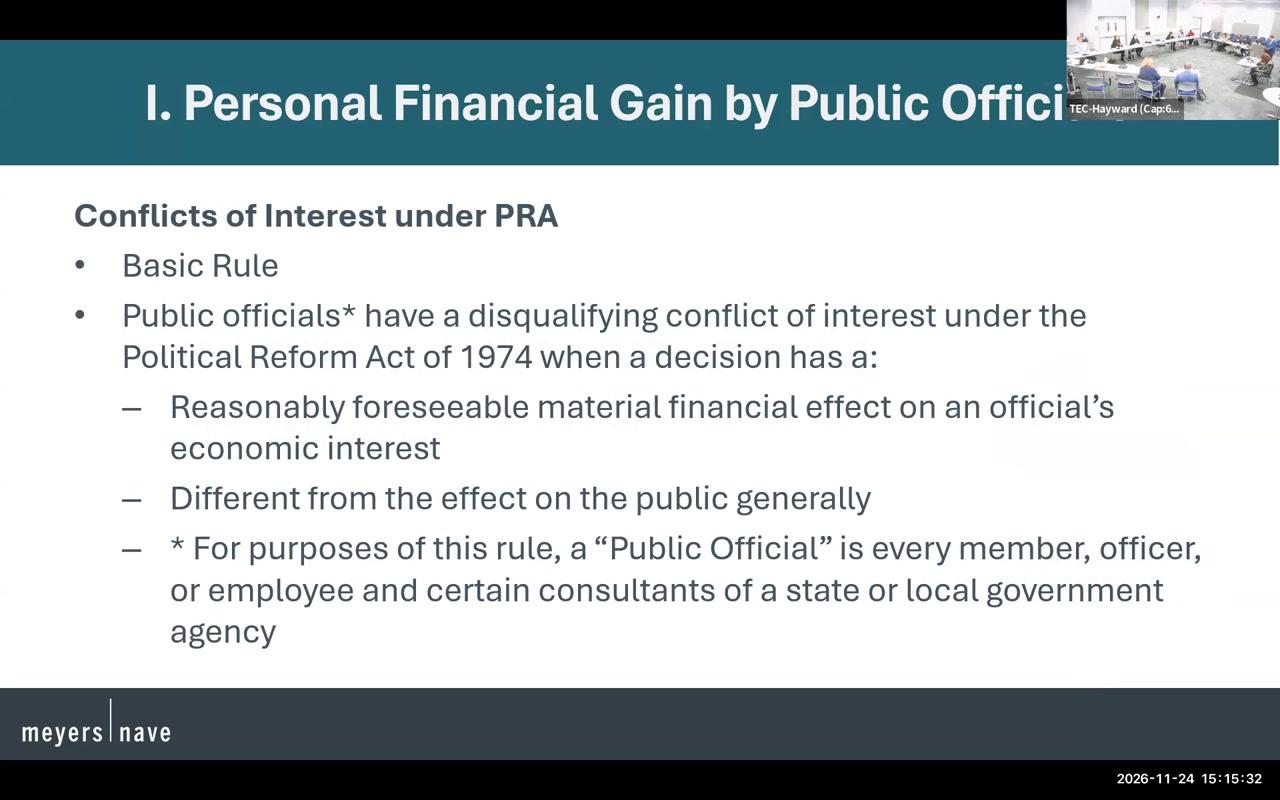
The longest stretch of the meeting, roughly an hour, went to the ethics training state law requires of local officials. Palmer Hilton, of counsel with the law firm Myers Nave, led the session, which included interactive quizzes.
The basics: AB 1234, codified in Government Code 53235.1, requires local officials to complete two hours of ethics training every two years.
Why it matters: These rules carry real consequences. Violations can void contracts, bring fines or disqualify officials from participating in decisions. For residents, advocates and contractors, the rules shape who can lobby, give and do business with the county, and how.
Where things stand: Hilton walked supervisors through a dense list of legal guardrails:
- Political Reform Act conflicts, including the four-part test, recusal and penalties
- Government Code 1090 contract conflicts, plus remote and noninterest exceptions
- A $500 campaign contribution limit and a $630 gift limit
- Honoraria, misuse of public funds and mass mailing restrictions
- Public Records Act obligations, common law bias and incompatible offices
- Competitive bidding requirements
Open meetings in the social media era: The Brown Act portion addressed serial meetings, where a majority of a body discusses business outside a noticed meeting, and AB 992, the state law governing officials' social media activity. The session flagged that something as small as liking a colleague's post can create Brown Act exposure.
Decisions and stakeholder impacts: No action was required. The training satisfies the state ethics requirement for participating officials. Groups that regularly engage the board, including contractors, campaign donors and advocacy organizations, operate within the same contribution, gift and contracting boundaries reviewed here.
New Fiscal Mandate, Big Numbers
The second training marked the county's first pass at SB 827, a new state law that adds a fiscal and financial training requirement for local officials.
The basics: SB 827 creates a two-hour fiscal training mandate beginning in 2026. Sitting officials must complete it by Jan. 1, 2028.
Why it matters: The session doubled as a briefing on the county's financial guardrails. It is the clearest recent snapshot of the rules governing how the board budgets, borrows and saves.
Where things stand: Trainers covered SB 827's origins, deadlines and the officials it covers, then turned to Alameda County's own financial policies:
- A 5% contingency and a 16.7% reserve
- A 7% capital ceiling and a 20% debt service ceiling
- Fund types, borrowing tools and investment principles
- Pensions administered through ACERA, the county's retirement association
- Expense rules under Resolution R2006-501 and procurement policy
Revenue limits: Trainers reviewed how Propositions 13, 218 and 26 constrain how California counties raise money. Together, those measures limit property taxes and restrict new assessments, fees and charges. This explains why counties lean heavily on state and federal dollars.
The capital gap: Trainers flagged $1.3 billion in deferred capital needs. That is maintenance and infrastructure work the county has identified but not yet funded.
What's next: Trainers offered a five-question checklist for supervisors to run through before casting fiscal votes. Officials who have not yet completed the training have until Jan. 1, 2028.
The $600 Million Question
The sharpest moment of the afternoon came near the end of the fiscal session. Miley asked what losing federal funding would mean for the county.
Where things stand: County Administrator Susan Muranishi said a quick staff review put federal funding "in the range of at least $600 million," with every program area affected. She noted that much of the money arrives as pass-through funding routed via the state, which makes federal dollars hard to separate from state dollars. She said the county is improving its tracking.
Why it matters: Because so much state funding originates in Washington, federal cuts would hit county finances well beyond line items labeled "federal." Social services and health care sit squarely in that exposure.
Decisions and stakeholder impacts: No action was taken. The estimate gives residents, nonprofits and county-funded service providers a baseline for gauging risk. Muranishi's emphasis on "at least" signals the true figure may be higher once tracking improves. For a county already carrying $1.3 billion in unfunded capital needs, any federal pullback would compete with existing obligations.
What's next: Watch for more precise federal funding figures as staff refine tracking. Advocates may want to ask which programs depend most on pass-through dollars.
Minor Items
- Late start: The meeting opened about 70 minutes behind its 2 p.m. scheduled start, with all five supervisors present.
- Closed session skipped: Board President David Haubert said no closed session would be held. Two potential-litigation items went unheard, and no report-out was made.
- Reimbursement guidance: Auditor-Controller/Clerk-Recorder Melissa Wilk and the County Administrator's Office plan to issue updated expense reimbursement guidance.
- No votes: The board took no votes during the session.
Looking Ahead
With ethics compliance renewed and the SB 827 clock running toward Jan. 1, 2028, the open question is how the county's $600 million-plus federal exposure will factor into upcoming budget deliberations.