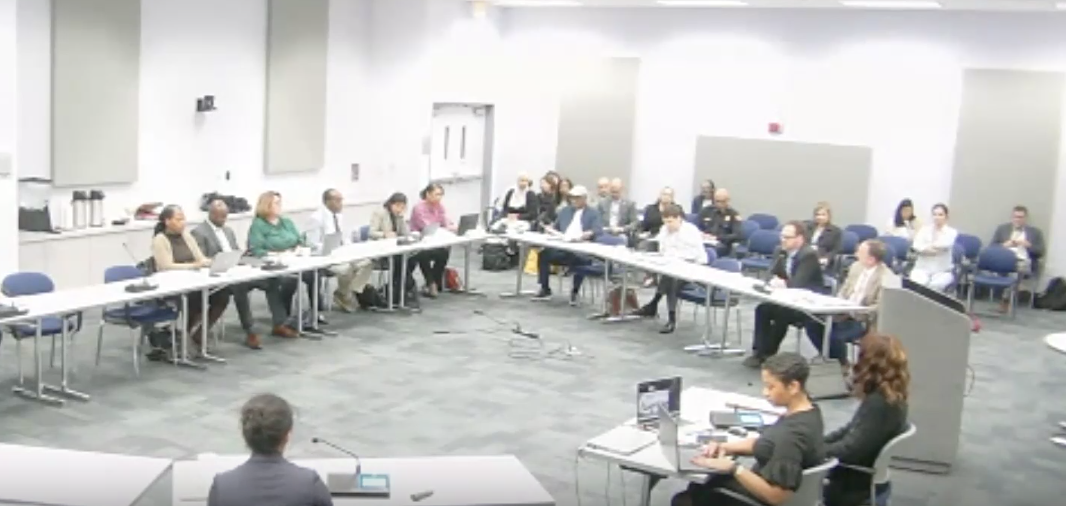
Board of Supervisors - Apr 23, 2026 - Special Meeting

Board of Supervisors - Apr 23, 2026 - Special Meeting

Board of SupervisorsAlameda CountyApril 23, 2026

Sources:

Locunity is a independent informational service and is not an official government page for this commission.We use AI-assisted analysis and human editorial review to publish information.

HR1 Threatens Billions in Safety-Net Funding as Alameda County Faces $91M Budget Gap

Alameda County supervisors got a sobering double dose of fiscal reality at a special budget workshop Thursday evening: federal legislation under HR1 could strip health coverage and food assistance from tens of thousands of county residents, while the county's own budget faces a $91.4 million gap driven by flatlined revenue and rising costs. Together, the presentations painted a picture of converging pressures that will define county governance for years to come.

  • Up to 2 million Californians could lose Medi-Cal coverage under HR1's new work requirements and eligibility restrictions, with 50,000 Alameda County residents at risk by 2030
  • 40,000 county CalFresh recipients face strict three-month time limits starting June 2026, with 19,000 at highest risk of losing food assistance
  • County budget gap hits $91.4 million for FY 2026-27 — and would have been $185 million without prior pension prepayments
  • HR1 impacts largely not yet reflected in county budget figures, meaning the gap could widen significantly
  • State faces structural deficits in the tens of billions, making it nearly impossible to backfill lost federal funding

A Federal Wrecking Ball Aimed at the Safety Net

The centerpiece of the evening was a detailed analysis from Jason Constantoras and Ryan Woolsey of the state Legislative Analyst's Office, who walked supervisors through the cascading effects of HR1 on California's health and social services programs.

The basics: HR1 is the federal budget reconciliation bill moving through Congress. It imposes new work and community engagement requirements on able-bodied adults receiving Medi-Cal (California's Medicaid program), increases how often childless adults must prove eligibility, restricts coverage for certain legally present non-citizens including refugees and asylees, and introduces copay requirements. On the financing side, it tightens rules on provider taxes — particularly the managed care organization (MCO) tax that California uses to fund Medi-Cal — and reduces federal matching rates for emergency care and immigrant services.

Why it matters: The LAO estimated the total impact to California is "likely in the low tens of billions of dollars each year," said Ryan Woolsey, LAO analyst — far exceeding the $1.5 billion in direct costs identified in the governor's current budget proposal. Research cited by the LAO found that work requirements generally do not result in more employment. Instead, they cause disenrollment through both direct ineligibility and what analysts call "administrative burden" — where people who actually qualify for benefits lose them because they cannot navigate the paperwork to prove compliance.

"These are people who do meet the requirements, but due to the heightened burden of proving that they are eligible, still kind of end up falling off the program," said Jason Constantoras, LAO analyst.

Where things stand: Projections estimate as many as 2 million Californians could be disenrolled from Medi-Cal, though estimates remain highly uncertain. On the financing side, the MCO tax revenue — worth billions to the state — could drop to near zero under HR1's tighter rules, compounded by Proposition 35 limitations. The governor's proposed response includes eliminating comprehensive coverage for newly affected immigrant groups and extending work requirements to state-funded immigrant coverage programs.

The County Braces for Impact

Anika Choudhury, Alameda County Health Director, brought the state-level numbers home. The county's HealthPAC indigent care program — the safety net of last resort — shrank from 90,000 enrollees before the Affordable Care Act to just 3,000 today, thanks to Medi-Cal expansion. Now it must prepare for a massive rebound.

"We've got a pretty big Medi-Cal enrollment in the state, but could be losing again, 80,000 people losing coverage due to work requirements," Choudhury said of the county's exposure. She pressed the LAO on whether the state could keep churning enrollees in Medi-Cal to prevent them from overwhelming county indigent care programs and the providers that depend on that revenue.

Andrea Ford, Social Services Agency Director, delivered the most granular local data of the evening. On Medi-Cal: 159,000 Alameda County residents may be subject to work requirements beginning in 2027, with 14,600 expected to lose coverage in FY 2026-27, rising to more than 50,000 by 2030.

CalFresh: Food Assistance Under Threat

Woolsey outlined HR1's parallel attack on CalFresh, California's food assistance program serving about 5 million people statewide and 166,000 in Alameda County. Expanded work requirements are estimated to disenroll approximately 650,000 people statewide, with an additional 72,000 cut due to immigration status changes. Benefits would also shrink for hundreds of thousands through technical changes to utility cost calculations.

The most significant financing blow: a new state cost-share for payment errors — potentially 15% of benefit costs. "That translates into about $2 billion annually beginning in October 2027," Woolsey warned. Meanwhile, the federal administrative cost-sharing ratio shifts the county share from 15% to 22.5%, costing counties collectively about $190 million per year.

Ford translated those numbers locally: "40,000 Alameda County CalFresh recipients will be subject to strict three-month time limits unless they comply with work requirements. 27,000 are non-exempt ABODs and 19,000 are at the highest risk of losing food assistance right now. Alameda County already has 1 in 10 residents experiencing food insecurity."

County CalFresh administrative costs will jump from $16.1 million to $26.3 million effective October 2026. Ford made direct funding requests to the LAO: continuation of the CalFresh match waiver through FY 2028-29, $200 million in statewide workforce funding, and urban county requests totaling $230 million for FY 2026-27 and $305 million for FY 2027-28 for Medi-Cal eligibility workload.

The Human Cost

Board President David Haubert framed the stakes in personal terms: "Many people are one paycheck away from homelessness. They're one catastrophic car repair away from homelessness. And it seems like they may be now one health catastrophe away from homelessness if they can't afford health care."

Decisions: No votes were taken at this informational workshop.

What's next: The state budget must be passed by June 15, with the governor's May revise due by May 14. The LAO noted the legislature is considering automation to reduce administrative burden and maximizing HR1 flexibilities — such as exempting counties with higher unemployment rates and using income measures instead of hours-worked to verify compliance. Expanded CalFresh time limits for able-bodied adults begin June 1, 2026.


$91 Million Gap and Near-Zero Revenue Growth

The County Administrator's Office followed the HR1 presentation with its own fiscal warning: a FY 2026-27 maintenance-of-effort budget showing a $6.1 billion total budget, $4.3 billion in general fund appropriations, and a $91.4 million funding gap.

Why it matters: The gap would have been $185 million without $93 million in pension savings from prior years' prepayments of unfunded liabilities — a strategy County Administrator Susan Muranishi credited directly to the Board's fiscal discipline. But revenue growth has essentially stalled.

"On the program side, the growth was so ridiculously low, we couldn't even calculate a percentage," Muranishi said. "On over a billion dollars of revenue, the net growth in program revenue was less than $2 million."

Where things stand: Major cost drivers include $41 million in net salary and benefit increases, a $63 million workers' compensation increase (nearly 90% above the current year), $33 million in internal service fund increases for emergency communication radios and building maintenance, an $18 million IHSS increase, $24 million more in medical care financing for Alameda Health System and St. Rose Hospital, $12 million in election costs, a $20 million CalFresh revenue loss partly attributable to HR1, and a $33 million decline in public safety sales tax revenue.

Assessed property valuation growth has slowed to 2.5%. For the first time in many years, non-program discretionary revenue does not offset program-side increases.

Board President Haubert underscored the point: "Our budget shortfall could be a lot worse. Worse if we had not paid down pension liabilities in prior years — could be double, $185 million instead of $91 million. That's the fiscal prudence that we have here in Alameda County."

The other side: Pending factors that could widen the gap include labor negotiations, active litigation, more than $1 billion in unfunded capital needs, Prop 1 implementation, Measure W, and the full impacts of HR1 — which are largely not yet reflected in the MOE figures. Since ERAF (Educational Revenue Augmentation Fund) began redirecting county property tax revenue to schools in FY 1992-93, the county has closed cumulative shortfalls totaling $2.7 billion.

What's next: The proposed balanced budget is due to the Board on May 28.


Minor Items

  • Economic snapshot: Alameda County unemployment stood at 4.5% as of February 2026. Median home price was $1.3 million (flat year-over-year). Foreclosure filings are up 32% year-over-year — the 11th straight month of increases — though levels remain well below historic peaks. AI-driven restructuring continues to fuel tech-sector layoffs, and the Federal Reserve has warned about elevated tech industry valuations.
  • State budget timeline: The Senate Democrats released a budget framework emphasizing responsible budgeting and essential program maintenance. The Assembly had not yet released priorities. With 40% of the general fund constitutionally dedicated to K-14 education under Proposition 98, legislative flexibility is severely constrained.
  • No public comment was received during the designated comment period.
HR1 Threatens Billions in Safety-Net Funding as Alameda County Faces $91M Budget Gap | Board of Supervisors | Locunity