
County Aims to Halve Unsheltered Homelessness by 2030 as Federal Aid Wobbles
Board of Supervisors • Alameda CountySeptember 29, 2026
Locunity is an independent informational service and is not an official government page for this commission. All information is sourced from public footage and an analysis of official agendas with the aid of responsible, fact-checked AI. to report an error or omission.
Alameda County has a draft plan to cut overall homelessness by one-third and unsheltered homelessness by half by 2030, along with the first shelter rate increase since 2018. Supervisors took no votes at their Sept. 29 special meeting. The work session previewed a November adoption vote, a January 2027 shelter-rate overhaul and a $19.5M federal funding hole, while Board President David Haubert warned that disorder in shelters could jeopardize Measure W renewal.
- Home Together 2030 draft targets a one-third cut in homelessness, with adoption slated for November
- New shelter rates for 813 beds start January 2027 at roughly $38M a year
- $19.5M in federal homeless grants have no funding source after new HUD rules barred them from reapplying
- Haubert warns of Measure W backlash and presses for treatment requirements in shelters
- $6.7B budget balanced, but the five-year forecast shows widening gaps
- Supervisors trained on disaster roles and asked for a full-day EOC drill
Homelessness Plan Sets Hard Targets, Higher Shelter Pay
Why it matters: The plan will guide Measure W and other homelessness spending countywide. Its measurable goals will shape how voters judge the county when Measure W renewal comes up.
Where things stand: Jonathan Russell, Director of Alameda County Health, Housing and Homelessness Services, presented Home Together 2030. The plan rests on five pillars: prevention, access, shelter, housing and health care. Its headline goals are to cut overall homelessness by one-third and to cut unsheltered homelessness by 50%, from about 5,000 people to 2,500.
Russell pointed to progress under the prior plan. "For the first time in year 4 of the 2026 plan, we had more people gained housing than entered or returned to homelessness," said Director Russell. He also cited a Terner Center report finding the county doubled its shelter inventory from 2018 to 2024, compared with a 59% Bay Area average.
Shelter money: The Social Services Agency funds 813 beds at $36 per bed-night, a rate unchanged since 2018. A one-time $13M board allocation supplements that funding. In January 2027, Housing and Homelessness takes over the contracts with:
- Differentiated rates for family, congregate and non-congregate beds
- 18-month contracts
- Community-developed standards
- Embedded housing navigation
"The total cost for just those expanded rates will be roughly $38 million per year to fund the 813 beds," said Director Russell. A later phase targets roughly 300 behavioral health bridge beds whose state funding is sunsetting. Staff said not all of those beds can be saved.
Federal squeeze: HUD reissued its Continuum of Care funding notice after a preliminary injunction but kept the original deadline. The county will submit a $74M application on behalf of 47 project teams. More than $26M in current grants were ruled ineligible, which leaves about $19.5M across 24 grants and 12 partners with no current funding source. Staff said the county intends to sustain those services per board direction. Awards are expected around December.
The other side: Nate Miley, Supervisor, District 4, questioned enforcement. "Will the people in that shelter then be back on the streets? We don't want that, do we?" he asked. Russell said payment drops to 75% of the rate after three consecutive noncompliant months, but "under no conditions would that mean that we were going to close a shelter to sacrifice the experience of the residents."
Haubert noted that District 1's point-in-time count rose even as the countywide count fell. Staff said Tri-Valley cities were asked for a joint proposal and have not responded, and that siting and zoning rest with cities.
Decisions and stakeholder impacts: No vote was taken.
- Shelter operators get their first raise since 2018 but face monitoring and reduced pay for persistent noncompliance after a three-month grace period.
- Partners holding the 24 ineligible HUD grants face uncertainty, with any backfill likely falling on county funds.
What's next: Public comment on the draft closes Oct. 1. A Mayors' Conference briefing follows Oct. 14. Final adoption is targeted for November, with city endorsements to follow.
Haubert Warns Disorder Could Sink Measure W
Why it matters: The exchange highlights the tension between local pressure for mandates and state Housing First requirements, with Measure W's future in the background.
Where things stand: Haubert said mayors, police and shelter operators report repeated police calls and a lack of rules. He cited police claims that 20% of people generate 80% of calls. "We don't require treatment, we don't require sobriety or even working towards sobriety," said Board President Haubert. He added: "I'm really concerned about Measure W being renewed because there's going to be a backlash of support for the funding that we have."
The other side: Russell said the new shelter standards set clear discharge criteria and monthly incident reporting. He added that permanent supportive housing leases do not prevent lawful eviction. "None of our programs require a person to go get treatment X or Y before accessing services," said Director Russell, citing state Housing First law and evidence favoring voluntary engagement.
An Alameda County Health official said "the bar for required treatment is very high," referring to involuntary 5150 holds and conservatorship. Staff is expanding substance use navigation in shelters.
Faster housing: Haubert pushed to convert commercial space into shelter and interim housing. "I would say that if anybody wants to sell an apartment building that thinks it might be something that we could use for housing, they should call us now," said Board President Haubert.
Staff said the next capital RFP, expected this fall or early next year, will focus on acquiring, rehabbing and converting existing apartments, hotels and possibly commercial buildings. Miley urged tapping hotels and tax-defaulted properties.
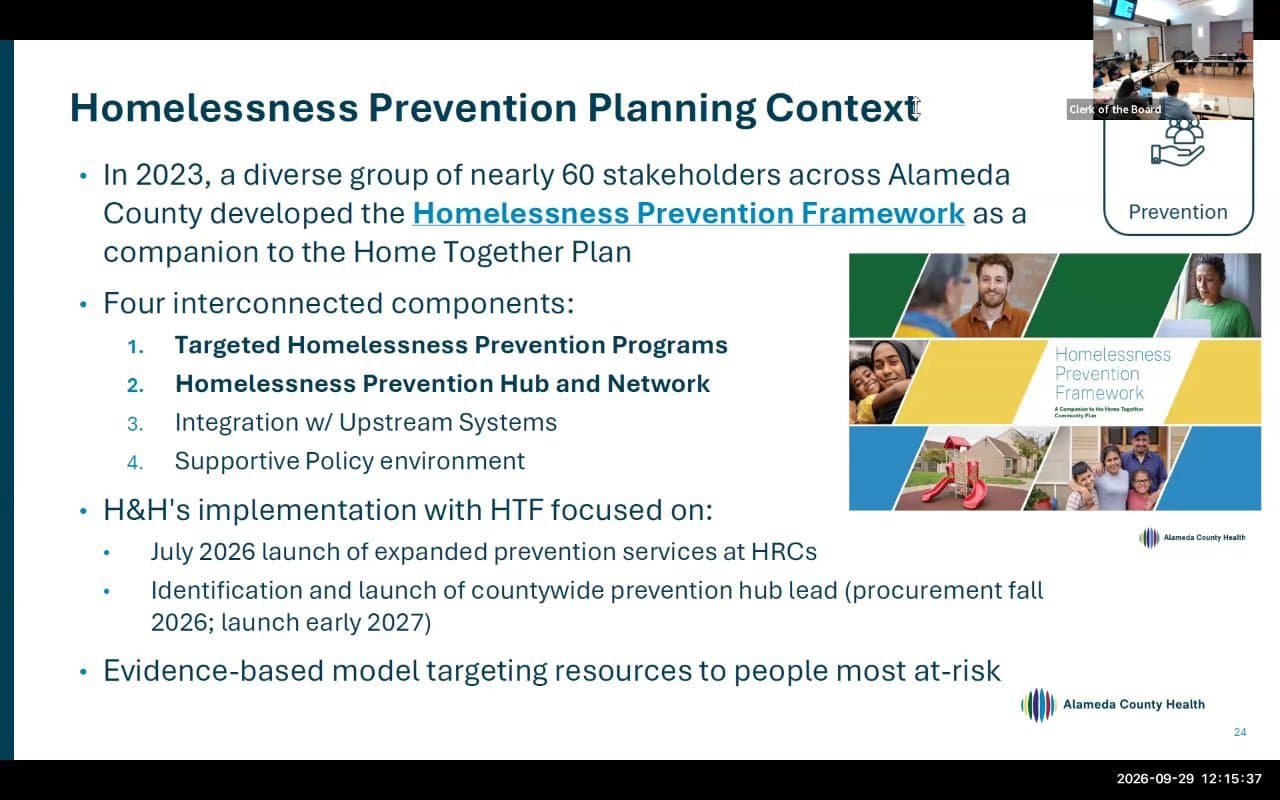
On prevention, staff has embedded more than $8M a year in aid at Housing Resource Centers, with a long-term goal of $20M annually. That money is separate from the $150M, five-year Flex Pool awarded to Abode. Elisa Marquez, Supervisor, District 2, requested a simple flyer listing center locations for constituents.
Decisions and stakeholder impacts: No action was taken. Owners of apartments, hotels and commercial buildings are the target sellers for the coming RFP. Providers remain bound by Housing First rules regardless of board frustration.
$6.7B Budget Balanced, but Gaps Widen
Why it matters: About half of this year's $185M gap was closed with one-time pension savings. Staff projects that the gaps will widen as labor and operating costs outpace revenue.
Where things stand: County Administrator's Office staff reported that the adopted FY 2026-27 budget totals about $6.7B across all funds, a 10% increase, with a $4.3B general fund. Roughly half of the $185M maintenance-of-effort gap was closed with $93M in pension prepayment savings. Major spending lines include:
- $2.2B in salaries and benefits
- $1.3B in contracts with 271 community-based organizations
- More than $800M for mental health
- $440M for housing and homelessness
- $347M in Measure W investments
Economic backdrop: Staff reported roughly 13,000 local layoffs by early September, versus 10,000 in all of 2025. The median single-family home price is $1.285M. Assessment roll growth of 2.98% continues a multiyear decline, and the Federal Reserve raised its benchmark rate a quarter point Sept. 16. Staff also flagged recession risk, IHSS implementation and rising litigation settlements. One supervisor reported that Kaiser plans to lay off 147 people in Pleasanton and Oakland.
The other side: One supervisor urged a comprehensive fee study, starting with the assessment appeals fee. "If we could do that analysis, I definitely feel that we are leaving funds on the table," the supervisor said. Staff said a fee-and-class study is underway. Miley cautioned that revenue from voter-approved measures may not last. Haubert pushed for efficiency reviews. "If we drive costs out of the system, we don't have to pass them on to our consumers, our applicants, our people who reside in our county," said Board President Haubert.
What's next: Staff will return around November with a deeper revenue review, including sales tax. Supervisors also requested budget-to-actuals reporting and the Measure W overage above the anticipated $170M a year. Staff said the books are still closing.
Disaster Training: Govern, Don't Command
Why it matters: Missing the proclamation window can cost recovery dollars, and spreading unverified information can endanger the public during fire and flood season.
Where things stand: The Office of Emergency Services led the session using a new elected officials' handbook developed with cities. Elected officials keep governance (policy, funding, oversight and advocacy) while responders run operations. "What we want to avoid is creating a second chain of command," said Brent Glazer, County Emergency Manager.
On emergency proclamations, Glazer was blunt. "I will always tell you that we have about 10 days to make a proclamation on the onset of a disaster," said Glazer. Other key points from the training:
- The board must ratify an official's proclamation within seven days.
- Documentation still applies under emergency procurement.
- All county employees are disaster service workers.
- Recovery can take five to seven years.
A board member asked for a press protocol, and Glazer said the county sets up a media hotline and provides scheduled releases and talking points. Glazer also reported almost 1,300 new alert sign-ups and three Oakland structure fires that each displaced at least 20 families. Marquez urged constituents to sign up for AC Alert and called for language access.
The other side: Miley called the training a good first step and requested an all-day tabletop exercise in the Emergency Operations Center in 2027. Haubert asked whether Urban Shield, a multidisciplinary training exercise, could return. "A disaster is not the time to exchange business cards," said a Sheriff's Office official, adding that the Sheriff is working to bring back a smaller version. Miley noted that the prior board ended Urban Shield on a 3-2 vote.
What's next: Haubert asked staff to set up a training exercise this year. Of 14 OES positions approved about two years ago, interviews for the remaining five are scheduled.
- Ballot positions: The Personnel Administration and Legislation Committee backed Propositions 1 and 40 and the Regional Transportation Measure, opposed Proposition 43, and sent Proposition 44 to the full board without a recommendation.
- Coliseum talks: Closed-session negotiations with Oakland Acquisition Company, Coliseum Way Partners and the City of Oakland, along with labor and litigation items, produced no reportable action.
- Homelessness hiring: The department has 122 full-time positions, including 36 created in the past year. Miley urged using emergency powers to speed hiring, but staff said civil service rules still apply.
- Storm prep: Staff will update sandbag locations ahead of El Niño season. A local hazard mitigation plan and safety element update will come to the board.
Looking ahead: The deadlines to watch are the Oct. 1 close of comment on Home Together 2030, the plan's adoption vote in November, HUD awards around December and new shelter rates in January 2027.