Board of Supervisors - May 19, 2026 - Special Meeting
Board of Supervisors • Alameda CountyMay 19, 2026
Locunity is a independent informational service and is not an official government page for this commission.We use AI-assisted analysis and human editorial review to publish information.
Alameda County Faces $91M Budget Gap as State and Federal Aid Falls Far Short
Alameda County's Budget Workgroup met for its third session on May 19 and heard a cascading set of fiscal warnings: the governor's May Revise delivers only a fraction of what counties requested to absorb federal policy changes, the local budget gap stands at $91.4 million with barely half closed, and the county's safety-net partners are running out of runway. With a proposed budget due May 28, the path to balance remains unclear — and next year looks worse.
- $91.4 million county budget gap for FY 2626-27 is roughly 55% closed; staff still searching for $41 million in solutions before May 28 deadline
- Governor's May Revise offers counties only $104 million of the $1.9 billion requested to offset rising costs from federal HR1 policy changes
- Medi-Cal disenrollments projected at 44,000 this budget year, growing to 1.1 million statewide by 2029-30 — hitting Alameda County's massive caseload hard
- East Bay job growth trails the nation at 3% over the past decade, with tech firms shifting investment from workers to AI
- Health director warns community-based organizations cannot sustain services without realistic expectations about bridge funding
- Public commenters urge the board to revisit the Babu jail settlement, citing more than 100 permanently unfilled funded positions as a structural budget drain
State Revenue Surges, but Counties Get Crumbs
Sacramento lobbyist Amy Costa of Full Moon Strategies delivered a sobering May Revise briefing to the workgroup: while the state is flush — projecting $16.5 billion above January revenue estimates — nearly all of it is headed into reserves rather than into the programs counties are begging to fund.
The basics: The May Revise proposes $15.1 billion for the Rainy Day Fund, $10 billion for the Prop 98 Reserve, and $4.5 billion for the State Fund for Economic Uncertainties. Counties, through the California State Association of Counties (CSAC), requested $1.9 billion for eligibility work, public hospitals, indigent care, CalFresh administration, and behavioral health to absorb the cost of federal HR1 changes. The governor proposed roughly $104 million in general fund.
Why it matters: Alameda County administers one of the largest Medi-Cal caseloads in the state. Without adequate state funding, the county must absorb rising redetermination workloads, growing uninsured populations, and higher indigent care costs at Alameda Health System — all while trying to close its own $91 million gap.
"We requested 1.9 billion kind of as part of the county family. And ultimately the governor is proposing about 104 million general funds and not nearly kind of what counties had put forward," said Amy Costa, Sacramento lobbyist.
The revenue picture comes with a red flag. Costa noted the current surge is historically unusual — and fragile. "The revenue surges we're seeing have only happened three other times. The dot-com boom, the real estate bubble in the mid-2000s, and then the surge we saw after COVID-19," she said, each followed by a stock market correction.
Where things stand: The governor proposed three new revenue measures to help balance the state budget — extending a net operating loss limitation ($850 million), a new digital software tax ($450 million), and a revised MCO tax ($575 million). All require two-thirds legislative votes in an election year, making passage uncertain. The Assembly opposes any new revenues, while the Senate favors a so-called "Walmart tax" on corporations whose employees rely on safety-net programs. That three-way split sets up a major negotiation before the June 15 constitutional deadline.
"The Senate had revenues in their plan, what's kind of called the Walmart tax. The governor has several revenue measures and the Assembly has none," Costa said.
Board President David Haubert pushed back on the state's reserve-building posture while safety-net funding is denied. "We know that people are going to suffer loss of insurance, our health safety net network is going to suffer. People and their families will suffer. But we're putting 15, 25, 30 billion away in additional reserves," Haubert said. "CSAC's asking for 1.9 billion to support the safety net. So is anybody talking about that?"
Costa warned the worst is yet to come: "Clearly in budget year plus one, a lot more of the HR1 impacts take effect. And so those are going to increase the state's exposure to those increased expenditures."
Federal Reconciliation Threatens Deeper Cuts
Amy Schrago of the County Administrator's Office detailed how the federal reconciliation framework — allocating $72 billion for immigration enforcement and $75 billion through the One Big Beautiful Bill Act — provides minimal relief for county-administered safety-net programs while dramatically increasing demand.
Why it matters: The state projects $1.5 billion in new costs from HR1 in the budget year alone. Medi-Cal disenrollments are projected at 44,000 statewide in the coming year, growing to 1.1 million by 2029-30. For Alameda County, that means surging redetermination workloads in social services, a growing uninsured population landing on indigent care, and intensifying pressure on Alameda Health System.
CalFresh administrative funding of $30 million statewide is far below the $103 million counties requested. IHSS impacts remain uncertain but will increase administrative burden and could reduce eligibility. Behavioral health faces a double squeeze from Prop 1 changes and Medi-Cal disenrollments simultaneously reducing funding streams.
"We administer one of the largest Medi-Cal caseloads in the state. And so both social services and healthcare will face major eligibility redetermination workload increases both on the Medi-Cal side and then for folks to fall off Medi-Cal on the indigent care side," Schrago said.
She also flagged state homelessness reporting requirements as burdensome, noting the county is "not opposed to accountability requirements at all. But the types of things that the state is putting in place can be burdensome to our system that's trying to already deliver services with restricted resources."
On a brighter note, Schrago reported the House introduced the bipartisan Build America 250 surface transportation reauthorization bill, though its path forward remains uncertain.
The $91.4 Million Question: How Does the County Close the Gap?
The workgroup's centerpiece was a presentation on Alameda County's FY 2626-27 maintenance-of-effort budget, which shows a $91.4 million funding gap driven by rising costs and flat revenues.
The basics: Net county costs are up $76 million (8%) while revenues are essentially flat. Key cost drivers include a $41 million net salary and benefit increase (after a $93 million pension prepayment windfall), $33 million in internal service fund increases — notably $19 million for an emergency communications radio system replacement — a $33 million decline in public safety sales tax, $20 million in lost CalFresh revenue from HR1 impacts, and $18 million in IHSS growth. Without the one-time pension prepayment savings, the gap would have exceeded $180 million.
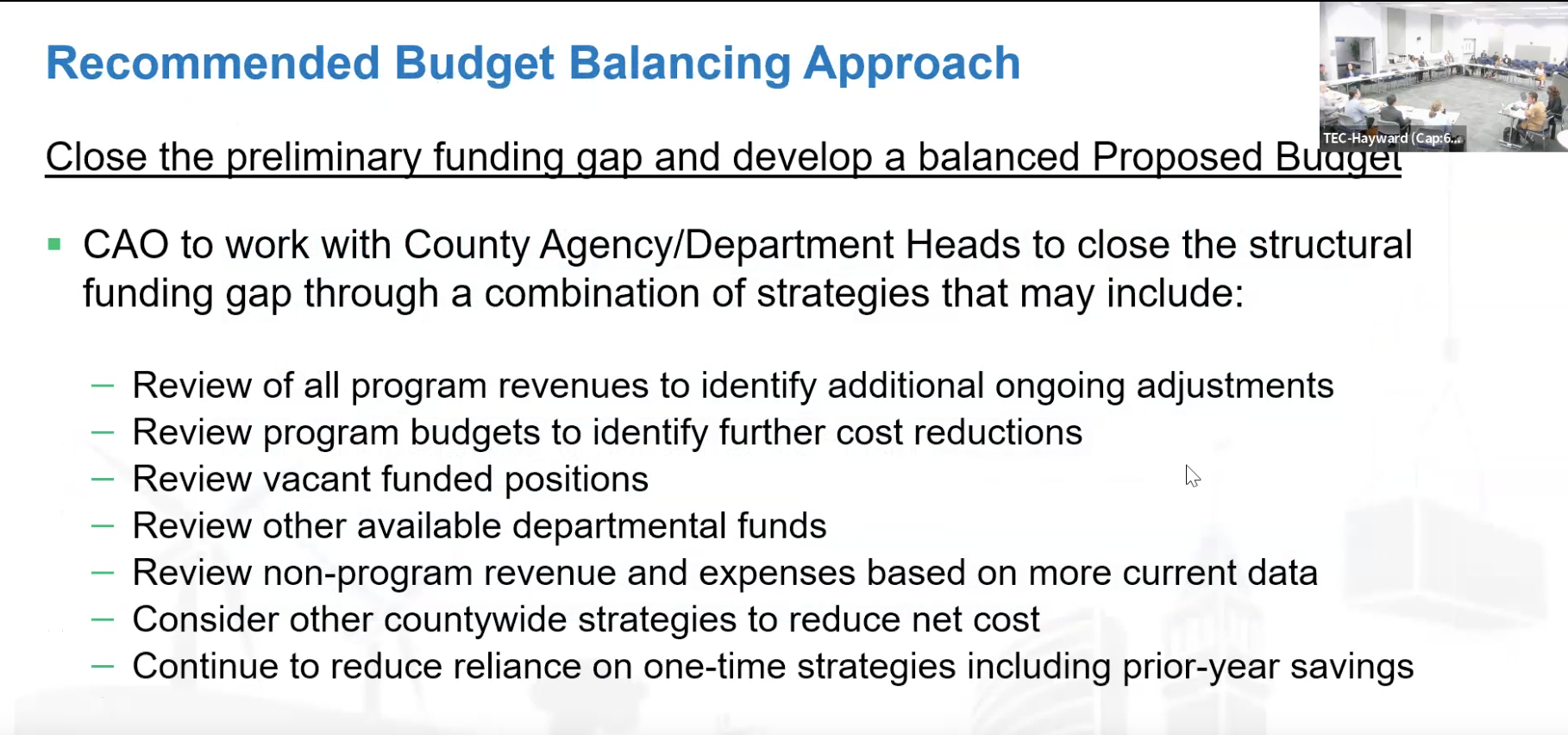
Where things stand: Staff have closed about $50 million of the $91.4 million gap through four strategies: $40 million in additional revenue identification, $10 million from eliminating long-vacant positions, $3 million in cost reductions, and $1 million in other solutions. That leaves roughly $41 million unresolved with three weeks until the proposed budget presentation on May 28.
County Administrator Susan Muranishi acknowledged the structural nature of the problem. "We have a structural funding gap like many other jurisdictions have. And we've been kind of whittling away at it. If we want to eliminate that structural gap completely, it's going to take more serious reductions," she said.
On staffing, Muranishi emphasized the county's fiscal discipline, noting it has maintained approximately 10,500 FTE without layoffs — a contrast to Santa Clara County, which is laying off 435 positions. "They also have four hospitals that they manage directly. And they have the same kind of structural issues that we do. And yet we've been more prudent — if you look at our growth over the years, we haven't cut positions but we also haven't increased staffing," she said.
Muranishi also pointed to Measure W as a lifeline: "I think the county is very fortunate in that we have Measure W. That is actually supplemental general purpose funding that the county has access to," she said, noting it is coming in above budget projections.
Staff Melanie Attendido of the County Administrator's Office underscored two fiscal guardrails: the county must maintain its triple-triple credit rating — the highest possible from all three major rating agencies — and faces over $1 billion in unfunded capital costs over the longer-term horizon. She also noted that overtime staffing at 24-hour facilities like Santa Rita Jail and juvenile hall is actually cheaper than adding new positions — "not something that you would ideally rely on, but from a financial standpoint it is more cost effective."
Chair Haubert Calls for Transparency and Efficiency
Board President David Haubert drew a sharp line between cuts and efficiencies. "If there are things that we can gain efficiencies in, I guess that's a better word than cut. We have to find those efficiencies — it's not cutting something, it's finding a new way of doing it and getting the same result more efficiently," he said.
He also stressed that the county's most vulnerable residents must be protected: "The least among us, the severely challenged, mentally and physically, the most vulnerable, seniors, foster youth and the like, in my opinion, need to be protected."
Haubert asked staff to include more granular information about unfunded vacant positions in the May 28 budget presentation: "What if we just added or had clarity for each department or agency how many unfunded positions there are from year to year, and how many we're planning to eliminate to close the gap — would just help provide that transparency."
He also urged the county's Sacramento lobbyist to push the legislature on priorities, saying "there's a whole lot bigger fish to go after than a little tiny discretionary budgets that seem to be met with more scrutiny than millions and billions of dollars that are being cut while other millions and billions of dollars are being put into reserve."
Health Director: Bridge Funding Risks Creating False Promises
Alameda County Health Director Anika Chaudhary offered one of the meeting's most pointed warnings, cautioning the board that community-based organizations delivering county health and human services are themselves in financial distress — and that well-intentioned bridge funding could backfire.
Why it matters: Much of Alameda County's health and human services funding flows through CBOs. If those organizations receive bridge funding with an implicit promise of continuation the county cannot keep, program disruptions will cascade through the safety net when the money runs out.
"At a time of increased demand for safety net services, that's also when our safety net providers need more support. And at the same time, county revenues are going down," Chaudhary said.
She urged the board to think strategically about sequencing support rather than spreading resources thin: "We just really want to be cognizant of not setting up expectations that funding is then going to continue."
Chaudhary warned that FY 2626-27 will be difficult, but FY 2727-28 will be worse as HR1 impacts intensify — making it critical to plan for a multi-year squeeze rather than treating the current gap as a one-time problem.
East Bay Economy: Slow Growth, K-Shaped Recovery
Melanie Attendido opened the meeting with an economic overview showing Alameda County's 4.5% unemployment rate still above historic pre-pandemic lows. The East Bay has seen just 3% employment growth over the past decade — the lowest in the region.
The tech sector illustrates the disconnect: companies like Cisco continue laying off workers despite record revenue, shifting investment toward AI. Tech wages rose 25% from 2023 to 2024 even as tech employment fell 6% — a textbook K-shaped expansion concentrating gains in fewer, higher-paid workers. The Federal Reserve held interest rates unchanged for the third consecutive time, with board members split on whether to prioritize employment or inflation containment.
Real estate data shows median home prices in Alameda County at $1.36 million, with sales up month-over-month but down year-over-year.
Public Commenters Push to Revisit Jail Settlement
Two public commenters during the state and federal budget discussion urged the board to reconsider the Babu jail settlement as a structural budget issue.
John Lindsey-Poland argued that 100 to 200 funded but unfilled sheriff positions tied to the settlement generate recurring one-time savings that distort the budget picture. He noted the jail population is now half what it was when the settlement was reached and requested that the May 28 budget presentation include prior-year actuals and salary and services breakdowns by program area for public transparency.
Kari Malkiki of RESTORE Oakland echoed those concerns, advocating for a "care first, jails last" approach. She argued that serving high-need populations through housing and community services rather than incarceration is more cost-effective long-term and represents a more sustainable budget strategy.
Minor Items
- Roll call and quorum: The Budget Workgroup convened its third session with quorum established; Vice Chair Lena Tam was present.
- Budget hearings timeline: The proposed FY 2626-27 budget presentation is scheduled for May 28, with budget hearings opening June 18.
- No votes taken: This was an informational workshop with presentations and board Q&A; no motions or formal actions were on the agenda.