
Supervisor Condemns Force in ICE Arrests as Board Clears Pay Raises
Board of Supervisors • Alameda CountyOctober 20, 2026
Locunity is an independent informational service and is not an official government page for this commission. All information is sourced from public footage and an analysis of official agendas with the aid of responsible, fact-checked AI. to report an error or omission.
Two federal immigration arrests that sent Alameda County residents to the hospital opened the Board of Supervisors' Oct. 20, 2026, meeting. A county supervisor read a condemnation into the record and pointed residents to state oversight channels. With Board President David Haubert excused, the four supervisors present then voted 4-0 on every roll call, adopting 5% raises, advancing military leave and benefit changes, and extending a $9.9M health records contract.
- ICE arrests condemned: Supervisor Nikki Fortunato Bas cites apparent excessive force in Emeryville and Oakland arrests.
- Military leave expands 4-0, but a deputy's spouse says the county's pay formula still hurts deployed families.
- 5% raises adopted for deputy sheriff, management and related classifications. The 2026-27 salary ordinance was introduced.
- $9.9M SmartCare extension approved. Epic go-live is set for July 2027 across three departments.
- Firefighter counseling contract renewed after a Hayward firefighter's suicide. A competitive bid is planned next year.
Federal Force, County Limits: ICE Arrests Hit Home
The basics: ACILIP is the county's partner on rapid response and immigrant legal services. The county's ICE-free zones policy governs how federal immigration agents may use county spaces.
Why it matters: The remarks show where county authority ends. Even when local policy is followed, residents can still be hurt during federal enforcement.
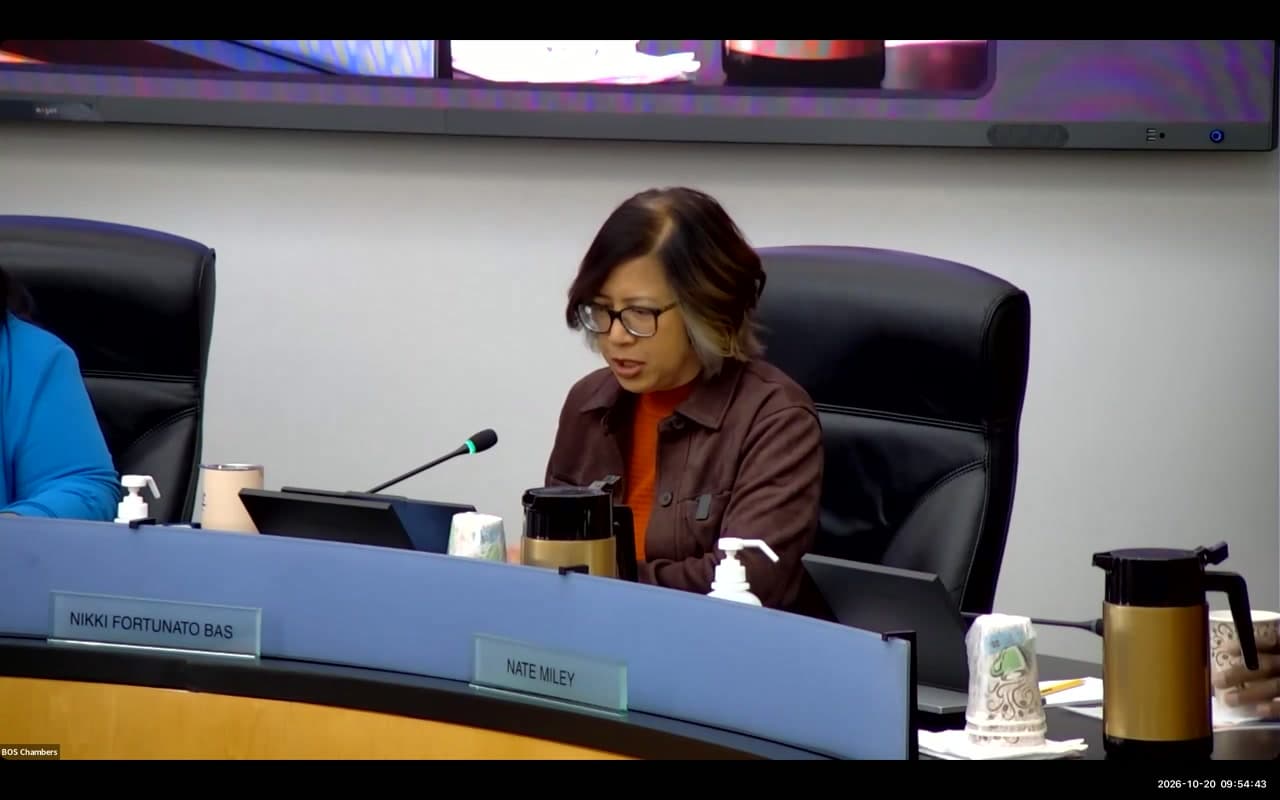
Where things stand: During board remarks, District 5 Supervisor Nikki Fortunato Bas read an ACILIP statement about two recent arrests by federal agents. One took place in Emeryville and the other near San Antonio Park in Oakland. Both detainees needed hospital care.
"I want to join ACILIP in condemning what appears to be excessive use of force that caused injuries requiring hospitalization for these two Alameda County residents," said Supervisor Fortunato Bas.
The other side: Fortunato Bas also relayed what Alameda Health System leaders told the county. They reported that the ICE-free zones policy was not violated because agents held a legal warrant and did not use county spaces for staging. That leaves the county's policy intact on paper. It also shows the policy's limits when agents arrive with warrants.
Decisions and stakeholder impacts: No vote was taken. Fortunato Bas urged residents to report unwarranted ICE activity to the state attorney general. Board Vice President Lena Tam, who presided, noted that county websites carry Know Your Rights information. The remarks matter most to immigrant families, legal service providers and Alameda Health System staff, who are caught between federal enforcement and county policy.
What's next: No follow-up action was scheduled. Residents can report unwarranted ICE activity to the state attorney general and find Know Your Rights materials on county websites.
Military Leave Expands, Pay Formula Questioned
The basics: Item 25 bundles three ordinances, labeled A, B and C. Together they expand Military Time Bank eligibility, raise the cafeteria benefit to $3,700 and lift the dental maximum to $2,000.
Why it matters: The changes broaden leave for employees serving in ongoing military operations. A public commenter argued that the county's math undercuts the benefit for the families who need it most.
Where things stand: Brittany Frederickson, a public commenter and the spouse of a deputy sheriff, thanked the board for extending military leave to ongoing operations. She then took aim at 2001 county language that counts non-taxable housing and hazard allowances as base salary. In her account, that calculation strips deployed families of supplemental pay and health benefits. She said families could keep those benefits only by moving onto a base, and that San Francisco, Contra Costa and other counties exclude these allowances.
The other side: Supervisors did not respond to her comments during the meeting. The ordinances moved forward unchanged.
Decisions and stakeholder impacts: District 2 Supervisor Elisa Marquez moved to waive the full first reading and introduce the ordinances. District 4 Supervisor Nate Miley seconded. The vote was For: 4 (Marquez, Miley, Fortunato Bas, Tam), Against: 0, Absent: 1 (Haubert).
The board also handled two salary items on identical 4-0 votes:
- Item 23 (second reading, adopted): A 5% raise effective Oct. 11, 2026, for DSA and ACMEA units and related classifications, plus more DA Team Leader slots. The item had been continued from Oct. 6, 2026. It finalizes negotiated raises for deputy sheriffs, management employees and district attorney staff.
- Item 24 (first reading, introduced): The 2026-27 County Salary Ordinance, which sets positions and pay schedules consistent with the adopted budget.
The raises and benefit bumps cover sheriff's office, DA and management workforces. The open question is whether deployed deputies' families see the full value of expanded leave.
What's next: Items 24 and 25 were introduced on first reading. The county's materials on item 25 are in Attachment 25.
One Launch Date: Epic Health Records in July 2027
Why it matters: The county extended its SmartCare contract with Streamline Healthcare Solutions through Sept. 30, 2029, raising the total to $9,891,056. Meanwhile, it is preparing to move behavioral health, public health and the Sheriff's Office onto Epic, an electronic health records system, all at once.
Where things stand: Supervisor Marquez asked how county staff and community-based organizations would be trained for the switch. Director Anika Chowdhury of Alameda County Health described a training program with several parts:
- Tiered training and certification
- Epic on-site and virtual training
- An Epic University and dedicated in-house trainers
- Training for community-based organizations once the system rolls out
"The current plan for go-live is July of 2027, and that would be going live at the same time with the Sheriff's Office, behavioral health, as well as public health," said Director Chowdhury.
Chowdhury said phasing the rollout would cost more. The single launch, however, depends on the Sheriff's jail health provider RFP, which the county is tracking. Staff confirmed the RFP is posted on GSA's Doing Business with Us site.
Decisions and stakeholder impacts: Item 4 passed in the mass motion, 4-0, with Haubert absent. Clinicians, community-based contractors and patients in county behavioral health and jail health systems face a single, high-stakes cutover. Vendors bidding on jail health services now sit on the project's critical path.
What's next: The jail health provider RFP is open on GSA's Doing Business with Us site. Epic go-live is targeted for July 2027.
Counseling for Firefighters After a Loss
Why it matters: The board approved up to $99,082 for Restoration Family Counseling Center to provide behavioral health services to Alameda County Fire Department personnel. The vote came shortly after a firefighter's death was linked to post-traumatic stress disorder (PTSD).
Where things stand: Fire Chief William McDonald said the provider began working with the department around 2024, after a fire in which firefighters were burned. It offers counselors skilled in public safety work. He referred to the provider as First Responder Restoration Network. The department tracks how many sessions are used.
"We do think that this extension will get us through another year, but we intend to do an RFP for services the following year," said Chief McDonald.
Decisions and stakeholder impacts: Supervisor Marquez noted that the board had adjourned in memory of Hayward firefighter Travis Foster, who died by suicide while suffering from PTSD. "It's just really important that we uplift these services," she said. Item 46 passed 4-0 in the mass motion, with Haubert absent.
What's next: The department plans an RFP for counseling services after this one-year extension.
Minor Items
- Traffic safety grant: The board accepted $100,000 from the California Office of Traffic Safety for the Nutrition Services Program, running Oct. 1, 2026, to Sept. 30, 2027. Supervisor Miley asked for crash data covering West Oakland and unincorporated areas. "I just want to see if we can get a similar grant for the unincorporated communities," he said. Director Chowdhury said she would follow up and ask the Office of Traffic Safety about other funding opportunities.
- Surveillance oversight: Supervisor Fortunato Bas reported on an Electronic Frontier Foundation briefing to the Together for All ad hoc committee on Oct. 8, 2026. She said the county's network surveillance system was built across departments over a decade and is hard to govern and monitor. She framed an upcoming renewal at the Public Protection committee as a chance to add privacy protections.
- Disaster readiness: Vice President Tam said her office's preparedness event in Alameda registered more than 400 residents and distributed more than 200 emergency backpacks. Supervisor Miley marked the Oakland Hills Firestorm anniversary, recalling a fire that destroyed 3,000 homes and killed 25 people.
- Routine votes: The consent calendar (minutes and a Behavioral Health Advisory Board resignation) and a mass motion covering dozens of contracts and grants each passed 4-0. County counsel reported no reportable action from closed session.
- In memoriam: The board adjourned in memory of three community members:
- Lawrence (Mac Kenneth Frazier), a former Newark administrator and Fremont High teacher who was a longtime presence outside the county administration building
- Lois Pryor, a 96-year-old Alameda fair housing advocate
- Kathy Jin, who ran the children's program at the Lincoln Square Recreation Center in Chinatown
Looking Ahead
The 2026-27 Salary Ordinance and the military leave and benefit ordinances will return for second reading. That is the moment for deployed employees' families to press the board on how housing and hazard allowances are counted.