
Alameda Moves to Bar ICE From City Property, Eyes Point Zoning
City Council • AlamedaOctober 7, 2026
Locunity is an independent informational service and is not an official government page for this commission. All information is sourced from public footage and an analysis of official agendas with the aid of responsible, fact-checked AI. to report an error or omission.
Alameda's City Council voted 5-0 on Oct. 6, 2026, to direct staff to draft rules barring civil immigration enforcement on city-owned property, while openly acknowledging that federal land on the island remains beyond its reach. In a session that ran to the 11 p.m. cutoff, the council also adopted a stricter campaign donation disclosure rule on a 4-1 split, paused a truck route redesign on Clement Avenue and weighed what Alameda Point should host.
- ICE off city land: 5-0 direction to draft a ban, inventory property and report requests
- Clement truck route paused after six neighbors defend bike and pedestrian safety features
- $100 donation disclosure rule adopted 4-1, going beyond the state's $500 Levine Act trigger
- Alameda Point leasing: $217,018 space-startup lease advances 5-0; data center policy due early 2027
- Guaranteed income pilot raised savings and cut debt with no detectable drop in work
1 Big Thing: Sanctuary City, With Limits
Why it matters: Alameda joins Alameda County, Berkeley, Oakland, San Francisco and others in restricting immigration enforcement staging on public land. But Coast Guard Island, the Naval Reserve Center and unconveyed parts of Alameda Point are federal property, where ICE can operate without city permission.
The basics: According to City Manager Jerry Bowden, Alameda police already do not take part in immigration enforcement under state law SB 54. The item responded to an April 2026 referral from Councilmember Tony Daysog. Staff surveyed regional approaches, including the county's ICE-free zones, a Berkeley resolution and an Oakland mayoral executive order. Staff offered four options but no recommendation.
Where things stand: Daysog pushed to put protections into formal rules, not just statements. "This middle-of-the-road to progressive city is going to stand with our vulnerable immigrants and making sure that city-owned properties are not a staging ground for ICE raids," said Daysog.
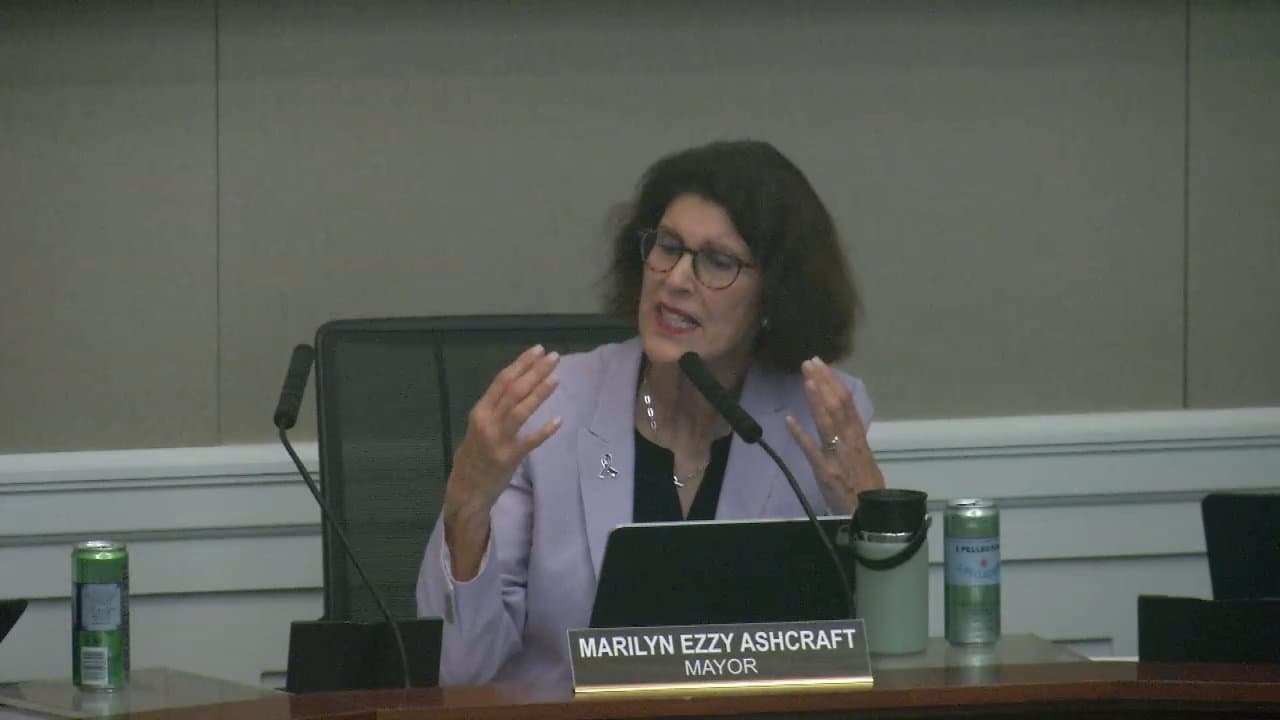
Mayor Marilyn Ezzy Ashcraft backed the symbolism but was candid about its reach. "ICE doesn't really need the parking lot at City Hall," she said. She recalled a 2025 Customs and Border Protection presence on Coast Guard Island. She then pivoted to land the city controls, proposing zoning limits on buffer land at Alameda Point. "But what happens on land that is Alameda property, we have a say over that," said Ezzy Ashcraft. Acting City Attorney Aslanian confirmed the city has broad zoning authority over property it fully owns and controls, known as in-fee property.
"This action, in my opinion, formally acknowledges the cruelty of the current federal policies, and it tells our neighbors that we see you and we stand by you," said Vice Mayor Michele Pryor.
The other side: Councilmember Tracy Jensen asked how a ban would be enforced and how officers and the public would be protected. "Going as far as to pass an ordinance or to formally prohibit the use of city-owned properties, I'm hesitant on that," said Jensen. She said she preferred expanded outreach, including through landlord contacts in the rent program. "The likelihood of federal law enforcement in Alameda using a city-owned parcel is low," Bowden responded. He added that local police would protect residents but would not intervene. Councilmember Greg Boller supported the measure but cautioned residents not to expect more than it can deliver.
Decisions and stakeholder impacts: Daysog moved and Boller seconded. The motion passed unanimously (For: 5 — Ezzy Ashcraft, Pryor, Daysog, Jensen, Boller; Against: 0; Absent: 0). The direction covers three steps:
- Reaffirm the city's sanctuary commitment.
- Prohibit civil immigration enforcement on city property.
- Inventory city property through the GIS mapping system and report ICE-related requests to the council.
Jensen had asked that the measure spell out implementation details. The mayor objected to dictating police tactics, and the council settled on asking staff to consider implementation. Jensen ultimately voted yes.
What's next: The acting city attorney may return with an ordinance, resolution and/or staff report. No deadline was set, given staff workload.
Clement Avenue: Trucks vs. the Cycle Track
Why it matters: Clement Avenue is the truck route in the city's General Plan. Making it work for trucks would narrow bike lanes to Caltrans minimums near a toddler playground and school walking routes.
Where things stand: The final segment of the Clement extension was built as part of the Skyline development on the former Pennzoil site. It has been finished for 11 months but remains closed. The curving stretch between Peru and Balsa is too narrow for two semi trucks to pass. "Two buses could not pass each other without sideswiping with the current configuration up there," said City Engineer Scott Wickstrom. For now, trucks use Sherman and Buena Vista.
Ezzy Ashcraft and Pryor brought the referral after a community meeting and a neighborhood walk. "I did think it needed more time and more deliberation than the fairly limited options that were presented," said Ezzy Ashcraft.
Wickstrom said moving the truck route off Clement would require a General Plan amendment. In the meantime, he proposed reversible paint striping so Clement could open soon, possibly keeping trucks on Buena Vista temporarily. Skyline buildings could see occupancy in November or December. Widening the road to the north would require permits from the Bay Conservation and Development Commission (BCDC), because the land falls within its 100-foot shoreline band. It would also shrink the park and be expensive. Boller asked why a designated truck route was built too narrow for trucks. Wickstrom deferred that answer to a later presentation.
The other side: Six Marina Shores and Buena Vista residents urged the council not to make permanent changes without a careful process.
- Leo Esclamado cited General Plan policy ME6.
- Meredith Levins suggested splitting eastbound and westbound truck traffic between the two streets.
- Christine Bowie argued that trucks belong on the wider Buena Vista.
- Anna Mayer and Catherine Powell asked for traffic calming on Buena Vista and said they do not oppose opening Clement to cars.
"Once that infrastructure is gone, I don't think it's possible for it to come back," said public commenter Catherine Powell.
Decisions and stakeholder impacts: The referral passed unanimously (For: 5, Against: 0) on a second by Pryor. Bike lanes, curb bulb-outs and the park edge are protected for now. Any move to relocate the route would shift the debate toward Buena Vista.
What's next: Staff will present a status update before any physical work. The council will then choose whether to proceed, amend the General Plan or pursue other routes.
Donation Disclosure: Lower Bar, Sharper Edges
Why it matters: The state Levine Act requires recusal when a party with business before the council gave a member more than $500 in the past year. Alameda's new handbook rule requires a public announcement of donations over $100 from such parties, without barring the member from voting.
Where things stand: Ezzy Ashcraft and Pryor proposed the change, citing the League of California Cities' transparency mission. "So I see no harm and a lot of upside with regard to open governance," said Daysog, who framed the rule as an extension of Form 460 campaign filings. Boller confirmed the rule is meant to be simpler than the Levine Act, not to import its exceptions. Aslanian agreed that donations between $100 and $500 trigger an announcement, not recusal. "Why not go out of our way to just be a little more transparent for something that's already publicly available?" asked Pryor.
The other side: Jensen said her research found no other city with such a rule. The mayor said she had not surveyed other cities. "I don't mind being a trendsetter," said Ezzy Ashcraft.
Jensen said there was no urgency and that the rule would not affect the termed-out mayor. "I have over 220 individual donors, and the majority of them are $100, between $100 and $500. So this will be a substantial burden on me if I'm elected mayor," said Jensen. She also asked why the council would act the same night without more public input. City Clerk Laura Weisiger said the referral process allows final action when properly noticed. She noted that public comment was open and no one spoke. "I didn't mean this to be controversial. I think of it as good governance," said Ezzy Ashcraft.
Decisions and stakeholder impacts: Daysog raised a concern that the word "business" might exclude nonprofits. Weisiger proposed the phrase "single source," which Aslanian called a campaign-finance term of art. The amended resolution passed 4-1 (For: 4, Against: 1, Absent: 0), moved by Daysog and seconded by Pryor. Jensen had announced beforehand that she would not support it.
Under the rule:
- Residents will hear about small donations at the meeting instead of searching filings.
- Applicants, appellants, bidders and contractors will see their donations aired publicly.
- Candidates with many small donors face added disclosure work.
The exchanges point to friction between the mayor and Jensen heading into the mayoral election.
Alameda Point: Who Gets In, on What Terms
Why it matters: Alameda Point needs $800 million in infrastructure, according to Director of Base Reuse and Economic Development Abby Thorn-Lyman. Each lease decision tests what kind of jobs and land uses the city wants there.
Where things stand: The council voted 5-0 to introduce a 37-month lease for Longshot Space Technologies in Building 29 at 1701 Monarch St., a former gun-testing facility. Boller moved and Daysog seconded. "Their prototype is a kinetic launch technology that uses no rocket fuel and instead uses compressed gas to push a payload forward very rapidly," said Annie Cox of Base Reuse and Economic Development.
The lease terms:
- Rent starts at $5,670 a month, rising 3.5% each year.
- The lease would generate $217,018 for the city.
- A 60-day termination clause keeps the site available for the unfunded De-Pave Park.
Three public commenters supported the lease: Longshot CEO Mike Grace, College of Alameda MESA program director Ann Gonzalez and Natel Energy's Kate Stirr. Gonzalez cited mentorship for first-generation STEM students.
The other side: Separately, Jensen sought objective criteria for selling or leasing city-owned Alameda Point assets, covering water, power, emissions and jobs. "I'm referring to businesses that may include data centers, that may include an ICE detention facility," said Jensen.
Bowden said a city effort to study data processing, which began Oct. 1, will bring policy proposals to the Planning Board, Public Utilities Board and council in early 2027. "We're not in a position today to approve a data center," he said. Aslanian noted that the governor signed seven data center bills last week.
Members split on how far to go:
- Daysog wanted to move faster. "I think the cleaner thing to do and the more immediate thing to do is simply to call for a moratorium on processing data center applications," said Daysog.
- The mayor favored informed decisions over a moratorium.
- Boller said no large data center application exists.
Public commenter Christina Liebner, an energy engineer, urged a different approach. "Perhaps instead of being reactive, we can be visionary and set a new standard for clean and equitable urban AI infrastructure," she said.
What's next: Jensen withdrew her referral. She pledged to push for the criteria in the economic development strategic plan, whose consultant contract goes to the council Oct. 20. The Longshot lease needs a second reading and takes effect 30 days after that.
Rise Up Alameda: The Final Numbers
Where things stand: On May 17, 2022, the council approved $4.6 million in American Rescue Plan Act funds for the pilot. It paid 150 low-income households $1,000 a month from December 2023 through November 2025.
Abt Global evaluated the program against a 180-person control group:
- Savings: 35% of participants had $500 in savings at 24 months, compared with 12% of the control group.
- Debt: 16% of participants went into debt, compared with 27%.
- Well-being: Participants reported lower stress.
- Work: The study found no detectable reduction in work.
- Mixed results: Civic engagement gains seen at 12 months faded by 24 months, and the study found no consistent effect on housing or food security.
"Helping these residents pay off their debt means that more money went into Alameda than into the hands of a credit card company," said Pryor. The council received the report without a vote. No members of the public spoke.
What's next: A celebration is set for Oct. 13 with former Stockton Mayor Michael Tubbs.
Minor Items
- Consent calendar passed 5-0; Boller recused from two items, citing residential property interests.
- Short-term rental ordinance (Item 5-K) was withdrawn and will return later.
- Proclamations marked Filipino American History Month and Domestic Violence Awareness Month. The city's Victim Services Division has handled 119 matters since 2025 and can be reached at 510-206-1657.
- AC Transit's 19 bus: Michael John Torrey opposed eliminating the line. Comments are due Oct. 14 at a 5 p.m. meeting at 1600 Franklin St.
- Free sandbags are available now at Lexington and West Hope, with staffed help Saturday, Nov. 7, from 8 a.m. to noon.
Looking Ahead
Council Referral 10D was continued to the next meeting. Supervisor Lena Tam hosts an emergency preparedness event Oct. 17 at the College of Alameda.