
City Council - Sep 01, 2026 - Meeting

City Council - Sep 01, 2026 - Meeting

City CouncilAlamedaSeptember 2, 2026

Sources:

Locunity is a independent informational service and is not an official government page for this commission.We use AI-assisted analysis and human editorial review to publish information.

Council Commits $25.5M to Rescue Stardust Gardens Amid Housing Authority Standoff

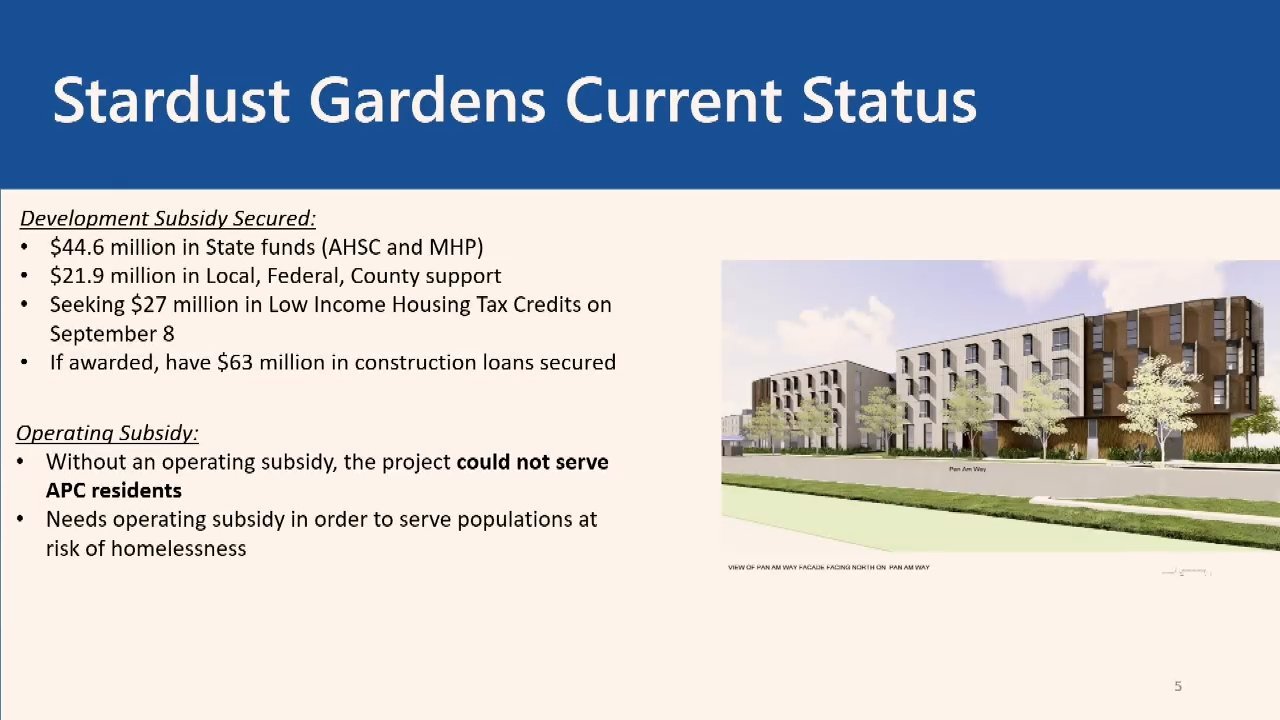
Alameda's City Council unanimously pledged up to $25.5 million in bridge funding to keep the 80-unit Stardust Gardens supportive housing project alive after the city's Housing Authority declined to commit federal vouchers needed to operate the building. The vote caps months of escalating tension between City Hall and the semi-independent authority — and sets a ticking clock on whether federal dollars will eventually replace city funds drawn from Alameda Point's infrastructure reserves.

  • Council approves $1M-per-year, 20-year backstop for Stardust Gardens, California's #1-ranked affordable housing project, after Housing Authority declines federal voucher commitment
  • Housing Authority Board Chair accuses city of "bullying" and says HUD confirmed voucher commitment would violate federal regulations; city points to identical San Francisco transaction as proof it's feasible
  • 810 housing units, $60M in grants, and a $7M ferry electrification award all hinge on Stardust Gardens breaking ground on schedule
  • Residents sound alarm on AI data centers at Alameda Point, citing water, energy, and transparency concerns during closed-session negotiations with Delaware-incorporated companies
  • Marina Shores families push back on Clement Avenue truck route, warning modifications would narrow the bike trail near a toddler playground
  • Council responds to grand jury critique of emergency readiness, committing to biannual exercises and community disaster workshops

A $25.5 Million Bet on Breaking the Alameda Point Logjam

Why it matters: Stardust Gardens is the first domino in a chain reaction. Without it, 478 market-rate homes by Katellis/Brookfield cannot proceed, $60 million in secured grants is at risk, and a $7 million ferry electrification award tied to Seaplane Lagoon infrastructure could evaporate. The state ranked Stardust Gardens as the No. 1 affordable housing project in California in its Affordable Housing and Sustainable Communities grant competition — and a Sept. 8 tax credit application deadline made council action urgent.

The basics: Midpen Housing plans to build 80 units of permanent supportive housing for extremely low-income and formerly homeless residents currently living in deteriorating Navy-era barracks at the Alameda Point Collaborative campus. The building cannot operate without ongoing rental subsidies. The standard mechanism: 30 project-based vouchers from the Alameda Housing Authority. The problem: AHA has refused to commit them.

Where things stand: City Manager Jerry Bowden told council the Housing Authority has roughly $22 million in unrestricted cash and operates as a federally designated Moving to Work agency, giving it unusual flexibility. "Federal vouchers are designed for exactly this," he said. HUD consultant David Vargas of Vargas Premier Corporate Consultants reinforced that assessment: "As a financially healthy agency with over $22 million in unrestricted cash and nicely cash flowing properties, we're just struggling with the reasoning."

Director Abby Thorne Liman, the city's base reuse chief, told council no city funds would flow until fiscal year 2029 when Stardust Gardens becomes operational. She also disclosed that the San Francisco Housing Authority completed an identical voucher transaction for Treasure Island the previous week. "I haven't heard anyone suggest that perhaps the Housing Authority of the City and County of San Francisco is violating federal law," Mayor Marilyn Ezzy Ashcraft said. "That was able to be done. And that's what I believe that people of goodwill can do."

Sixteen public speakers addressed the item — the vast majority in support. Abby Goldworth Potluri, Midpen's senior vice president, described more than a decade of work and $48 million in secured upfront funding. Andrea Urton, executive director of the Alameda Point Collaborative, detailed the cost of maintaining crumbling barracks housing — $8,000 to $11,000 per unit turn, plus a $168,000 plumbing upgrade last year — and noted 79% of residents have lived in Alameda for more than 10 years. Representatives from San Francisco Bay Ferry, Alameda Food Bank, Brookfield Residential, Operation Dignity, East Bay YIMBY, and East Bay Housing Organizations all urged approval.

The other side: AHA Board Chair Carly Grobe delivered a pointed rebuttal. "City staff have presented incorrect and incomplete information to scapegoat the Housing Authority," she said. "HUD has confirmed that if AHA were to commit vouchers at this time, we would be in violation of HUD regulations governing project-based vouchers." AHA Executive Director Vanessa Cooper confirmed alignment on the project's goals but said federal regulations and a projected 2027 budget deficit prevented an immediate commitment: "We must do that in a way that complies with federal law and protects the approximately 1,800 Alamedans who are already subsidized." AHA analyst Sepideh Kimarci noted the authority has held five project-based voucher competitions since 2015 and that Reshape scored lowest both times it applied.

AHA Vice Chair Vadim Sedelnikov offered a middle path, supporting the city's bridge funding while defending the authority's position and urging a collaborative approach. Former Housing Authority Commissioner Michael Pucci supported the project but cautioned council to take AHA's budget projections seriously, recounting a 2004 Section 8 funding crisis.

Decisions: The council voted 5-0 to authorize the city manager to sign a commitment letter for $1 million annually over 20 years with 2.5% escalation — totaling $25.5 million — funded from the Alameda Point Fund, not the general fund. Councilmember Tony Daysog, who moved the motion, urged restraint: "I really encourage us to dial down the temperature in the room between City Hall staff and the Housing Authority staff. I think we should just simply keep our eyes on what's the most important prize, and that's building Stardust Gardens as soon as possible." He noted the Alameda Point Fund has approximately $28 million in reserves but warned "the flexibility can't go on forever."

Councilmember Greg Boller, who seconded, added guardrails: if alternative funding sources such as HUD-VASH vouchers or Measure W revenue materialize, the city's commitment would be proportionally reduced. "I just want to make it clear that the city wants to do its part, but ultimately, we don't think we're going to need to spend any money on this," he said. "We want the federal funds to go to this purpose."

What's next: The city manager will finalize the commitment letter in substantial conformance with the version presented and report back to council regularly. The Housing Authority Board is expected to return with updated budget projections at its next meeting. The tax credit application deadline was Sept. 8. If the Housing Authority eventually issues the 30 vouchers, the city's $25.5 million commitment would wind down. If not, Alameda faces two decades of infrastructure trade-offs at Alameda Point.


Residents Warn Against AI Data Centers at Alameda Point

Across two public comment periods, at least six speakers urged the council to reject proposals to site AI data centers at Alameda Point, linking the topic to closed-session real property negotiations the council had just conducted.

Why it matters: Speakers identified specific companies — Apollo Atomics, Giga Energy, Bulwark Dynamics, and American Rail — all incorporated in Delaware, and raised concerns that negotiations were happening behind closed doors with entities whose operations could strain the island community's infrastructure.

Public commenter Amos White laid out five specific harms: "A typical AI data center uses as much electricity as 100,000 households, risking rate hikes and grid strain for residents." He also cited water consumption of 1 to 5 million gallons per day, air quality impacts from backup generators, noise pollution, and inequitable burden on the community. Chris Blair questioned the secrecy of negotiations. Doyle Saylor objected to a nondisclosure agreement the council had signed regarding a data center in Pittsburgh, California, calling it unacceptable for a public body. Katie Connell, speaking later in the meeting, urged the council to pursue community place-making and arts tenants for waterfront buildings rather than utilitarian industrial uses.

No formal council action was taken. The issue is expected to return as closed-session negotiations continue.


Marina Shores Families Push for Truck Route Alternatives

Three residents from the Marina Shores neighborhood asked the council to delay a planned reconfiguration of Clement Avenue that would enable two-way truck traffic between Peru Drive and the neighborhood entrance.

Why it matters: The proposed modifications would narrow the Cross Alameda bike trail and widen the road adjacent to a popular toddler playground in a neighborhood of roughly 4,000 families. Residents argued the plan conflicts with Alameda's Vision Zero safety goals.

Ken Levins, president of the Marina Shores HOA, proposed splitting truck traffic between Clement Avenue (westbound) and Buena Vista Avenue (eastbound), which he said would allow narrowing of both streets and preserve parking, trees, and pedestrian bulb-outs. Anna Mayer, a resident with two young children, said narrowing the bike trail near the playground was unacceptable. Leo Escalado, a Clement Avenue homeowner, said more than 500 young children live in the immediate area and directly asked for a council referral.

No formal referral was made during the meeting. Staff had been moving toward a September implementation.


Fourth Amendment in Two Minutes: A Speaker Takes On Flock Cameras

A public commenter identified as Sid delivered a concise broadside against the city's contract with Flock Safety, the automated license plate reader company. He cited the Supreme Court's Carpenter v. United States ruling — which requires warrants for cell phone location data — and argued Flock cameras perform equivalent tracking without consent or warrants. He referenced the Institute for Justice's catalog of more than 100 documented misuse incidents. "Those who would give up essential liberty to purchase a little temporary safety deserve neither liberty nor safety," he said, quoting Benjamin Franklin. "We cannot call ourselves a free country if we allow mass surveillance."

No council action was taken.


Grand Jury Calls Out Emergency Gaps; Council Responds

Why it matters: Alameda is an island with limited evacuation routes, making emergency preparedness especially consequential. The Alameda County Civil Grand Jury's 2025-26 report, "A Call for Readiness," found the city's Emergency Operations Plan had gone seven years without an update.

Where things stand: The city agreed with several findings: the plan update was overdue (now completed as of April 2026), a five-year update cycle should be adopted, no outdoor siren system exists, and social media messaging during tsunami events needed improvement. The city pushed back on two recommendations: it defended its disaster registry, citing CAL OES guidance permitting such tools, and noted that after-action reports are already required, pointing to completed reviews for COVID-19 and the 2024 tsunami warning.

Fire Chief Nick Luby described plans for two tabletop exercises per year, expanded CERT volunteer engagement, a new four-hour community disaster preparedness workshop format, and a 300-person community event co-hosted with Supervisor Tam on Oct. 17. Councilmember Boller flagged a technical issue with the response language for findings 26-29 and 26-30, which was incorporated into the motion.

Decisions: Passed 5-0 (Jensen moved, Pryor seconded) to authorize the city manager to finalize and transmit the response with clarified language.


Minor Items

  • Consent calendar approved 5-0, including increased authority to cite vehicles parked in bike lanes, noted by Councilmember Tracy Jensen.
  • Dewar Marine Operations lease extension (Building 41): Council introduced an ordinance granting a six-month extension with two six-month options at historic Alameda Point. The building is in PFAS remediation limbo pending Navy conveyance; the extension keeps marine research and educational programs active. Passed 5-0.
  • Faction Brewing lease amendment (Building 22): Council introduced an ordinance for a three-year lease extension that includes a structured repayment plan for $222,000 in deferred and unpaid rent from pandemic-era struggles. The deal is projected to generate $1.8 million in lease revenue over the amended term, preserving a well-known Spirits Alley anchor. Passed 5-0.
  • Domestic violence prevention video premiere (Item 3A): Alameda Family Services Youth Advisory Board screened a wordless domestic violence awareness video produced over more than a year by roughly eight high school students. Executive Director Katherine Schwartz said the project originated after a family was murdered by the father in Alameda. The mayor reminded viewers of available resources including Alameda PD, Alameda Family Services, Building Futures, and the city's Victim Services coordinator.
  • Bay Ferry honors Mayor Ashcraft (Item 3B): San Francisco Bay Ferry Executive Director Seamus Murphy presented a resolution of appreciation for the mayor's role in expanding ferry service, including the Seaplane Lagoon transbay route — now the highest-ridership East Bay route — a new 100-employee maintenance facility, and the Woodstock Alameda-Oakland Estuary service, which Murphy said had "stellar ridership" from week one and needs to become permanent everyday service.