Buncombe Panel Backs Tougher Housing Loan Terms, 4-1, Over Developer Worries
Affordable Housing Subcommittee • Buncombe CountySeptember 1, 2026
Locunity is an independent informational service and is not an official government page for this commission. All information is sourced from public footage and an analysis of official agendas with the aid of responsible, fact-checked AI. to report an error or omission.
Buncombe County's Affordable Housing Subcommittee voted 4-1 on Sept. 1, 2026, to send the full Board of Commissioners a tougher set of Affordable Housing Services Program (AHSP) loan rules. The package puts county repayment first and drops the case-by-case exceptions developers have leaned on. Members also learned how state disaster-recovery rules left the county hit hardest by Hurricane Helene with the smallest award, and its flagship Cox Avenue project facing a $15M gap.
- AHSP overhaul advances 4-1 to the Board's first October meeting, ahead of November and December application windows.
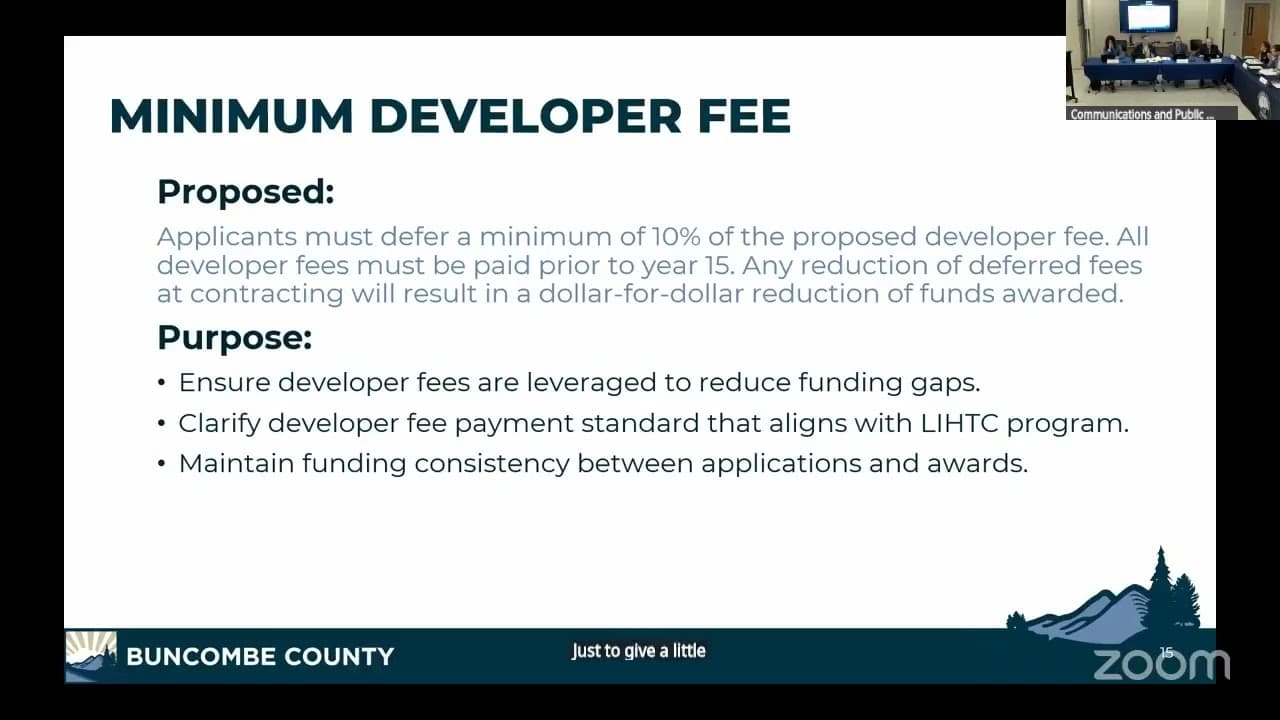
- Developers must defer at least 10% of fees, and county loans shrink dollar-for-dollar if that deferral drops.
- County claims 50% of project cash flow after deferred developer fees. A proposed exceptions clause was rejected.
- Buncombe received the lowest state CDBG-DR award for tax credit housing, and none of its eight 4% applications won.
- Cox Avenue's 203 units face a $15M hole. Members want to press state agencies and brief the Board.
County Loans, Not Grants: AHSP Rules Tighten
Why it matters: The rules decide how millions in county housing loans are repaid, and they arrive just before the next funding cycle opens. The new terms shift risk and negotiation onto developers, and some members fear they could deter projects.
Where things stand: Under the new developer fee rule, applicants must defer at least 10% of their proposed developer fee. A deferred fee is the share a developer agrees to collect later rather than at closing. That 10% becomes a fixed dollar figure at application. If other financing later reduces it, the county loan drops by the same amount.
Staff reviewed nine funded projects. "So on one end of the range, we have projects that have deferred hundreds of thousands up to $1 million less than they proposed," said Jonathan, county staff. Matthew Cable, county staff, said a $500,000 savings could fund emergency repair or administrative programs.
The cash flow terms are the bigger change. Today, repayment is negotiated on the back end. Across four sample projects, fees, reserves and the developer fee all came ahead of the county, which collected anywhere from 35% to 100% of leftover cash. The new rule gives the county 50% of available cash flow each year after deferred developer fees.
The model mirrors the City of Asheville's CDBG-DR program, which offers 0% gap financing over a 35-year term. Staff removed Asheville's "unless otherwise permitted" flexibility. Peer policies vary:
- Wake County and the City of Raleigh reject cash-flow repayment unless the first mortgage lender requires it.
- The City of Charlotte's terms resemble current AHSP.
"The goal is to prioritize more consistent and timely repayment of county loans. These are not grants," Jonathan said.
The other side: Subcommittee Member Drew led the pushback. "I'm concerned about hamstringing the program, again, without some fail-safes potentially," Drew said, noting that Asheville's program has not yet closed a loan. Drew added, "When our partners that typically take advantage of these programs are raising concerns, I just want to tread really carefully."
Drew asked whether the terms conflict with tax credit investor and lender standards. "It's not clear how it doesn't line up," Jonathan replied. Drew then requested language allowing exceptions "unless approved by the Buncombe County Affordable Housing Subcommittee."
The case for firm rules: The Subcommittee Chair asked, "Why would we choose to be different in our funding process of negotiating after we've put rules and regulations forward?" The chair said the subcommittee was created "to be able to put those guidelines and guardrails in place so that we actually did have a process and it wasn't being bypassed and coming to individual commissioners to then address."
Cable said "the onus would be on the developer to find funding that works alongside ours." He pointed to Asheville awards to Laurel Street ($7M, 112 units) and MHO ($9.5M, 126 units) as signs developers accept the terms. The exceptions clause was not added.
Decisions and stakeholder impacts: The motion passed. (For: 4, Against: 1, Absent: not stated.) The dissenting member was not identified, and Commissioner Sloan seconded. The package also:
- Sets a uniform 10% cap on administrative and overhead costs.
- Merges the rarely funded New Start and Administrative Support grants.
- Adds mortgage aid to rental assistance.
The current $2,500 per-household assistance cap stands, and it was unclear whether members settled on a higher maximum. Developers gain predictability but lose room to negotiate. County dollars may stretch further.
What's next: The full Board takes up the package at its first October meeting. Household-impact applications open in November, and unit development applications open in December.
Hardest-Hit County, Smallest Disaster Housing Award
Why it matters: Buncombe lost the most housing to Helene, staff said, yet state rules pushed it to the back of the line for disaster housing money. "And so 60 units is 20% of the total loss," Cable said.
Where things stand: The state paired federal Low Income Housing Tax Credits (LIHTC) with Community Development Block Grant–Disaster Recovery (CDBG-DR) funds across 16 counties. The rules limited each county to one award before any county could get a second. Funding grew from $60M to just over $69M in mid-August, and all of it is now committed.
The state's tax credit plan guaranteed Buncombe one 9% project: Place Apartments, an MHO development in Arden. "If even $1 was provided, then that project would be our one project for the county," Cable said. That put every other county ahead for the larger 4% deals, and none of Buncombe's eight 4% applications were funded. Haywood County, by contrast, received $10M, above the cap.
Staff noted three factors that set Buncombe apart. It is the only county in the program with an entitlement community inside it, the City of Asheville. It is also the only western county in the Metro tax credit region. Separately, Asheville is investing just under $18M in CDBG-DR funds for 331 units.
Cox Avenue's hole: The county's 203-unit Cox Avenue project at 50 and 52 Cox Ave. counted on $15M in CDBG-DR and received none. The site sits downtown across from the transit transfer station, and most units would serve households below 60% of area median income. The county and partner Harmony Housing are weighing several options:
- Dropping federal wage requirements to cut construction costs.
- Tapping HOME consortium funds.
- Reapplying for 4% tax credits.
Asked whether more CDBG-DR money might come, Commissioner Sloan said, "The actual answer is we don't know, but probably not. That bucket's probably expended." Cable added that a separate non-tax-credit program "does exclude projects within the City of Asheville."
The politics: "I'm worried that the folks involved with DCR and Grow NC are going to point the finger at HFA and they're going to point their finger back at each other," Sloan said. Drew recounted telling state lawmakers that "Buncombe County is not just Asheville." The chair said state officials assume Asheville's $225M allocation covers the county.
What's next: Members reached consensus to brief the Board of Commissioners. The chair referenced a Sept. 15 meeting. Members also plan to invite Helene Recovery staff for an October deep dive.
Minor Items
- Evictions level off: Monthly filings are running 200 to 250, versus 150 to 200 before the moratorium, after a storm-related spike.
- Eviction benchmarks: Buncombe's filings equal 8% of renter households, with 3% granted, unchanged from last year. Mecklenburg fell to 19% filed and 8% granted.
- Bylaws amended: Chair and vice chair selection moves to the start of each calendar year. It passed by voice vote without opposition.
- Minutes: The Aug. 4, 2026, minutes were approved as submitted by voice vote.
Looking Ahead
The subcommittee meets next on Oct. 6. The full Board weighs the AHSP package at its first October meeting.