
Buncombe Asks State to Guarantee at Least One Housing Tax-Credit Award
Affordable Housing Subcommittee • Buncombe CountyOctober 6, 2026
Locunity is an independent informational service and is not an official government page for this commission. All information is sourced from public footage and an analysis of official agendas with the aid of responsible, fact-checked AI. to report an error or omission.
Buncombe County's Affordable Housing Subcommittee moved Oct. 6, 2026, to keep the county from being shut out of North Carolina's main affordable-housing finance tool while it recovers from Tropical Storm Helene. By voice vote, members authorized their chair to send the state a letter asking that its 2027 tax-credit rules guarantee Buncombe at least one award. A staff briefing on Helene housing aid showed the scale of the recovery challenge: most local applicants to the state's home-repair program have dropped out.
- Letter to state housing agency approved: Buncombe seeks at least one guaranteed 2027 tax-credit award.
- Buncombe is excluded from the 12% Helene credit boost because the state classifies it as a "metro" county.
- Only 660 of 2,151 Buncombe applicants remain in the state's single-family repair program.
- Two grant windows are open: multifamily closes Nov. 2, and workforce ownership closes Dec. 13.
- Buyouts of about 214 more properties in flood and landslide areas begin this month, with no local funds.
1 Big Thing: Buncombe Fights Its 'Metro' Label
The basics: The Low-Income Housing Tax Credit (LIHTC) is the largest federal subsidy for building affordable rentals. Each year the NC Housing Finance Agency (NCHFA) sets the rules for awarding these credits in a Qualified Allocation Plan (QAP).
Why it matters: NCHFA's 2027 draft keeps a Helene-related boost for the western region but leaves out Buncombe. The draft also drops last year's disaster-recovery provisions. Together, those changes put the county's main affordable-housing pipeline at risk.
Where things stand: Federal legislation lets states raise their annual tax credits by 12%. After Helene, NCHFA sent that increase to the West Region, and the 2027 draft continues the set-aside.
"But it's worth noting that Buncombe County is part of the metro region, so this additional provision would not account for Buncombe County, would not be available to the county," said Jonathan Jones, Buncombe County staff.
Metro credits are split by population share. Buncombe makes up about 6.7% of the seven metro counties, which normally caps its award. The draft also removes the remaining disaster provisions, including the CDBG-DR funds distributed through last year's QAP.
Staff drafted a letter asking NCHFA to keep last year's language. If necessary, the agency would adjust awards so Buncombe receives no fewer than one. Staff chose this route rather than trying to fold Buncombe into the competitive western pool. Staff member Matt said similar language was added to the QAP after Hurricane Fred.
"So we're asking it to be extended just because of the ongoing acknowledgment for the West through another mechanism, that 12%," said Matt, Buncombe County staff.
The other side: One member's first instinct was a tougher letter asking NCHFA not to exclude the metro region from the 12% at all. After staff explained their approach, the member instead asked to add a sourced figure, such as one from FEMA, showing how many residential units Buncombe lost. The member noted the county tops that list. Another member summed up the ask:
"This is basically saying, please ensure we get at least one, but don't limit us to one," said a subcommittee member.
Parking minimums drop: The draft also eliminates fixed per-unit parking requirements for LIHTC projects. "This was in response to state legislation that removed the authority of local governments to set parking minimums," Jones said. The county had asked in past years that NCHFA defer to local rules. A member quipped that "the legislature intervened because of our comment letters." Jones replied, "That may be one way to look at it." NCHFA will still require "sufficient" parking, which swaps a clear number for a case-by-case judgment.
Decisions and stakeholder impacts: The motion passed by voice vote with no recorded opposition; individual tallies were not stated. A subcommittee member made the motion, and Resident Member Meaghan Austin was credited with the second. Affordable-housing developers and nonprofits working in Buncombe gain if the guaranteed award survives. Western counties keep their 12% pool either way.
What's next: Staff will add the lost-unit figure and route the letter to the chair for signature. Public comment closes Oct. 16. Preliminary applications are due Jan. 22, and full applications are due May 14. That calendar typically lines up with the county's Affordable Housing Services Program cycle.
Helene Home-Repair Aid Loses Most Applicants
Why it matters: Single-family recovery is the largest share of state disaster dollars. Yet most storm-damaged Buncombe homeowners who applied are no longer in the program.
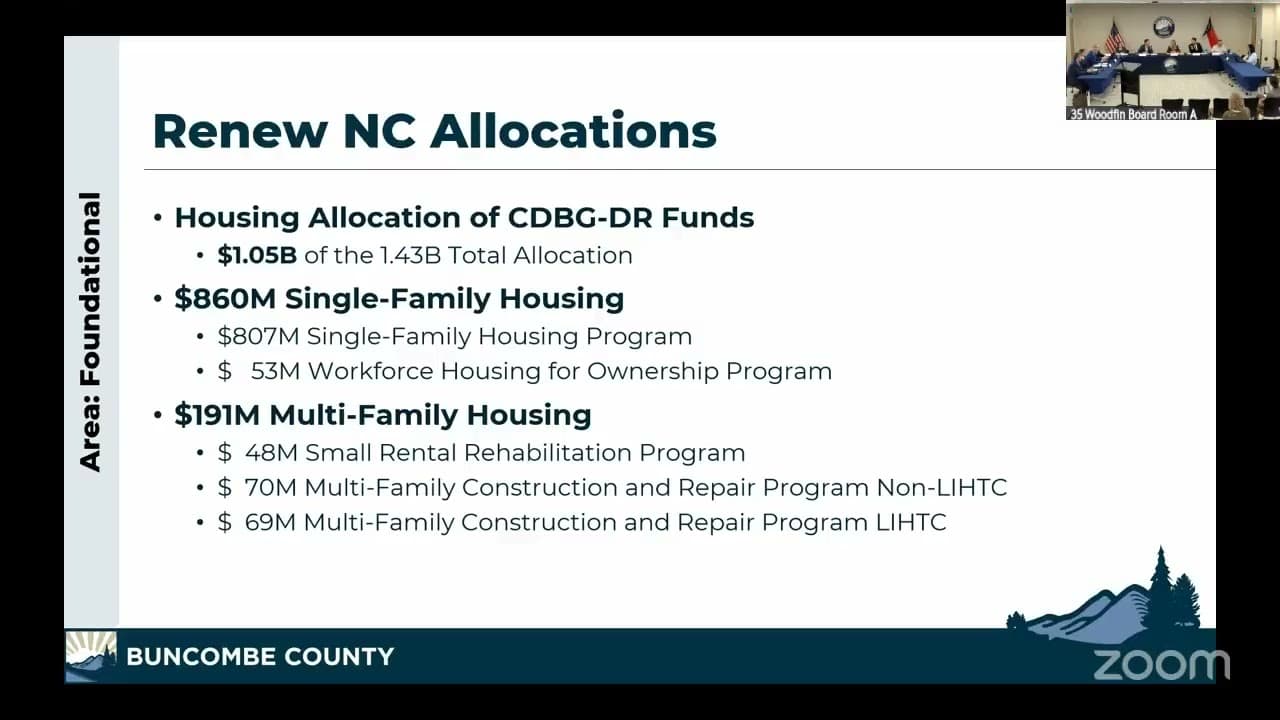
Where things stand: Congress appropriated just over $1.4 billion in CDBG-DR (federal disaster recovery block grants) to North Carolina. That is separate from the City of Asheville's own $225 million. About $1.05 billion flows through Renew NC, which is HUD-funded and managed by the NC Department of Commerce. Kevin Madsen, Buncombe County staff, said the money is split three ways: $807 million for single-family, $53 million for workforce housing and $191 million for multifamily.
Buncombe produced 2,151 of roughly 7,500 applications statewide.
"We have seen that number go from that 2,151 to 660 that are currently deemed eligible or that have not withdrawn from the program," Madsen said. That is about 29%.
The program reported 35 homes completed and 25 under construction. Repair timelines depend on cost:
- Rehab under $50,000 takes about 51 days.
- Rehab from $50,000 to $100,000 takes about 81 days.
- Larger jobs shift to replacement (about 81 days) or reconstruction (about 171 days).
"So just want to provide clarity that that program provides some relocation assistance, but not a comprehensive package," Madsen said. The aid covers lodging but not storage, furniture or pet fees. The Long-Term Recovery Group helps fill those gaps.
Small landlords stay away: Owners of 1–4 unit rentals filed only 32 Buncombe applications, and 12 are moving forward. "We did receive feedback that a number of community members did not apply based on some of the HUD provisions," Madsen said. Staff pointed especially to the required 10-year affordability period. The state is moving about $9 million out of this program through an amendment that is still in public comment.
Decisions and stakeholder impacts: Homeowners face long rebuild timelines and gaps in relocation aid. Duplex-to-fourplex rentals, a key source of naturally affordable housing, may not return as affordable stock. Some Renew NC programs can be used inside Asheville, including a $3 million allocation for the city's single-family administrative costs, while others cannot.
What's next: Staff will send a summary of why applicants drop out, along with talking points. That information would be "really helpful as we're all out advocating for affordable housing," said Subcommittee Chair Amanda Edwards.
Two Grant Windows, Different Rules for Asheville
Why it matters: These are near-term chances to finance new affordable units, and eligibility rules decide which local projects can compete.
Workforce Housing for Ownership: This $53 million pool is for traditional single-family homes for buyers at or below 80% of area median income. Applications are due Dec. 13 and go through local agencies. For-profit developers, community land trusts and others may seek $2 million to $5 million per project. Whether condos or duplexes qualify is still to be determined. There is no county cap, so five Buncombe applicants, each seeking $5 million, will compete with one another.
A member raised a local project: "Ferry Road potentially got a workforce housing aspect built into it." Midway through the meeting, Madsen answered: "I did look up and confirm there is not the same limitation for City of Asheville limits for Workforce for Ownership." The member concluded Ferry Road could be in the running.
Non-LIHTC multifamily: Applications are due Nov. 2. Awards range from $500,000 to $15 million per project, and sites inside city limits are ineligible. There is no award timeline; staff estimated about three months. One member asked about the purpose of this pool, suggesting it was a roundabout way to fund LIHTC projects that once would not have competed. Matt explained that it is tied to the 2026 LIHTC round. Projects with prior-round awards and funding gaps may apply, but projects that received CDBG-DR in that specific round may not.
"LIHTC isn't the only path to creating affordable housing," Matt said, adding that "it is the largest inducer or supporter of affordable housing nationally."
Where things stand: In the LIHTC multifamily construction program, Buncombe received $1.7 million supporting 60 units, out of $69.1 million statewide.
What's next: Staff will check whether the workforce ownership funding notice includes a per-unit cost cap and will forward the answer.
Buyouts Expand to About 214 More Properties
Why it matters: Buyouts permanently remove housing from hazard zones and build a county land portfolio that could become parks and greenways.
Where things stand: The Hazard Mitigation Grant Program (HMGP) buys out damaged properties. Its first two groups yielded 49 acquired parcels, and all but two are complete. Groups 3 and 4, about 214 properties, kick off this month. They are mostly single-family homes, plus at least one apartment complex and some commercial sites, covering flood and landslide areas. About 26 remain pending. Participation is voluntary, and many new owners of resold properties have declined to continue.
Funding is 75% federal and 25% state. "It is no local funds going towards it. It is all federal and state funding," Madsen said. Owners receive pre-disaster market value, and demolition follows within 90 days of closing. The parcels are deed-restricted against future housing. Each reuse requires FEMA approval, which could take three months to a year.
Federal aid context: FEMA has provided more than $568 million to North Carolina residents across more than 161,000 households; a Buncombe-specific figure was not available. Other aid includes $34.2 million for private roads and bridges, a $30 million state allocation and $220 million through the National Flood Insurance Program. Fewer than 20 households remain in the federal continuing housing program.
What's next: A member asked when a full map of acquired parcels would be available. Staff said the timing is unknown. A workgroup is building a matrix aligned with the open space plan, the greenway plan and Swannanoa small area planning.
Minor Items
- Minutes: The Sept. 1, 2026, minutes were approved unanimously as written.
- Infrastructure bids: The county applied for more than $40 million in competitive Community Infrastructure and Commercial District Revitalization funds, including Swannanoa sidewalks.
- Public comment: Members received one written comment from a Mr. Morton; it was not read aloud.
Looking Ahead
The subcommittee's next meeting moves to Thursday, Nov. 5, because Election Day falls on its usual first Tuesday. Watch for the Oct. 16 QAP comment deadline and the Nov. 2 multifamily grant deadline before then.